

COURTKUTCHEHRY SPECIAL SERIES ON LANDMARKS JUDGEMENTS ON WILLS, CODICIL & PROBATE
Gopal Swaroop v. Krishna Murari Mangal & Ors.: Supreme Court Restores Validity of Will, Upholds Son’s Exclusive Inheritance Rights
Division Bench Reinstates Single Judge’s Decree
Statutory Requirements Met; No Suspicious Circumstances Found
By Vishwas Kumar
New Delhi: March 23, 2026:
On 25 November 2010, the Supreme Court of India delivered a significant ruling in Gopal Swaroop v. Krishna Murari Mangal & Ors. (Civil Appeal No. 6801 of 2003), resolving a contentious family dispute over succession rights. The case revolved around the validity of a Will executed by Panna Lal, which bequeathed his share of property exclusively to one son, Gopal Swaroop.
important legal precedents on wills and succession on Gopal Swaroop v. Krishna Murari Mangal Case
Initially, the Trial Court and a Single Judge of the High Court upheld the Will, finding it valid and enforceable. However, the Division Bench of the High Court later invalidated the document, citing lack of proper proof and raising doubts about its authenticity. This reversal prompted an appeal to the Supreme Court.
A Division Bench comprising Justice Markandey Katju and Justice T.S. Thakur carefully examined the evidence and statutory requirements under the Indian Succession Act. The Court emphasized that the Will had been duly executed and attested, satisfying all legal formalities. Importantly, it found no suspicious circumstances surrounding the document, thereby rejecting the High Court’s reasoning.
The Supreme Court reinstated the Will, restoring the decree of the Single Judge in favour of Gopal Swaroop. By doing so, the Court reaffirmed the principle that once statutory requirements are met and no credible suspicion exists, a Will must be given full effect.
This judgment underscores the judiciary’s commitment to upholding testamentary freedom while ensuring compliance with succession laws. It also highlights the importance of proper attestation and the evidentiary weight carried by statutory compliance in inheritance disputes. For families, the ruling serves as a reminder that courts will respect the wishes of a testator when expressed clearly and lawfully.
For More, Read Here the Summary of the Judgement from the Book: WILL WRITING SIMPLIFIED, read below or open page no 436, Chapter 14.1 in the book. (Online book purchase link available here on: Buy online: Amazon | Flipkart
|
|
Case Summary |
: |
Gopal Swaroop v. Krishna Murari Mangal & Ors. |
|
|
Court |
: |
Supreme Court of India |
|
|
Citations |
: |
(2010) 11 SC CK 0020: Civil Appeal No. 6801 of 2003. |
|
|
Link |
: |
https://www.courtkutchehry.com/judgements/664662/gopal-swaroop-vs-krishna-murari-mangal-and-others/
|
|
|
Decided on |
: |
25 November 2010 |
|
|
Coram |
: |
Hon’ble Mr. Justice Markandey Katju and Hon’ble Mr. Justice T.S. Thakur. (Division Bench) |
|
|
Relevant Paragraphs |
: |
Para Nos.2–18 |
1. Facts of the Case:
The dispute arose from a suit for partition and separate possession filed by the plaintiff (respondent no. 1) claiming his share in joint family property, with his father, Panna Lal, as the Karta. During pendency, Panna Lal died, and the appellant (one of the sons) set up a Will allegedly executed by him, under which the appellant alone was to inherit Panna Lal’s share. The Trial Court decreed the suit, recognizing 1/5th share for the plaintiff and holding the Will proved. Appeals followed up to the Division Bench.
2. Law Points Involved:
(i). Scope of interference in Letters Patent Appeal against concurrent findings of fact.
(ii). Proof of execution and attestation of a Will under Section 63 of the Indian Succession Act, 1925 and Section 68 of the Indian Evidence Act, 1872.
(iii). Effect of registration of a Will and existence (or absence) of suspicious circumstances.
3. Acts/Provisions/Articles Referred:
(i). Civil Procedure Code, 1908 – Section 100
(ii). Indian Evidence Act, 1872 – Sections 63, 68
(iii). Indian Succession Act, 1925 – Section 63
4. Judgments Referred:
(i). Smt. Asha Devi v. Dukhi Sao, (1974) 08 SC CK 0014.
(ii). B. Venkatamuni v. C.J. Ayodhya Ram Singh, (2006) 10 SC CK 0054.
(iii). Bhagwan Kaur v. Kartar Kaur, (1994) 04 SC CK 0079
https://www.courtkutchehry.com/judgements/691485/bhagwan-kaur-vs-kartar-kaur-and-others/]
(iv). Seth Beni Chand v. Kamla Kunwar, (1976) 09 SC CK 0025.
(v). Janki Narayan Bhoir v. Narayan Namdeo Kadam, (2002) 12 SC CK 0087.
(vi). Gurdev Kaur v. Kaki, (2006) 04 SC CK 0079.
https://www.courtkutchehry.com/judgements/658741/gurdev-kaur-and-others-vs-kaki-and-others/]
(vii). Yumnam Ongbi Tampha Ibema Devi v. Yumnam Joykumar Singh, (2009) 03 SC CK 0200.
(viii). Rur Singh v. Bachan Kaur, (2009) 02 SC CK 0115.
https://www.courtkutchehry.com/judgements/663585/rur-singh-d-th-lrs-and-others-vs-bachan-kaur/
(ix). Anil Kak v. Sharada Raje (2008) 04 SC CK 0062;
(x). H. Venkatachala Iyengar v. B.N. Thimmajamma (1958) 11 SC CK 0008;
5. Obiter Dicta:
Proof of a Will does not require mathematical certainty. The test is satisfaction of a prudent mind. A registered Will, in absence of suspicious circumstances, merits acceptance once an attesting witness establishes execution consistent with statutory provisions.
6. Ratio Decidendi:
Execution of a Will is proved when at least one attesting witness testifies that the testator signed the document in his presence and in the presence of another attesting witness, and the witnesses signed in the presence of the
testator. The requirements of Section 63, Succession Act and Section 68, Evidence Act were satisfied through DW-2’s deposition. The Division Bench erred in reversing concurrent findings that the Will was duly executed and free from suspicious circumstances.
7. Final Ruling:
Appeal allowed. The Supreme Court set aside the Division Bench judgment and restored the decision of the learned Single Judge, upholding the Will executed by Panna Lal in favour of the appellant. Each party to bear own costs.
8. Gist Highlighting Dispute with Final Decision:
The central issue was the validity of a Will executed by Panna Lal bequeathing his share exclusively to one son, Gopal Swaroop. While the Trial Court and Single Judge upheld its validity, the Division Bench invalidated it for want of proper proof. The Supreme Court reinstated the Will, emphasizing satisfaction of statutory requirements and absence of suspicious circumstances, restoring the Single Judge’s decree in favour of the appellant.
Read full Judgement Here:
Gopal Swaroop v. Krishna Murari Mangal & Ors.
Supreme Court of India
(2010) 11 SC CK 0020: Civil Appeal No. 6801 of 2003.
https://www.courtkutchehry.com/judgements/664662/gopal-swaroop-vs-krishna-murari-mangal-and-others/
You Can Also Purchase the Book from here on: Buy online: Amazon | Flipkart
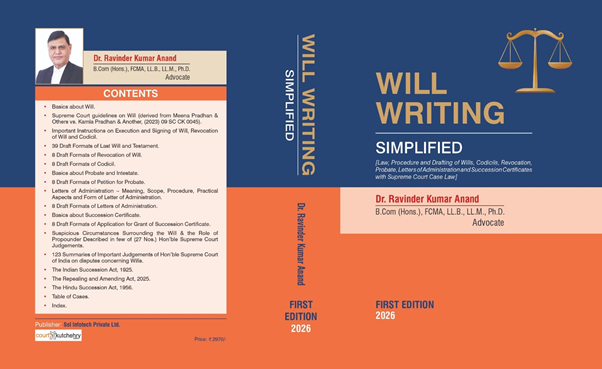
OUR RECOMMENDATION: Check out 123 Key Judgements, as highlighted in the book, WILL WRITING SIMPLIFIED, for the quick research and reference purposes. Click the link here: https://www.courtkutchehry.com/pages/blog/123-supreme-court-judgments-on-wills/
Keywords for SEO & Faster Searches
- Gopal Swaroop v. Krishna Murari Mangal Supreme Court
- 2010 inheritance dispute judgment India
- Validity of Will Supreme Court India
- Civil Appeal No. 6801 of 2003
- Supreme Court restores Single Judge decree
- Testamentary succession India Supreme Court ruling