COURTKUTCHEHRY EXCLUSIVE: EXTRACTS FROM BEST SELLING BOOK: WILL WRITING SIMPLIFIED
Gopal Krishan & Others v. Daulat Ram & Others (2025) 01 SC CK 0047: Supreme Court Rejects Hypertechnical Suspicion in Wills
Liberal Reading of Section 63(c) Protects Testamentary Intent
Illness, Layout, and Registration Not Grounds for Doubt
By Vishwas Kumar
New Delhi: April 08, 2026:
The Supreme Court’s ruling in Gopal Krishan & Others v. Daulat Ram & Others, Civil Appeal No. 13192 of 2024 has become a landmark in succession law, particularly on the interpretation of Section 63(c) of the Indian Succession Act and Section 68 of the Evidence Act. Delivered in 2025, the judgment underscores that courts must not invalidate a Will on hypertechnical grounds when genuine testamentary intent is evident. Lawyers continue to cite this case because it provides a clear precedent on how to distinguish real suspicion from trivial objections.
These legal principles are further explained in this notable Supreme Court judgment on wills and inheritance law in the case of P.P.K. Gopalan Nambiar vs P.P.K. Balakrishnan Nambiar and Others, which examines key aspects of succession, validity, and interpretation of wills in India.
Background of the Case
The testator, Sanjhi Ram, executed a Will on 7 November 2005 and died the very next day. The Will benefitted his nephew, who had cared for him after his wife’s death. The Will was challenged on multiple grounds: illness and proximity to death, lack of registration, irregular spacing and seal placement, thumb impression issues, and delay in producing the death certificate. Both the Civil Court and High Court raised doubts, but the Supreme Court reversed, holding that none of these amounted to genuine suspicion.
Key Observations by the Court
- Illness and Proximity to Death
The Court held that mere illness or old age does not establish lack of soundness of mind. Unless evidence shows impaired faculties, proximity to death cannot invalidate a Will. - Unregistered Will
The Court reaffirmed that registration is not mandatory. An unregistered Will is legally valid if execution and attestation are proved. - Irregular Spacing and Seal Placement
The Civil Court found uneven spacing suspicious. The Supreme Court dismissed this as hypertechnical, noting that narrower spacing at the end of a page is natural when fitting content. - Thumb Impression and “Direction” Issue
The High Court wrongly held that the attesting witness failed to state the mark was affixed “by direction of the testator.” The Supreme Court clarified that such direction is required only when another person signs for the testator. If the testator himself signs or marks, witnesses need only see him do so. - Delay in Producing Death Certificate
The Court held that omission to produce a death certificate does not vitiate proof of a Will when attestation is otherwise proved. - Alleged Manipulation of Layout
Slight variation in alignment or spacing cannot, without more, indicate forgery. Courts must avoid trivial objections. - Propounder’s Burden and Proof
The propounder produced an attesting witness who testified that the Will was executed in his presence, read over by the deed writer, and signed/marked by the testator. This satisfied Section 63(c) and Section 68. - Soundness of Mind
The attesting witness confirmed the testator was of sound mind and understood the contents. This fulfilled evidentiary requirements. - Interpretation of Section 63(c)
The Court emphasized a liberal reading: attestation is valid if witnesses see the testator sign, see another sign at his direction, or receive acknowledgment. Strict technical reading is unwarranted unless fraud is alleged. - Absence of Unnatural Exclusion
The Will benefitted the nephew who cared for the testator. The Court found this natural, not suspicious.
Precedent and Continuing Relevance
This case is frequently cited because it establishes that:
- Suspicion must be real, germane, and valid. Trivialities like spacing, illness, or lack of registration cannot invalidate a Will.
- Section 63(c) must be read liberally. Courts must give effect to genuine testamentary intent rather than frustrate it with technicalities.
- Propounder’s burden is satisfied once attesting witness proves execution and sound mind. The burden then shifts to challengers to prove fraud.
- Judicial conscience must be satisfied by evidence, not hypertechnical objections.
Lawyers rely on Gopal Krishan v. Daulat Ram to defend Wills against speculative challenges, especially where illness, unregistered nature, or minor layout issues are raised.
Why Lawyers Still Cite It
- It protects genuine testamentary intent from being derailed by technicalities.
- It clarifies the scope of “direction of the testator” under Section 63(c).
- It reinforces that registration is not mandatory.
- It provides a strong precedent against speculative suspicion.
- It emphasizes liberal construction of testamentary acts to uphold last wishes.
In essence, the judgment strengthens the principle that courts must focus on genuineness and sound mind, not trivial irregularities. It remains a cornerstone in succession disputes, guiding lawyers and judges alike.
LEGAL RESEARCH RESOURCES:
Access detailed inheritance cases here.. Click the link here: https://www.courtkutchehry.com/pages/blog/123-supreme-court-judgments-on-wills/
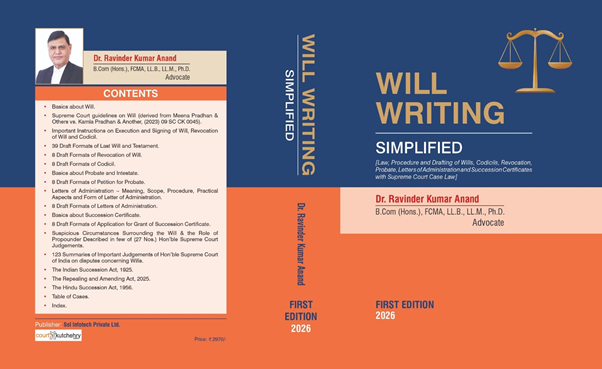
EXTRACTS FROM BOOK, WILL WRITING SIMPLIFIED, By Dr Ravinder Kumar Anand. [📘 Buy Will Writing Simplified online: Amazon | Flipkart ]
Case Title Gopal Krishan & Others v. Daulat Ram & Others, (2025) 01 SC CK 0047: Civil Appeal No.13192 of 2024.
https://www.courtkutchehry.com/judgements/1211993/gopal-krishan-ors-vs-daulat-ram-ors/]
| Suspicious Circumstance | Court’s Observation & Para Reference in the Judgement |
|---|---|
| Testator’s illness and proximity to death | The Will was executed one day before death. Court held illness alone does not create suspicion if mental faculties are intact. [Para 3.1, 4] |
| Unregistered Will | Lack of registration does not invalidate a Will if execution is proved. [Para 3.1, 4, 8] |
| Irregular spacing / seal placement | Minor spacing variations are natural and not suspicious. [Para 3.1, 4] |
| Thumb impression issue | “Direction of testator” required only if someone else signs; not when testator signs himself. [Para 9–14] |
| Delay in death certificate | Non-production does not affect proof of Will. [Para 3.1] |
| Layout manipulation allegation | Minor formatting differences are not evidence of forgery. [Para 4] |
| Propounder’s burden | Attesting witness proved execution and compliance with law. [Para 12–14] |
| Witness on sound mind | Testator was of sound mind and understood contents. [Para 12, 14] |
| High Court interpretation error | Supreme Court corrected misinterpretation of Section 63(c). [Para 13–14] |
| No unnatural exclusion | Beneficiary selection was natural and justified. [Para 2.2, 14] |
| Direction under Section 63(c) | Applies only when another person signs on behalf of testator. [Para 9–14] |
| Liberal interpretation | Law should uphold genuine intention, not reject on technicalities. [Para 13–14] |
| Attestation requirement | Witness must see signing or receive acknowledgment. [Para 13–14] |
| Suspicion must be real | Cannot be based on trivial factors like spacing or illness. [Para 8, 14] |
| Burden shifting | Once execution is proved, challenger must prove fraud. [Para 8, 12–14] |
| Liberal construction | Courts should respect the testator’s final wishes. [Para 13–15] |
FAQ Section
Q1: Does illness or proximity to death make a Will suspicious?
No. Illness or old age alone does not prove unsoundness of mind. Faculties must be shown impaired.
Q2: Is registration mandatory for a Will?
No. An unregistered Will is valid if execution and attestation are proved.
Q3: Why was irregular spacing not suspicious?
Because narrower spacing at the end of a page is natural and not evidence of forgery.
Q4: What does “direction of the testator” mean under Section 63(c)?
It applies only when someone else signs for the testator. If the testator signs himself, witnesses need only see him do so.
Q5: Does delay in producing a death certificate invalidate a Will?
No. Proof of attestation suffices; omission of a death certificate is not fatal.
Q6: What must attesting witnesses prove?
That the testator signed or marked the Will in their presence, understood its contents, and was of sound mind.
Q7: Why is this case still cited?
Because it rejects hypertechnical suspicion, clarifies Section 63(c), and protects genuine testamentary intent.
BOOK REFERENCE:
[📘 Buy Will Writing Simplified online: Amazon | Flipkart ]