
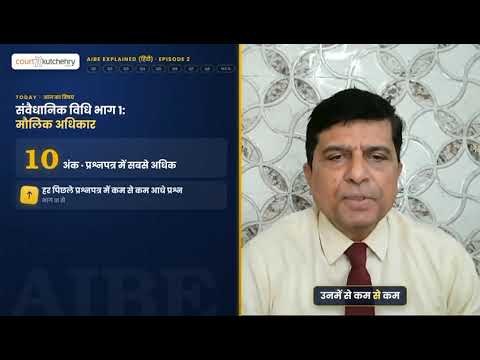
Watch the Video
In this 11-minute video in Hindi, Advocate Vinayak Pawar presents Episode 2 of “AIBE Explained”, Constitutional Law Part 1, explaining the Fundamental Rights through seven exam-style questions and the most-asked cases. This English article turns it into revision notes for Hindi-medium aspirants, with a Hindi–English glossary and a quick self-test.
Why Part III Deserves Your First Revision Hour
Constitutional Law carries 10 marks in the AIBE, the most of any subject, and at least half come from Part III. For a Hindi-medium candidate, the paper may use the Hindi term while your notes use the English one, so learn each Article with its Hindi term, its English term and one case. The seven questions of the episode follow in order.
Revision Card 1: Article 12 and the Meaning of “State” (राज्य)
Most Fundamental Rights run only against the “State”: the Union and State Governments and Legislatures, and all local or “other authorities”, the phrase that produces most questions.
- Ajay Hasia v. Khalid Mujib Sehravardi, (1980) 11 SC CK 0008 (decided 1980, reported 1981): a society running a government engineering college was held to be an instrumentality of the State.
- Pradeep Kumar Biswas v. Indian Institute of Chemical Biology, (2002) 04 SC CK 0073: a seven-judge Bench asked whether the body is financially, functionally and administratively dominated by or under the control of the Government.
Revision Card 2: Article 13, Eclipse and Severability
Article 13 makes a law void to the extent it is inconsistent with the Fundamental Rights. Two doctrines flow from it.
आच्छादन का सिद्धांत (Doctrine of Eclipse)
A pre-Constitution law that conflicts with a Fundamental Right is not dead; it is only eclipsed. If the conflict is later removed by a constitutional amendment, the law becomes operative again. Case: Bhikaji Narain Dhakras v. State of Madhya Pradesh, (1955) 09 SC CK 0022.
पृथक्करणीयता का सिद्धांत (Doctrine of Severability)
Where only one part of a statute is invalid and the rest can survive on its own, the court cuts away only the invalid part. The episode cites R.M.D. Chamarbaugwala v. Union of India (1957) for this doctrine.
Revision Card 3: Article 14 and the “Person v. Citizen” Trap
Article 14 guarantees equality before the law (विधि के समक्ष समता) and the equal protection of the laws (विधियों का समान संरक्षण). The single most repeated AIBE trap is who can claim which right.
| Who can claim | Articles |
|---|---|
| Every person, citizen or not | 14, 20, 21, 22 |
| Citizens only | 15, 16, 19, 29 |
Article 14 also forbids unreasonable classification and arbitrariness.
Revision Card 4: Reservation (आरक्षण) under Articles 15 and 16
- Indra Sawhney v. Union of India, (1992) 11 SC CK 0030: the nine-judge Bench upheld 27% reservation for Other Backward Classes, excluded the creamy layer (क्रीमी लेयर), and held that reservations should ordinarily not exceed 50%.
- The 103rd Constitutional Amendment, 2019 added Articles 15(6) and 16(6), allowing up to 10% reservation for the economically weaker sections (EWS).
- That amendment was upheld by majority in Janhit Abhiyan v. Union of India (2022).
Revision Card 5: The Six Freedoms of Article 19
Article 19(1) gives citizens six freedoms, easy to recall as “speak, meet, join, move, live, work”: speech and expression (a), peaceful assembly (b), associations or unions (c), movement throughout India (d), residence (e) and profession, occupation, trade or business (g).
The gap at (f) is itself a question: the right to property was deleted by the 44th Amendment and now survives as a constitutional right under Article 300A. Each freedom can be curtailed only by reasonable restrictions under Articles 19(2) to 19(6).
Revision Card 6: Article 21 after Maneka Gandhi
Article 21 protects life and personal liberty (प्राण और दैहिक स्वतंत्रता). Before 1978 it was read narrowly. Maneka Gandhi v. Union of India, (1978) 01 SC CK 0026 changed that: the procedure established by law must be just, fair and reasonable. Since then the Court has read into it the right to livelihood (आजीविका), Olga Tellis v. Bombay Municipal Corporation, (1985) 07 SC CK 0019; privacy (निजता), K.S. Puttaswamy v. Union of India (2017); and death with dignity (गरिमा के साथ मृत्यु), Common Cause v. Union of India, (2018) 03 SC CK 0092.
Revision Card 7: Articles 20, 22 and 32, and the Five Writs
- Article 20: no ex post facto criminal law, no double jeopardy, no compulsion to be a witness against oneself.
- Article 22: grounds of arrest, a lawyer, production before a magistrate within 24 hours, and safeguards for preventive detention.
- Article 32: the right to move the Supreme Court for enforcement of Fundamental Rights. Dr. B.R. Ambedkar called it the “heart and soul” (हृदय और आत्मा) of the Constitution.
- Emergency (आपातकाल): under Article 359, as amended by the 44th Amendment, Articles 20 and 21 cannot be suspended even during an Emergency.
The five writs are habeas corpus (बंदी प्रत्यक्षीकरण), mandamus (परमादेश), prohibition (प्रतिषेध), certiorari (उत्प्रेषण) and quo warranto (अधिकार-पृच्छा).
Key Legal Terms: Hindi ↔ English
| Hindi | English |
|---|---|
| मौलिक अधिकार | Fundamental Rights |
| अनुच्छेद | Article |
| राज्य | State (Article 12) |
| आच्छादन का सिद्धांत | Doctrine of eclipse |
| पृथक्करणीयता का सिद्धांत | Doctrine of severability |
| आरक्षण | Reservation |
| आजीविका | Livelihood |
| निजता | Privacy |
| गरिमा के साथ मृत्यु | Death with dignity |
| आपातकाल | Emergency |
Quick Test
The episode ends with a quick test. Try these (answers in brackets):
- Which doctrine allows a pre-Constitution law to revive after an amendment? (Eclipse, Bhikaji Narain Dhakras)
- Is Article 19 available to a foreign national? (No, only to citizens)
- Which amendment introduced EWS reservation? (103rd Amendment, 2019)
- Which case made “procedure established by law” mean a fair procedure? (Maneka Gandhi, 1978)
- Which two Articles survive an Emergency? (Articles 20 and 21)
Key Takeaways
- Part III gives at least half of the 10 Constitutional Law marks in the AIBE.
- Fundamental Rights run against the “State”: learn Ajay Hasia and Pradeep Kumar Biswas for Article 12.
- Article 14 protects every person; Articles 15, 16, 19 and 29 protect only citizens.
- Indra Sawhney: 27% OBC, creamy layer out, 50% ceiling; EWS upheld in Janhit Abhiyan.
- After Maneka Gandhi, Article 21 covers livelihood, privacy and dignity in death; Articles 20 and 21 cannot be suspended in an Emergency.
Frequently Asked Questions
Is this episode in Hindi or English?
The episode is in Hindi. The same lesson is also available in English as Episode 2 of AIBE Explained, linked above.
What is the difference between eclipse and severability?
Eclipse keeps a whole pre-Constitution law dormant until the conflict is removed. Severability removes only the invalid part of a law and keeps the rest.
Why is Article 32 called the heart and soul of the Constitution?
Because it guarantees the remedy without which the other rights could not be enforced.
Which Article 21 cases should I learn first?
Maneka Gandhi (1978), Olga Tellis (1985), Puttaswamy (2017) and Common Cause (2018), the four the episode highlights.
Where can I watch the Hindi episode?
Watch Advocate Vinayak Pawar explain it in Hindi here: https://youtu.be/e8GtbCed23k.
Conclusion
Fundamental Rights are the most rewarding part of the AIBE syllabus, and the Hindi episode keeps them to seven questions.
Learn each Article with its Hindi name, its English name and one case, and the questions become easy in either language.
▶ Watch in English: Fundamental Rights for AIBE: Articles 12 to 32 with Landmark Cases | Constitutional Law Part 1 |Ep 2
📖 Read the full article: Fundamental Rights for AIBE: Articles 12 to 32 with Landmark Cases | Constitutional Law Part 1 | AIBE Explained Ep 2
Research Judgments Like These on CourtKutchehry
Every judgment cited in this article, and lakhs more, can be searched and read on CourtKutchehry. Searching and reading judgments is free. A membership adds unlimited summaries, all related judgments, original court PDF downloads, bookmarks, notes and the CourtKutchehry AI assistant.
| Membership | Price | Works out to | AI credits |
|---|---|---|---|
| Monthly (1 month) | ₹599 | ₹599 / month | 1,000 / month |
| Quarterly (3 months) · Save 16% | ₹1,499 | ₹499.67 / month | 1,100 / month |
| Six-monthly (6 months) · Save 33% | ₹2,399 | ₹399.83 / month | 1,200 / month |
| Yearly (12 months) · Save 44% · Best value | ₹3,999 | ₹333.25 / month | 1,300 / month |
Every plan is a one-off purchase for a fixed period: nothing auto-renews and no card is kept on file. Prices are exclusive of applicable tax, which is added at checkout. Extra AI chat credits can be topped up from ₹99. A free verified account gets 5 summaries and 50 AI trial credits.
Prices are as displayed on courtkutchehry.com on 20 November 2026 and are subject to change without notice. Please check the pricing page for the current plans and offers.
For more judgments, legal opinions and case analysis, visit courtkutchehry.com
Visit CourtKutchehry →