
Watch the Video
In this 10-minute video, Episode 2 of the CourtKutchehry series “AIBE Explained” and Part 1 of Constitutional Law, the episode explains why Constitutional Law, at 10 marks, is the highest-scoring AIBE subject and why at least half of its questions come from Part III. He covers the Fundamental Rights, Articles 12 to 35, in eight questions, with the landmark cases the Bar Council keeps asking about, and then solves five practice questions. This article explains each point in writing.
Q1. What Is “State” under Article 12?
Fundamental Rights are mostly enforceable against the “State”. Article 12 includes the Union and State Governments and Legislatures, and all local or other authorities.
The phrase “other authorities” has been read through the idea of an instrumentality or agency of the State. In Ajay Hasia v. Khalid Mujib Sehravardi, (1980) 11 SC CK 0008, the Supreme Court held that a society running a government engineering college was “State”, and listed indicators such as government funding of the capital, deep and pervasive State control, and functions of public importance. In Pradeep Kumar Biswas v. Indian Institute of Chemical Biology, (2002) 04 SC CK 0073, a seven-judge Bench held that the real test is whether the body is financially, functionally and administratively dominated by or under the control of the Government.
Q2. What Does Article 13 Do?
Article 13 makes laws inconsistent with Fundamental Rights void to the extent of the inconsistency. Two doctrines flow from it, and both are favourite AIBE questions.
Doctrine of eclipse
A pre-Constitution law that violates a Fundamental Right is not wiped out; it is only overshadowed. If the Constitution is later amended to remove the conflict, the law revives. This was laid down in Bhikaji Narain Dhakras v. State of Madhya Pradesh, (1955) 09 SC CK 0022.
Doctrine of severability
If only part of a law is invalid, and the valid part can stand on its own, the court strikes down only the bad part. The video cites R.M.D. Chamarbaugwala v. Union of India (1957) on this point.
Is a constitutional amendment a “law” under Article 13? In Shankari Prasad v. Union of India, (1951) 10 SC CK 0005, the Court said no. The debate ended in Kesavananda Bharati v. State of Kerala, (1973) 04 SC CK 0051: Parliament cannot destroy the basic structure.
Q3. The Scope of Article 14
Article 14 guarantees equality before the law and the equal protection of the laws to every person, citizen or not. By contrast, Articles 15, 16, 19 and 29 are available only to citizens. That distinction is asked again and again.
Article 14 forbids unreasonable classification. In State of West Bengal v. Anwar Ali Sarkar, (1952) 01 SC CK 0001, the Court applied the twin test: the classification must rest on an intelligible differentia, and the differentia must have a rational nexus with the object of the law. In E.P. Royappa v. State of Tamil Nadu, (1973) 11 SC CK 0036, it added that equality is the antithesis of arbitrariness.
Q4. Reservation: Articles 15(4), 15(5), 16(4) and 16(4A)
- Article 15(4): special provisions for backward classes, SCs and STs.
- Article 15(5): admission to educational institutions, including private unaided non-minority ones.
- Article 16(4): reservation in public appointments for inadequately represented backward classes.
- Article 16(4A): reservation in promotion for SCs and STs.
In Indra Sawhney v. Union of India, (1992) 11 SC CK 0030, a nine-judge Bench upheld reservation for Other Backward Classes, excluded the creamy layer, and held that reservations should ordinarily not exceed 50%.
The 103rd Amendment, 2019 added Articles 15(6) and 16(6), permitting up to 10% reservation for the economically weaker sections (EWS). The Supreme Court upheld the amendment by majority in Janhit Abhiyan v. Union of India (2022).
Q5. The Six Freedoms under Article 19
Article 19(1) gives citizens six freedoms: speech and expression; assembly; association; movement; residence; and profession, occupation, trade or business. Each is subject only to the reasonable restrictions in Articles 19(2) to 19(6).
The right to property, Article 19(1)(f), was deleted by the 44th Amendment; it is now a constitutional right under Article 300A.
In Romesh Thappar v. State of Madras, (1950) 05 SC CK 0017, the Court held that freedom of speech includes freedom of the press and of circulation. In Shreya Singhal v. Union of India (2015), it struck down Section 66A of the Information Technology Act, 2000 as vague and overbroad.
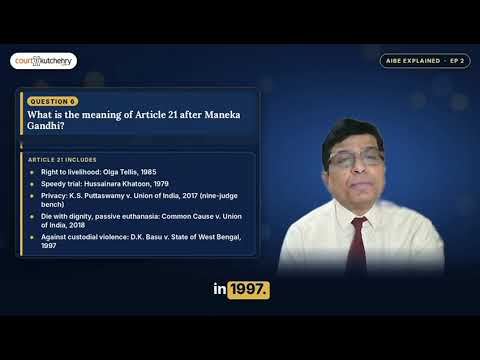
Q6. Article 21 after Maneka Gandhi
In A.K. Gopalan v. State of Madras, (1950) 05 SC CK 0006, the Court read the Fundamental Rights in separate compartments and accepted any procedure enacted by law. In Maneka Gandhi v. Union of India, (1978) 01 SC CK 0026, a seven-judge Bench rejected that approach: Articles 14, 19 and 21 are linked, and the procedure must be just, fair and reasonable, not arbitrary.
After Maneka Gandhi, Article 21 has been read to include many rights:
- the right to livelihood: Olga Tellis v. Bombay Municipal Corporation, (1985) 07 SC CK 0019;
- speedy trial and free legal aid: Hussainara Khatoon v. Home Secretary, State of Bihar, (1979) 02 SC CK 0038;
- the right to privacy: K.S. Puttaswamy v. Union of India (2017), decided by nine judges;
- the right to die with dignity, recognising passive euthanasia and living wills: Common Cause v. Union of India, (2018) 03 SC CK 0092.
Article 21A, inserted by the 86th Amendment, 2002, gives children aged 6 to 14 the right to free and compulsory education.
Q7. Articles 20 and 22
Article 20 gives three protections in respect of conviction: no ex post facto criminal law (20(1)), no double jeopardy (20(2)), and no compulsion to be a witness against oneself (20(3)).
Article 22 protects a person who is arrested: the right to be told the grounds of arrest, to consult a lawyer, and to be produced before a magistrate within 24 hours. In D.K. Basu v. State of West Bengal (1997), the Court laid down guidelines against custodial violence.
Under Article 359, as amended by the 44th Amendment, Articles 20 and 21 cannot be suspended even during an Emergency.
Remember this line: in an Emergency, Articles 20 and 21 stay on.
Q8. Article 32: The Heart and Soul of the Constitution
Article 32 lets a person move the Supreme Court directly for enforcement of Fundamental Rights, through writs of habeas corpus, mandamus, prohibition, certiorari and quo warranto. Dr. B.R. Ambedkar called it the heart and soul of the Constitution.
Article 226 gives the High Courts writ jurisdiction that is wider than Article 32, because it can be used not only for Fundamental Rights but also “for any other purpose”.
Key Takeaways
- Article 12: “other authorities” are tested by Government domination (Pradeep Kumar Biswas).
- Article 13 brings in the doctrines of eclipse and severability; Kesavananda Bharati protects the basic structure.
- Article 14 applies to every person; Articles 15, 16, 19 and 29 only to citizens.
- EWS reservation is in Articles 15(6) and 16(6); the right to property is now Article 300A; Article 21A covers education for ages 6 to 14.
- Articles 20 and 21 cannot be suspended in an Emergency, and Article 226 is wider than Article 32.
Frequently Asked Questions
Which Fundamental Rights are available only to citizens?
Articles 15, 16, 19 and 29, among others. Article 14 and Article 21 are available to every person.
What is the doctrine of eclipse?
An inconsistent pre-Constitution law becomes dormant, not dead, and revives if the conflict is removed (Bhikaji Narain Dhakras).
Which amendment removed the right to property from Part III?
The 44th Amendment. Property is now a constitutional right under Article 300A.
What did Maneka Gandhi change?
It held that the procedure under Article 21 must be just, fair and reasonable, and that Articles 14, 19 and 21 must be read together.
Where can I watch the full explanation?
Watch the full explanation in 10 minutes: https://youtu.be/wy10x6Z0EZA.
Conclusion
Part III is the single richest source of marks in the AIBE: the definition of “State”, Article 13, the two tests under Article 14, reservation, the six freedoms, Article 21 and the writ remedies.
Learn each landmark case in one line: name, year, principle.
▶ Watch the video: Fundamental Rights for AIBE: Articles 12 to 32 with Landmark Cases | Constitutional Law Part 1 |Ep 2
📖 Read more: Maneka Gandhi v. Union of India (1978)
Research Judgments Like These on CourtKutchehry
Every judgment cited in this article, and lakhs more, can be searched and read on CourtKutchehry. Searching and reading judgments is free. A membership adds unlimited summaries, all related judgments, original court PDF downloads, bookmarks, notes and the CourtKutchehry AI assistant.
| Membership | Price | Works out to | AI credits |
|---|---|---|---|
| Monthly (1 month) | ₹599 | ₹599 / month | 1,000 / month |
| Quarterly (3 months) · Save 16% | ₹1,499 | ₹499.67 / month | 1,100 / month |
| Six-monthly (6 months) · Save 33% | ₹2,399 | ₹399.83 / month | 1,200 / month |
| Yearly (12 months) · Save 44% · Best value | ₹3,999 | ₹333.25 / month | 1,300 / month |
Every plan is a one-off purchase for a fixed period: nothing auto-renews and no card is kept on file. Prices are exclusive of applicable tax, which is added at checkout. Extra AI chat credits can be topped up from ₹99. A free verified account gets 5 summaries and 50 AI trial credits.
Prices are as displayed on courtkutchehry.com on 20 November 2026 and are subject to change without notice. Please check the pricing page for the current plans and offers.
For more judgments, legal opinions and case analysis, visit courtkutchehry.com
Visit CourtKutchehry →