
Watch the Video
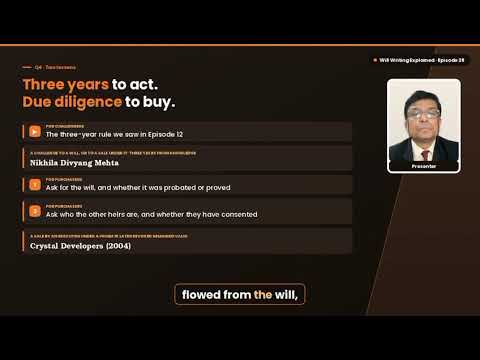
In this 12-minute video, CourtKutchehry presents Episode 28 of “Will Writing Explained”: when does a dispute over a will become a crime? The episode explains forgery of a will (Section 467 of the Indian Penal Code), why a criminal conviction needs stronger proof (Arjan Singh v. Hazara Singh, 1979), the “blank signed paper” allegation, whether a good-faith buyer from the heir is protected (Rajeev Gupta v. Prashant Garg, 2025), buying during a pending case (lis pendens), why mutation is not title, and how to protect a will against forgery. This article covers the same ground, with the corresponding provisions of the new criminal laws.
▶ Watch on YouTube: Forged Will: Crime, Fraud and the Innocent Buyer | Will Writing Ep 28
Forgery of a Will: The Criminal Provisions
Forging a will is one of the most serious forms of forgery known to Indian criminal law.
- Section 467 IPC punished forgery of a valuable security, will or authority to adopt. From 1 July 2024, the corresponding provision is Section 338 of the Bharatiya Nyaya Sanhita, 2023 (BNS), which also covers forgery of a will. Both provide for imprisonment that may extend to life.
- Section 471 IPC punished fraudulently or dishonestly using as genuine a document known to be forged. Its BNS counterpart is Section 340(2).
- Cheating and criminal conspiracy are often added: Section 420 IPC (now Section 318(4) BNS) and Section 120B IPC (now Section 61(2) BNS).
Offences committed before 1 July 2024 continue to be tried under the IPC; later offences fall under the BNS.
Why a Criminal Conviction Needs Stronger Proof: Arjan Singh (1979)
A civil court asks whether the propounder has proved the will and removed suspicion, on a balance of probabilities. A criminal court asks whether the prosecution has proved forgery by the accused. These are different questions.
In Arjan Singh v. Hazara Singh, (1979) 02 SC CK 0045, the High Court had reversed an acquittal and convicted the accused under Sections 467 and 471 IPC for forging a will. The Supreme Court (Justices S. Murtaza Fazal Ali and A.D. Koshal) set the conviction aside. There was no direct evidence of forgery. The case rested on one prosecution handwriting expert, contradicted by three defence experts, which the Court described as a question of oath against oath.
The Court also held that circumstances such as non-registration, earlier wills not being revoked and late production of the will may weigh with a civil court deciding whether a will is genuine, but they cannot take the place of the proof needed to convict someone of forgery.
Remember this line: a suspicious will can fail in a civil court without anyone being guilty of forgery.
Civil and Criminal Cases Side by Side
Families often file both a civil suit (to set aside the will or for a declaration) and a criminal complaint (for forgery). Some points to keep in mind:
- The two proceedings can run in parallel; the result of one does not automatically decide the other.
- A criminal complaint should not be used as pressure in what is really a property dispute. Courts have quashed proceedings where a civil dispute was given a criminal colour without material showing a crime.
- Where forgery is clear, for example a will dated after the testator’s death or a signature on a page he never saw, the criminal law is the right remedy.
The “Blank Signed Paper” Allegation
A common allegation is that the testator signed blank papers for some other purpose, and a will was later typed over the signature. This is a serious charge, and courts examine it carefully:
- Does the signature sit naturally at the end of the text, or is the text squeezed around it?
- Are all pages signed, and do the page breaks make sense?
- Did the testator have any reason to sign blank papers?
- Do the attesting witnesses describe the testator signing the completed document?
Independent evidence can defeat the allegation. In Swarnalatha v. Kalavathy, (2022) 03 SC CK 0096, the Supreme Court noted that the father’s will referred to the mother’s will, which made fabrication on blank signed papers unlikely.
Is a Good-Faith Buyer Protected? Rajeev Gupta (2025)
Rajeev Gupta v. Prashant Garg, (2025) 04 SC CK 0256 arose from a long family dispute over property claimed under a 1951 will. Parts of the property were sold in 1992 by registered sale deeds; the family member through whom the buyers claimed had stood recorded in the revenue records for decades. Years later, other family members sued to cancel the sales and recover possession.
The Supreme Court (Justices Dipankar Datta and Prashant Kumar Mishra) restored the trial court’s dismissal of the suit. Among its holdings:
- The will was not proved. The plaintiffs relied on it for their title, so they had to prove it under Section 68 of the Evidence Act, through an attesting witness; a certified copy without proof that the original was lost was not enough.
- The buyers were protected as bona fide purchasers for value under Section 41 of the Transfer of Property Act, 1882, which protects transfers by an ostensible owner. That family member’s name had been in the records for decades, he collected rent openly, and the buyers took registered deeds.
- The suit was time-barred. Cancellation of the sale deeds was the real relief, so the three-year period under Article 59 of the Limitation Act applied.
Buying During a Pending Case: Lis Pendens
Section 52 of the Transfer of Property Act says that while a suit in which the right to immovable property is directly in question is pending, the property cannot be transferred so as to affect the rights of the other party under the decree. In Rajeev Gupta, the Court reiterated that a transfer pending litigation is not void; it is simply subject to the result of the suit. On the facts, the earlier suit was found collusive, so it did not help the plaintiffs.
For buyers, the practical lesson is to search for pending litigation before buying property that came through a will, because a buyer during a pending suit takes the risk of losing it.
Mutation Is Not Title
Mutation in revenue or municipal records is done for fiscal purposes, mainly to know who pays the land revenue or property tax. In Jitendra Singh v. State of Madhya Pradesh, 2021 SCC OnLine SC 802, a case where mutation was sought on the basis of a disputed will, the Supreme Court reiterated that a mutation entry does not confer any right, title or interest. Where title is disputed, the claimant must go to the civil court, and mutation follows its decision.
So a forged will that has been used to get a mutation does not make the beneficiary the owner, and a genuine will is not defeated because mutation has not yet been done.
How to Protect a Will Against Forgery
- Register the will under the Registration Act, 1908. It is optional, but it creates an official record of the date and the executant.
- Or deposit it in a sealed cover with the Registrar under the Registration Act’s provisions on deposit of wills.
- Sign every page, and have the witnesses sign the last page in the testator’s presence.
- Use independent witnesses who can be traced years later, and record their addresses.
- Consider a video recording of the signing and a doctor’s note on capacity.
- Tell the executor where the original is kept, and keep a certified copy elsewhere.
- Never sign blank papers, for anyone.
Key Takeaways
- Forging a will was punishable under Section 467 IPC; it is now Section 338 BNS, with use of a forged document under Section 340(2) BNS.
- Suspicious circumstances can defeat a will in a civil court but cannot alone prove forgery in a criminal case (Arjan Singh, 1979).
- A bona fide buyer for value from an ostensible owner can be protected under Section 41 TPA (Rajeev Gupta, 2025).
- A transfer during a pending suit is not void but subject to the decree (Section 52 TPA).
- Mutation is not title; disputed wills go to the civil court.
Frequently Asked Questions
Which section applies to forging a will now?
Section 338 of the Bharatiya Nyaya Sanhita, 2023, which replaced Section 467 IPC from 1 July 2024. Using a forged will as genuine falls under Section 340(2) BNS.
If a civil court rejects a will, is someone guilty of forgery?
Not necessarily. A civil court can reject a will for unexplained suspicion; a criminal court needs proof that the accused forged it.
Is a buyer who purchased from the heir safe if the will is later disputed?
It depends on the facts. A bona fide purchaser for value from an ostensible owner can be protected under Section 41 TPA, as in Rajeev Gupta, but a buyer during a pending suit takes subject to the decree.
Does mutation based on a will make me the owner?
No. Mutation is only for fiscal purposes and does not confer title.
What is the best protection against a forged will?
Registration or deposit of the will, independent traceable witnesses, signing every page, and telling the executor where the original is kept.
Where can I watch the full explanation?
Watch the video explain forged wills in 12 minutes: https://youtu.be/0BGBwaJE020.
Conclusion
A dispute over a will becomes a crime only when someone has actually forged or knowingly used a false document, and that must be proved to the criminal standard. Many wills fail in civil courts without any crime being proved, and courts are wary of criminal cases used as leverage.
For buyers and families alike, the protections are practical: check the will and the records, search for pending cases, remember that mutation is not title, and protect your own will so that no one can credibly say it was forged.
▶ Watch the video: Forged Will: Crime, Fraud and the Innocent Buyer | Will Writing Ep 28
Research Judgments Like These on CourtKutchehry
Every judgment cited in this article, and lakhs more, can be searched and read on CourtKutchehry. Searching and reading judgments is free. A membership adds unlimited summaries, all related judgments, original court PDF downloads, bookmarks, notes and the CourtKutchehry AI assistant.
| Membership | Price | Works out to | AI credits |
|---|---|---|---|
| Monthly (1 month) | ₹599 | ₹599 / month | 1,000 / month |
| Quarterly (3 months) · Save 16% | ₹1,499 | ₹499.67 / month | 1,100 / month |
| Six-monthly (6 months) · Save 33% | ₹2,399 | ₹399.83 / month | 1,200 / month |
| Yearly (12 months) · Save 44% · Best value | ₹3,999 | ₹333.25 / month | 1,300 / month |
Every plan is a one-off purchase for a fixed period: nothing auto-renews and no card is kept on file. Prices are exclusive of applicable tax, which is added at checkout. Extra AI chat credits can be topped up from ₹99. A free verified account gets 5 summaries and 50 AI trial credits.
Prices are as displayed on courtkutchehry.com on 20 November 2026 and are subject to change without notice. Please check the pricing page for the current plans and offers.
For more judgments, legal opinions and case analysis, visit courtkutchehry.com
Visit CourtKutchehry →