
Watch the Video
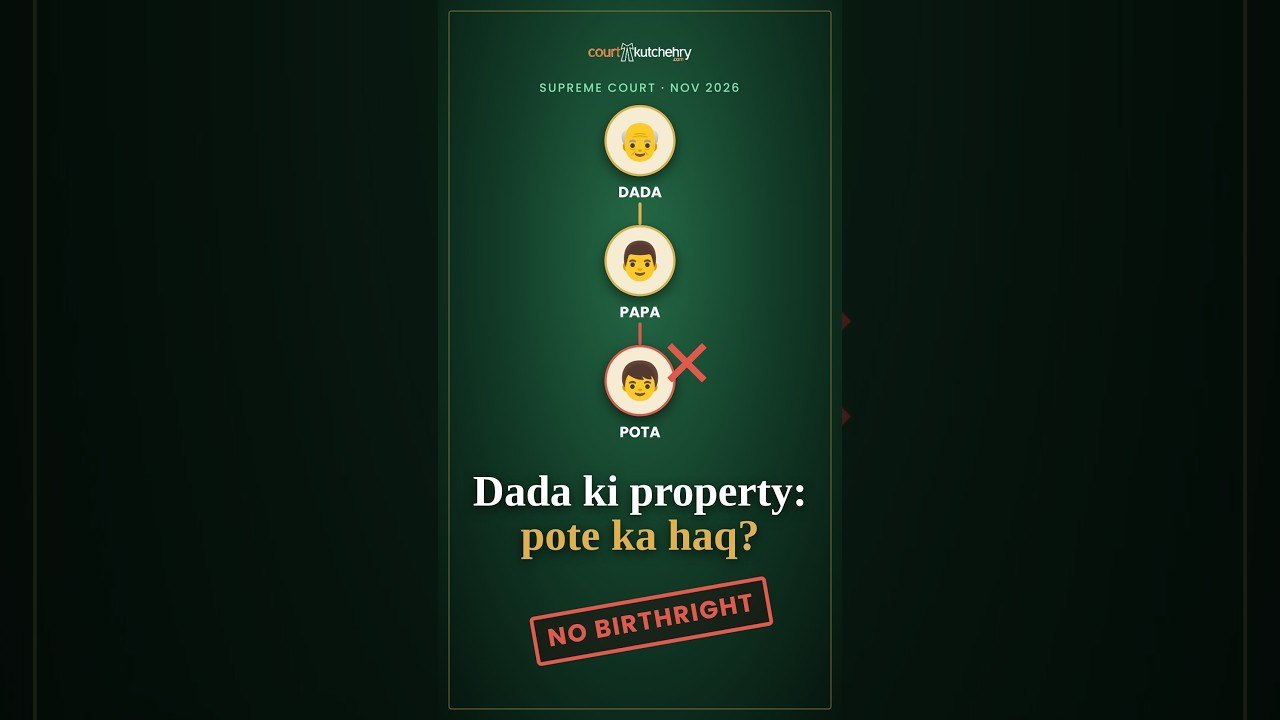
In this 2-minute Short, Advocate Vinayak Pawar asks a family question answered by the Supreme Court on 6 November 2026: if your father sells property he got from your grandfather, can you claim half by birth? This article stays with that one question: why the answer is usually no, and when it can be different.
The “Half Share” Belief
The claim usually runs: “It was my grandfather’s, so it is ancestral; I had a share from birth; my father could not sell my half.” Under the old Mitakshara law a son did acquire an interest by birth in ancestral property. The Hindu Succession Act, 1956 changed how a Hindu man’s property passes on intestacy, and the Supreme Court has now restated what that means for a sale.
The Case in Brief
In J. Rajesh v. M. Kumaran, 2026 INSC 1208, the property in Chennai had belonged to the grandfather. A 1994 compromise decree in a partition suit allotted a portion to the appellant’s father, who sold it in 1997. The grandson later sued for half, as a coparcener by birth. The Madras High Court rejected the claim, and a bench of Justice Augustine George Masih and Justice Sunita Agarwal dismissed his appeal.
Why the Father Could Sell
- Section 8 decides who inherits. When a Hindu man dies intestate, his property passes first to his Class I heirs: his widow, sons, daughters, mother and certain others.
- A grandson whose father is alive is not a Class I heir. A son’s son steps in only if his own father died before the grandfather.
- What the son receives is his own. The Court held that the share falling to a son under Section 8 is his exclusive property in his individual capacity, not joint family property of his branch. His son gets no right in it by birth.
- Owner’s power. Being his own, the father can sell, gift or bequeath it without the son’s consent.
- Partition closes the door. Here the property had already been divided by the 1994 decree, so there was no joint family property left out of which the grandson could claim.
Remember this line: if your father inherited it under Section 8, it was his to sell.
Not a New Rule
In Commissioner of Wealth Tax v. Chander Sen, (1986) 3 SCC 567, and Yudhishter v. Ashok Kumar, (1987) 1 SCC 204, the Court held that what a son inherits under Section 8 is his individual property, not HUF property. In Uttam v. Saubhag Singh, (2016) 03 SC CK 0094, a grandson’s partition suit failed: once the grandfather’s share devolved under Section 8 after a notional partition, it ceased to be joint family property.
When the Answer Can Be Different
The Short itself warns that genuine coparcenary property can be different: property that was already joint family property and remains part of an unpartitioned coparcenary. There, sons and, after the 2005 amendment to Section 6, daughters are coparceners by birth. In Vineeta Sharma v. Rakesh Sharma, (2020) 9 SCC 1, a three-judge bench held that a daughter’s right as a coparcener arises by birth, whether or not her father was alive on 9 September 2005.
Even then, a karta may sell joint family property for legal necessity or the benefit of the estate. The property’s history decides each case.
Key Takeaways
- A grandson cannot claim half of property his father inherited from the grandfather under Section 8 merely because of birth.
- The share falling to a son under Section 8 is his individual property (J. Rajesh v. M. Kumaran, 6 November 2026).
- The father may therefore sell, gift or bequeath it without the son’s consent.
- Genuine coparcenary property under Section 6 is different; check the property’s history first.
Frequently Asked Questions
My father sold grandfather’s house. Can I challenge the sale?
Not on the ground of birthright if your father inherited it under Section 8; it was his individual property. The property’s history decides the answer.
Does it matter that I was born before the sale?
No. In J. Rajesh, the grandson was born before his father sold the property, and his claim still failed.
What if my grandfather left a will?
Then the property passes under the will, not Section 8.
Can daughters claim a share by birth?
In genuine coparcenary property, yes, after the 2005 amendment, as explained in Vineeta Sharma. In property the father inherited under Section 8, neither sons nor daughters have a right by birth.
Where can I watch the video?
Watch the Short here: https://youtu.be/nX3ROC7lRx0.
Conclusion
Can the grandson claim half? Where the father inherited it under Section 8, no: it was his own to sell.
Before any dispute goes to court, check whether there was a will, a partition, or a pre-existing coparcenary. Those facts usually decide who owns it.
▶ Watch the full episode: Grandfather's Property: Does the Grandson Have a Right by Birth? Supreme Court Says No
📖 Read the full article: Grandfather’s Property: Does the Grandson Have a Right by Birth? Supreme Court Says No (Section 8, Hindu Succession Act)
Research Judgments Like These on CourtKutchehry
Every judgment cited in this article, and lakhs more, can be searched and read on CourtKutchehry. Searching and reading judgments is free. A membership adds unlimited summaries, all related judgments, original court PDF downloads, bookmarks, notes and the CourtKutchehry AI assistant.
| Membership | Price | Works out to | AI credits |
|---|---|---|---|
| Monthly (1 month) | ₹599 | ₹599 / month | 1,000 / month |
| Quarterly (3 months) · Save 16% | ₹1,499 | ₹499.67 / month | 1,100 / month |
| Six-monthly (6 months) · Save 33% | ₹2,399 | ₹399.83 / month | 1,200 / month |
| Yearly (12 months) · Save 44% · Best value | ₹3,999 | ₹333.25 / month | 1,300 / month |
Every plan is a one-off purchase for a fixed period: nothing auto-renews and no card is kept on file. Prices are exclusive of applicable tax, which is added at checkout. Extra AI chat credits can be topped up from ₹99. A free verified account gets 5 summaries and 50 AI trial credits.
Prices are as displayed on courtkutchehry.com on 20 November 2026 and are subject to change without notice. Please check the pricing page for the current plans and offers.
For more judgments, legal opinions and case analysis, visit courtkutchehry.com
Visit CourtKutchehry →