
Watch the Video
In this 2-minute video, Advocate Vinayak Pawar explains the Supreme Court’s judgment of 6 November 2026 on whether a grandson has a right by birth in property his father inherited from the grandfather. This article explains the Chennai family dispute, Section 8 of the Hindu Succession Act and what it means for your family.
Grandfather’s Property: Mine by Birth?
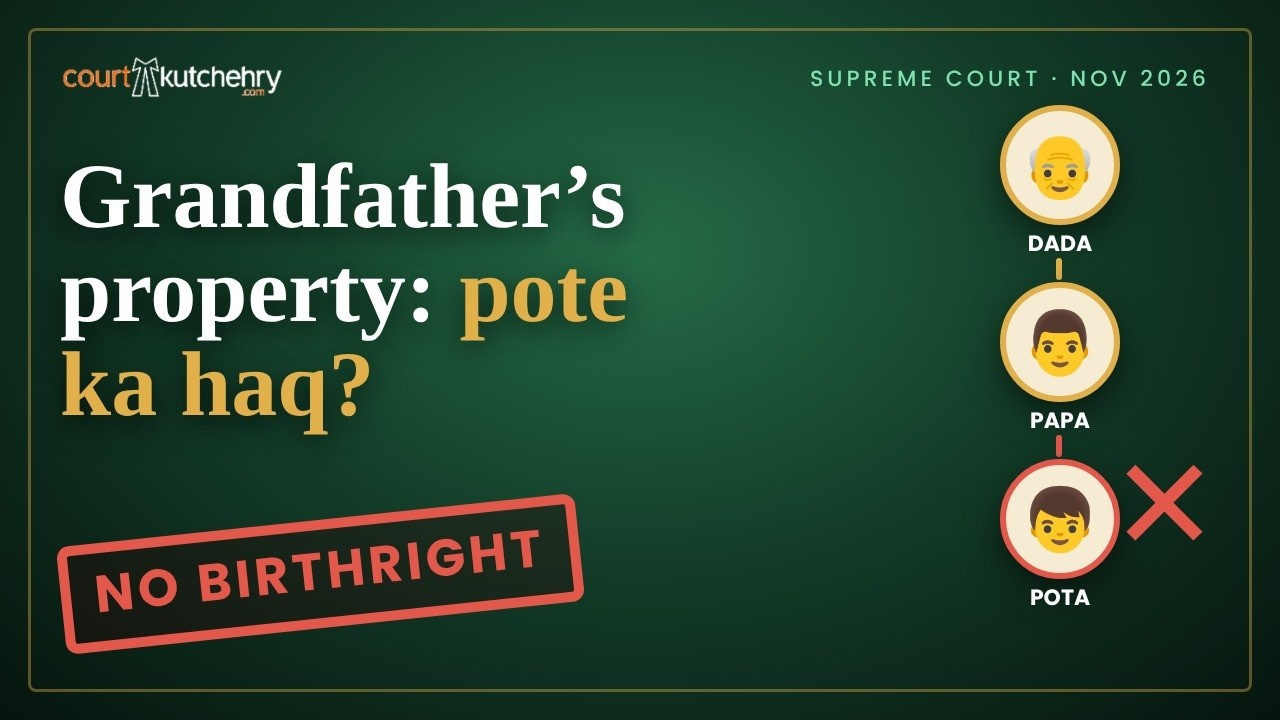
Many families believe that whatever comes from the grandfather is “ancestral property” in which a grandson has a share from birth. So if the father sells it, the grandson can claim half. On 6 November 2026, the Supreme Court explained why that belief is often wrong, in J. Rajesh v. M. Kumaran, 2026 INSC 1208.
The Story
The property in Chennai originally belonged to the appellant’s grandfather. In 1993, the grandfather’s daughter filed a suit for partition, and under a compromise decree of 3 February 1994 a portion was allotted to the appellant’s father. The appellant was born in January 1994. In 1997, the father sold his portion.
The grandson, as a minor acting through his mother, then sued for partition, claiming half of that property as a coparcener by birth. The trial court in Chennai granted a preliminary decree, but the Madras High Court set it aside in 2010. The grandson appealed to the Supreme Court.
What Section 8 Says
When a Hindu man dies without a will, his property passes under Section 8 of the Hindu Succession Act, 1956 to his heirs, first to the Class I heirs: widow, sons, daughters, mother and certain others. A son’s son is a Class I heir only if his own father has died before the grandfather. A grandson whose father is alive is not a Class I heir.
What the Supreme Court Held
A bench of Justice Augustine George Masih and Justice Sunita Agarwal dismissed the grandson’s appeal and his suit. The Court held:
- Section 8 is a self-contained provision. The old Hindu law rule that a grandson had a right by birth in his grandfather’s property during his father’s lifetime was not saved by the Act.
- Property that devolves under Section 8 goes to the Class I heirs as tenants in common. Once it has been partitioned, it ceases to be joint family property.
- “The share falling to a son becomes his exclusive property in his individual capacity”, not coparcenary property of his branch. His son gets no right by birth in it.
- Since the property had already been partitioned, there was no joint family property left to claim.
The Court reaffirmed the long-settled view in Commissioner of Wealth Tax v. Chander Sen, (1986) 3 SCC 567 and Yudhishter v. Ashok Kumar, (1987) 1 SCC 204: property a son inherits from his father under Section 8 is his individual property, not HUF property in his hands.
Remember this line: under Section 8, what the father inherits is the father’s own.
What It Means for You
- If your grandfather died without a will and his property came to your father under Section 8, it is your father’s own property. He can sell it, gift it or leave it by will.
- You get a share only as your father’s heir, after his death, and only if he has not already sold it or left it to someone else by will.
- Genuine coparcenary property is different. Where property was already joint family property before 1956, or remains part of a coparcenary, sons and daughters can still acquire rights by birth under Section 6 as amended in 2005. So check the property’s history and documents before you file a case.
Share With Your Family
Family property disputes often start from a wrong assumption. Before claiming or refusing a share, find out how the property came to the family, whether there was a will, and whether there was ever a partition. Those three facts usually decide the answer.
Key Takeaways
- Under Section 8 of the Hindu Succession Act, a man’s property passes to his Class I heirs if he dies without a will.
- A grandson whose father is alive is not a Class I heir.
- What the son inherits this way is his individual property; his son gets no right by birth in it (J. Rajesh v. M. Kumaran, 2026).
- The father can sell, gift or bequeath such property; the grandson inherits only as the father’s heir, later.
- Genuine coparcenary property is governed by Section 6 and can be different, so check the property’s history.
Frequently Asked Questions
Is all property from the grandfather “ancestral”?
No. If the grandfather died after 1956 without a will and the property passed to the father under Section 8, it is the father’s individual property.
Can my father sell property he inherited from my grandfather?
Yes, if he inherited it under Section 8. It is his own property, and the grandson has no birthright to stop the sale.
When is a grandson a Class I heir?
Only when his father has died before the grandfather. Then the grandson takes his father’s place among the Class I heirs.
What did the Supreme Court decide in J. Rajesh v. M. Kumaran?
It held that the share falling to a son under Section 8 is his exclusive individual property, and dismissed the grandson’s suit for half of it.
Does this apply to coparcenary property?
Not automatically. Genuine coparcenary property is governed by Section 6, under which sons and daughters can have rights by birth. The facts and documents decide.
Where can I watch the full explanation?
Watch Advocate Vinayak Pawar explain it here: https://youtu.be/dPc2QrqffMs.
Conclusion
The Supreme Court has restated a rule that surprises many families: property a father inherits from the grandfather under Section 8 is the father’s own. The grandson has no share in it by birth while the father is alive.
The real question in any such dispute is the history of the property. Was there a will? Was it coparcenary property before 1956? Was there a partition? Answer those first.
▶ Watch the video: Grandfather's Property: Does the Grandson Have a Right by Birth? Supreme Court Says No
Research Judgments Like These on CourtKutchehry
Every judgment cited in this article, and lakhs more, can be searched and read on CourtKutchehry. Searching and reading judgments is free. A membership adds unlimited summaries, all related judgments, original court PDF downloads, bookmarks, notes and the CourtKutchehry AI assistant.
| Membership | Price | Works out to | AI credits |
|---|---|---|---|
| Monthly (1 month) | ₹599 | ₹599 / month | 1,000 / month |
| Quarterly (3 months) · Save 16% | ₹1,499 | ₹499.67 / month | 1,100 / month |
| Six-monthly (6 months) · Save 33% | ₹2,399 | ₹399.83 / month | 1,200 / month |
| Yearly (12 months) · Save 44% · Best value | ₹3,999 | ₹333.25 / month | 1,300 / month |
Every plan is a one-off purchase for a fixed period: nothing auto-renews and no card is kept on file. Prices are exclusive of applicable tax, which is added at checkout. Extra AI chat credits can be topped up from ₹99. A free verified account gets 5 summaries and 50 AI trial credits.
Prices are as displayed on courtkutchehry.com on 20 November 2026 and are subject to change without notice. Please check the pricing page for the current plans and offers.
For more judgments, legal opinions and case analysis, visit courtkutchehry.com
Visit CourtKutchehry →