
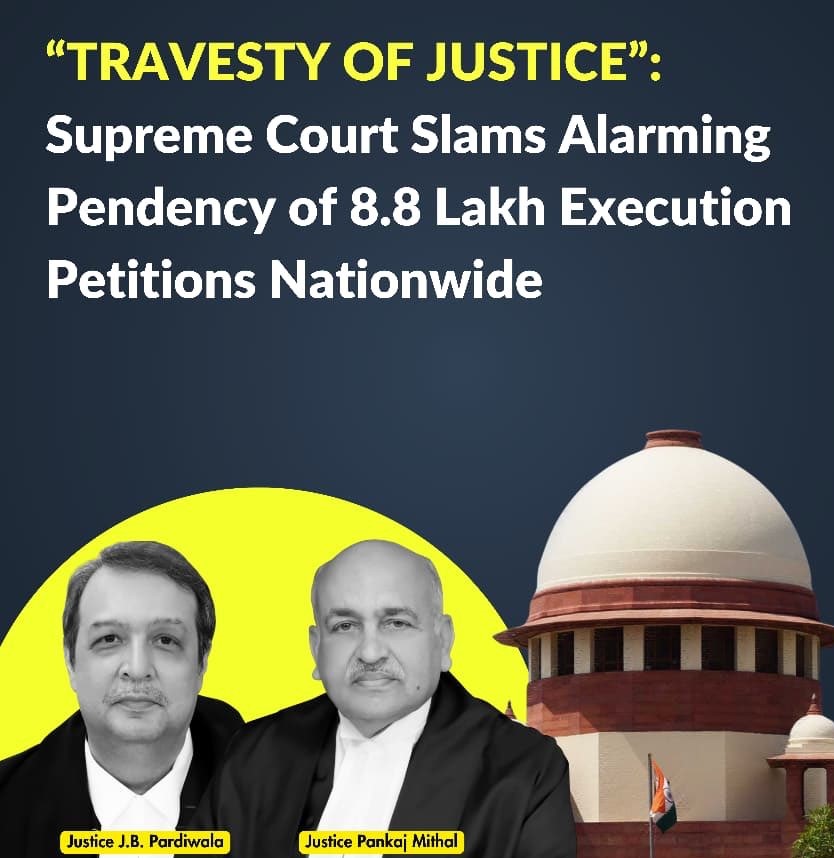
Justice Stalled After Judgment As 10 Lakhs Execution Petition Pending in District Courts
Supreme Court Calls Pendency of Execution Petitions “Frightening”
High Courts Asked to Ensure Speedy Enforcement of Decrees
By Legal Reporter
New Delhi: April 15, 2026:
The Supreme Court has flagged the alarming backlog of over 10 lakh execution petitions in district courts, with nearly 8 lakh pending for more than six months. It has directed High Courts to evolve mechanisms for speedy disposal, reinforcing that justice delayed in execution is justice denied.
Winning a civil case in India often does not mean the end of litigation. After obtaining a decree, the victorious party must file an execution petition if the losing party fails to comply. This process ensures that the decree is enforced—whether it involves possession of property, recovery of money, or compliance with orders. Unfortunately, execution petitions themselves face massive delays, leaving litigants unable to enjoy the fruits of their judgments.
Case Title: Ajit Kaur @ Surjit Kaur v. Darshan Singh (Dead) through LRs .
To understand key legal principles on inheritance disputes, will validity, and succession law, read the full Supreme Court judgment here: Ajit Kaur vs Darshan Singh Supreme Court judgment on wills and inheritance law .
Supreme Court’s Intervention
A bench of Justices J.B. Pardiwala and Pankaj Mithal expressed grave concern over the pendency of execution petitions, describing the situation as “very frightening and disappointing.” According to data presented, 10 lakh execution petitions are pending in district courts, with 7,95,981 cases pending for more than six months.
The Court noted that despite its earlier directions in March 2025 to dispose of execution petitions within six months, High Courts have not reported back on mechanisms evolved to ensure compliance. It has now directed all High Courts to file responses by October 7, 2026, detailing the steps taken.
Key Legal Provisions and Rules
- Order XXI, Code of Civil Procedure (CPC), 1908
- Governs execution of decrees and orders.
- Provides procedures for delivery of property, attachment of assets, arrest and detention, and other enforcement mechanisms.
- Section 36, CPC
- States that a decree may be executed by the court which passed it or by another court to which it is transferred.
- Supreme Court’s Directions (2025 onwards)
- Execution petitions should ideally be disposed of within six months.
- High Courts must evolve mechanisms and guide district courts for effective disposal.
- Judicial Precedent
- The Court highlighted a case where a litigant obtained a favourable verdict in 2006, but execution remained pending for two decades. This illustrates how decrees often become meaningless without enforcement.
Court’s Observations
- Litigants’ woes begin after decree: The Court noted that obtaining a favourable judgment is only half the battle; enforcement is often more difficult.
- Positive progress but insufficient: Over 4.3 lakh execution petitions were decided in the last six months, and 7.7 lakh in the past year, showing improvement but still leaving a daunting backlog.
- Need for systemic reform: The Court questioned whether High Courts have issued any procedural guidance to district courts and demanded accountability.
Implications
- For Litigants: Even after winning cases, parties may wait years for enforcement. This undermines faith in the justice system.
- For Judiciary: The backlog highlights inefficiencies in execution processes, requiring urgent reforms.
- For High Courts: They must now devise clear mechanisms—such as dedicated execution benches, stricter timelines, and use of technology—to ensure compliance.
- For Rule of Law: Justice delayed in execution erodes the credibility of judicial outcomes and emboldens non-compliance.
[RESEARCH RESOURCES]
EXTRACTS FROM BOOK, WILL WRITING SIMPLIFIED, By Dr Ravinder Kumar Anand. [📘 Buy Will Writing Simplified online: Amazon | Flipkart ]
FAQ: Understanding Execution Petitions
Q1: What is an execution petition?
It is an application filed by a decree-holder to enforce a court judgment when the losing party fails to comply.
Q2: Which law governs execution petitions?
Execution is governed by Order XXI of the Code of Civil Procedure, 1908.
Q3: How long should execution petitions take?
The Supreme Court has directed that execution petitions should ideally be disposed of within six months.
Q4: Why are so many execution petitions pending?
Delays arise from procedural bottlenecks, resistance by judgment-debtors, lack of dedicated execution mechanisms, and insufficient judicial resources.
Q5: What powers do courts have in execution?
Courts can order delivery of property, attachment of assets, arrest and detention of judgment-debtors, or police assistance to enforce decrees.
Q6: What did the Supreme Court say about High Courts?
It directed High Courts to evolve mechanisms and report back on steps taken to ensure speedy disposal of execution petitions.
Q7: What happens if execution is delayed for decades?
The decree-holder suffers injustice despite winning the case, as seen in a property dispute where execution remained pending for 20 years.
Conclusion
The Supreme Court’s strong words highlight a critical weakness in India’s justice delivery system: winning a case does not guarantee relief unless execution is timely. With over 10 lakh execution petitions clogging district courts, systemic reforms are essential. High Courts must now take responsibility to ensure decrees are enforced swiftly, restoring faith in the judiciary and upholding the principle that justice delayed is justice denied.