
Watch the Video
In this 10-minute video in Hindi, Episode 10 of “AIBE Explained” (Hindi), the episode takes up the first part of the Law of Evidence in six questions, giving the new Bharatiya Sakshya Adhiniyam, 2023 (BSA) section with the old Evidence Act section each time, and ends with five practice questions in the style of past AIBE papers. This article is written in English for Hindi-medium aspirants: a section-by-section revision sheet of the Hindi episode, with a glossary of the Hindi terms it uses.
Evidence Act to BSA: What Changed
The Law of Evidence carries 8 marks in the AIBE. From 1 July 2024, the Indian Evidence Act, 1872 has been replaced by the Bharatiya Sakshya Adhiniyam, 2023. The BSA has 170 sections in place of the old 167, and electronic and digital records are now fully treated as documents.
For a Hindi-medium candidate, the challenge is double: the section numbers have changed, and the paper may use either the Hindi or the English name of a concept. The episode handles the first problem by always giving the pair of numbers. The glossary below handles the second.
Key Legal Terms: Hindi ↔ English
| Hindi | English | BSA (old Act) |
|---|---|---|
| साक्ष्य | Evidence | 2(1)(e) (3) |
| सुसंगति | Relevancy | 3 to 9 (5 to 11) |
| रेस जेस्टे / एक ही संव्यवहार | Res gestae / same transaction | 4 (6) |
| हेतु, तैयारी, आचरण | Motive, preparation, conduct | 6 (8) |
| षड्यंत्रकारी | Conspirator | 8 (10) |
| अन्यत्र उपस्थिति | Alibi | 9 (11) |
| विशेषज्ञ की राय | Expert opinion | 39 (45) |
| स्वीकृति | Admission | 15 (17) |
| संस्वीकृति | Confession | 22 to 24 (24 to 30) |
| सह-अभियुक्त | Co-accused | 24 (30) |
| मृत्युकालिक कथन | Dying declaration | 26 (32) |
| अनुश्रुत साक्ष्य | Hearsay evidence | 55 (60) |
Q1 (प्रश्न 1): What Is Evidence?
BSA 2(1)(e) (old Section 3) divides evidence into oral evidence, the statements witnesses make before the court, which now include statements given electronically, and documentary evidence, which now expressly includes electronic or digital records. Exam tip: if the option says “an email is not documentary evidence”, it is wrong under the BSA.
Q2 (प्रश्न 2): The Chain of Relevancy
Before a fact can be proved, it must be relevant. The episode’s chain runs from Section 3 to Section 9:
- Res gestae (BSA 4, old 6): facts so connected with the fact in issue that they form part of the same transaction, such as a shout for help during an assault.
- Motive, preparation and conduct (BSA 6, old 8): why the act was done, what was done to get ready for it, and how the party behaved before or after.
- Conspirators (BSA 8, old 10): anything said or done by one conspirator in reference to the common design is relevant against all.
- Alibi (BSA 9, old 11): a fact inconsistent with a relevant fact, such as being in another city at the time, is relevant.
Expert opinion sits further on, in BSA 39 (old 45), which now also covers the Examiner of Electronic Evidence.
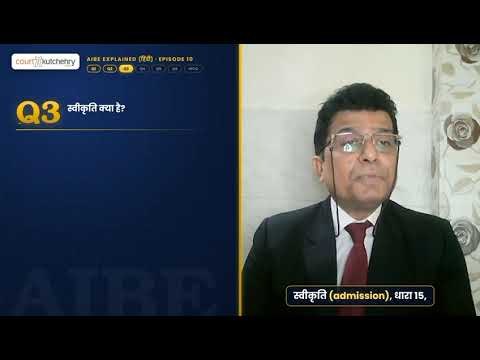
Q3 (प्रश्न 3): What Is an Admission?
An admission (BSA 15, old 17) is a statement, oral, documentary or electronic, that suggests an inference about a fact in issue or a relevant fact, made by a party or certain persons connected with him. It can generally be proved against the maker, not in his own favour. It is strong evidence, but not conclusive proof.
Q4 (प्रश्न 4): When Is a Confession Inadmissible?
A confession is a special kind of admission: an accused admits the offence. The BSA keeps three walls around it, and one door through them:
- Inducement, threat or promise (BSA 22, old 24): a confession caused this way is irrelevant.
- Police (BSA 23, old 25 and 26): a confession to a police officer, or in police custody unless made in the immediate presence of a Magistrate, cannot be proved against the accused.
- Co-accused (BSA 24, old 30): the confession of one accused can only be “taken into consideration” against another tried jointly for the same offence.
- The door: proviso to BSA 23(2) (old 27): information from an accused in custody that leads to the discovery of a fact can be proved, but only so much of it as distinctly relates to the fact discovered.
Two cases from the episode explain the door and the third wall. In Pulukuri Kotayya v. King Emperor (Privy Council, 1947), the Privy Council held that only the part of the statement that leads to the discovery is admissible, not the confession around it. In Kashmira Singh v. State of Madhya Pradesh, (1952) 03 SC CK 0002, the Supreme Court held that a co-accused’s confession is not substantive evidence; the court first weighs the other evidence and uses the confession only to lend assurance.
Remember this line: a confession to the police stays out; only the discovery it leads to comes in.
Q5 (प्रश्न 5): Dying Declarations and Conviction
A statement by a person about the cause of his death, or the circumstances of the transaction that caused it, is relevant under BSA 26 (old 32) whenever the cause of that death is in question. Under Indian law, the person need not have been expecting death at the time.
- Khushal Rao v. State of Bombay, (1957) 09 SC CK 0020: there is no absolute rule that a dying declaration needs corroboration; if true and voluntary, it can alone support a conviction.
- Laxman v. State of Maharashtra (Constitution Bench, 2002): a doctor’s certificate of fitness is not essential; what matters is that the person recording it was satisfied that the declarant was in a fit state of mind.
Q6 (प्रश्न 6): The Hearsay Rule
BSA 55 (old 60) says oral evidence must always be direct: a fact that could be seen must be proved by the person who saw it, a fact that could be heard by the person who heard it. Hearsay (अनुश्रुत साक्ष्य) is therefore excluded, except where the law makes an exception, the dying declaration being the best-known.
Five Exam Traps from This Episode
- The definition of evidence is now BSA 2(1)(e), not Section 3.
- The discovery rule is no longer a separate section: it is the proviso to BSA 23(2).
- Old Sections 25 and 26 are combined in BSA 23.
- Dying declaration is BSA 26, not 32; expectation of death is not required.
- A co-accused’s confession (BSA 24) can support, but cannot by itself found, a conviction.
Key Takeaways
- The BSA has replaced the Evidence Act from 1 July 2024, with 170 sections and full recognition of electronic records.
- Relevancy runs through BSA 3 to 9: res gestae (4), motive and conduct (6), conspirators (8), alibi (9).
- Admission: BSA 15; confessions: BSA 22, 23 and 24, with the discovery proviso in 23(2) (Pulukuri Kotayya).
- Dying declaration: BSA 26; it can alone found a conviction (Khushal Rao); fitness certificate not essential (Laxman).
- Oral evidence must be direct: BSA 55.
Frequently Asked Questions
What is संस्वीकृति in English?
Confession. स्वीकृति is admission. Every confession is an admission, but not every admission is a confession.
Which BSA section replaces old Section 27?
The proviso to Section 23(2) of the BSA.
Is a dying declaration valid if the person did not expect to die?
Yes. Under BSA 26 (old 32), expectation of death is not required.
Can a court convict only on the confession of a co-accused?
No. Under Kashmira Singh, it is not substantive evidence; it can only lend assurance to other evidence.
Is the episode in Hindi or English?
This upload is in Hindi. The English version of Episode 10 is linked above.
Where can I watch the full explanation?
Watch the Hindi episode in 10 minutes: https://youtu.be/ht9l7tKCN5c.
Conclusion
The first part of the law of evidence asks two questions: is the fact relevant, and is the statement admissible? The Hindi episode answers both with the new BSA number and the old one side by side. Revise from the glossary table, and you will recognise the concept whichever language the question is set in.
The next episode covers documents, electronic records, burden of proof, presumptions, estoppel and the examination of witnesses.
▶ Watch the video: साक्ष्य विधि भाग 1: सुसंगति, स्वीकृति, संस्वीकृति, मृत्युकालिक कथन (Evidence Act → BSA) | Ep 10
▶ Watch in English: Evidence Part 1: Relevancy, Res Gestae, Admissions, Confessions & Dying Declarations Ep 10
📖 Read the full article: Evidence Part 1: Relevancy, Res Gestae, Admissions, Confessions and Dying Declarations (BSA) | AIBE Explained Ep 10
Research Judgments Like These on CourtKutchehry
Every judgment cited in this article, and lakhs more, can be searched and read on CourtKutchehry. Searching and reading judgments is free. A membership adds unlimited summaries, all related judgments, original court PDF downloads, bookmarks, notes and the CourtKutchehry AI assistant.
| Membership | Price | Works out to | AI credits |
|---|---|---|---|
| Monthly (1 month) | ₹599 | ₹599 / month | 1,000 / month |
| Quarterly (3 months) · Save 16% | ₹1,499 | ₹499.67 / month | 1,100 / month |
| Six-monthly (6 months) · Save 33% | ₹2,399 | ₹399.83 / month | 1,200 / month |
| Yearly (12 months) · Save 44% · Best value | ₹3,999 | ₹333.25 / month | 1,300 / month |
Every plan is a one-off purchase for a fixed period: nothing auto-renews and no card is kept on file. Prices are exclusive of applicable tax, which is added at checkout. Extra AI chat credits can be topped up from ₹99. A free verified account gets 5 summaries and 50 AI trial credits.
Prices are as displayed on courtkutchehry.com on 20 November 2026 and are subject to change without notice. Please check the pricing page for the current plans and offers.
For more judgments, legal opinions and case analysis, visit courtkutchehry.com
Visit CourtKutchehry →