
Watch the Video
In this 10-minute video, Episode 10 of the CourtKutchehry series “AIBE Explained”, the episode covers the first part of the Law of Evidence, now the Bharatiya Sakshya Adhiniyam, 2023, in six questions, giving the BSA section first and the old Evidence Act section alongside it, and then solves five practice questions. This article explains each point in writing.
From the Evidence Act to the BSA
The Law of Evidence carries 8 marks in the AIBE. From 1 July 2024, the Indian Evidence Act, 1872 has been replaced by the Bharatiya Sakshya Adhiniyam, 2023 (BSA). The structure is the same, with 170 sections against the old 167. The main change is that electronic and digital records are now fully treated as documents. The episode covers the first part of the subject in six questions, giving the BSA section first and the old Evidence Act section alongside it.
Q1. What Is Evidence?
BSA 2(1)(e) (old Section 3) defines evidence in two classes:
- oral evidence: statements the court permits or requires witnesses to make before it, and these now include statements given electronically; and
- documentary evidence: documents, including electronic or digital records, produced for the inspection of the court.
The BSA therefore treats a statement recorded through video-conferencing, an email or a server log as evidence in its own right, not as an afterthought.
Q2. The Chain of Relevancy
The law of evidence first asks: is this fact relevant? The key relevancy provisions are:
| Rule | BSA | Old Act |
|---|---|---|
| Facts in issue and relevant facts | 3 | 5 |
| Res gestae: facts forming part of the same transaction | 4 | 6 |
| Motive, preparation and previous or subsequent conduct | 6 | 8 |
| Things said or done by a conspirator in reference to the common design | 8 | 10 |
| Facts inconsistent with relevant facts, including alibi | 9 | 11 |
| Opinion of experts, now including the Examiner of Electronic Evidence | 39 | 45 |
| Character | 46 to 50 | 52 to 55 |
Res gestae covers facts so connected with the fact in issue that they form part of the same transaction, such as a cry for help at the moment of an attack. A plea of alibi is relevant because it is inconsistent with the presence of the accused at the scene.
Q3. What Is an Admission?
An admission (BSA 15, old 17) is a statement, oral, documentary or electronic, which suggests any inference as to a fact in issue or relevant fact, made by a party or certain persons connected with him.
Under BSA 19 (old 21), admissions are relevant and may be proved against the person who makes them, but not ordinarily by or on his behalf, except in the limited cases the section allows. An admission is not conclusive proof, but it may operate as an estoppel.
Q4. When Is a Confession Inadmissible?
A confession is an admission by an accused that he committed the offence. The BSA keeps the old safeguards:
- Confession caused by inducement, threat, coercion or promise from a person in authority is irrelevant: BSA 22 (old 24).
- Confession to a police officer, or made while in police custody unless made in the immediate presence of a Magistrate, cannot be proved against the accused: BSA 23 (old 25 and 26).
- Information leading to discovery: under the proviso to BSA 23(2) (old 27), so much of the information given by an accused in police custody as distinctly relates to the fact thereby discovered may be proved.
- Confession of a co-accused: BSA 24 (old 30), may be taken into consideration against another accused tried jointly for the same offence.
- Judicial confession recorded by a Magistrate: BNSS 183 (CrPC 164).
The scope of the discovery proviso was settled by Pulukuri Kotayya v. King Emperor, (1946) 12 BOM CK 0014. The Privy Council held that only the part of the statement that relates distinctly to the discovery is admissible, for example “I hid the knife under the stone”. A statement such as “with which I stabbed the deceased” is not admissible under this provision.
On the confession of a co-accused, Kashmira Singh v. State of Madhya Pradesh, (1952) 03 SC CK 0002 held that it is not substantive evidence. The court must first consider the other evidence, and may use the co-accused’s confession only to lend assurance to a conclusion already reached on that evidence.
Remember this line: a co-accused’s confession can support a conviction, but it cannot found one.
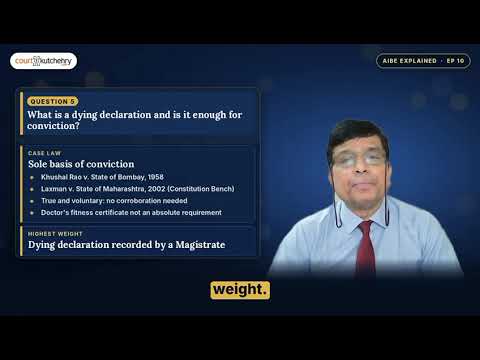
Q5. Dying Declarations and Conviction
A statement by a person as to the cause of his death, or the circumstances of the transaction resulting in his death, is relevant under BSA 26(a) (old 32(1)), in any proceeding in which the cause of his death is in question. Unlike English law, it does not matter whether the person was under expectation of death when the statement was made.
- Khushal Rao v. State of Bombay, (1957) 09 SC CK 0020: there is no absolute rule that a dying declaration must be corroborated. If the court is satisfied that it is true and voluntary, it can by itself found a conviction.
- Laxman v. State of Maharashtra (Constitution Bench, 2002): a doctor’s certificate that the declarant was in a fit state of mind is not essential. What matters is that the person recording the statement was satisfied that the declarant was in a fit mental condition.
Q6. The Rule against Hearsay
BSA 55 (old 60) requires that oral evidence must in all cases be direct: a fact that could be seen must be proved by a witness who saw it, a fact that could be heard by one who heard it, and so on. That is the rule against hearsay. Dying declarations, res gestae and admissions are among its recognised exceptions.
Some facts need no proof at all:
- Facts judicially noticeable: BSA 51 and 52 (old 56 and 57).
- Facts admitted by the parties: BSA 53 (old 58).
AIBE Practice Questions
The video ends with five practice questions. Try these on the same lines:
- Which BSA section deals with res gestae? Answer: Section 4 (old 6).
- A confession to a police officer is barred by which BSA section? Answer: Section 23 (old 25).
- Which case explained the discovery provision now in the proviso to BSA 23(2)? Answer: Pulukuri Kotayya v. King Emperor.
- Which BSA provision covers dying declarations? Answer: Section 26(a) (old 32(1)).
- Oral evidence must be direct under which BSA section? Answer: Section 55 (old 60).
Key Takeaways
- The BSA has 170 sections; evidence under BSA 2(1)(e) includes electronic statements and records.
- Relevancy: BSA 3, 4, 6, 8, 9 (old 5, 6, 8, 10, 11); experts BSA 39; character BSA 46 to 50.
- Admissions: BSA 15 and 19; confessions: BSA 22, 23, 24, with the discovery proviso in BSA 23(2) (Pulukuri Kotayya).
- A co-accused’s confession is not substantive evidence (Kashmira Singh).
- Dying declaration: BSA 26(a); it can alone found a conviction (Khushal Rao), and a doctor’s certificate is not essential (Laxman).
Frequently Asked Questions
Is the Indian Evidence Act still in force?
It has been replaced by the Bharatiya Sakshya Adhiniyam, 2023 from 1 July 2024. The principles are largely the same, but the section numbers have changed.
Can a confession made to the police ever be used?
The confession itself cannot be proved against the accused, but information leading to the discovery of a fact can be proved to the extent it distinctly relates to the fact discovered (proviso to BSA 23(2)).
Does a dying declaration need corroboration?
Not as a rule of law. Khushal Rao v. State of Bombay held that a true and voluntary dying declaration can be the sole basis of conviction.
Must the declarant expect to die?
No. Under Indian law, the statement is relevant whether or not the person was under expectation of death when it was made.
What is the evidentiary value of a co-accused’s confession?
It may be taken into consideration under BSA 24, but it is not substantive evidence and can only lend assurance to other evidence (Kashmira Singh v. State of Madhya Pradesh).
Where can I watch the full explanation?
Watch the full explanation in 10 minutes: https://youtu.be/BPdKTdQZ9L4.
Conclusion
The first half of the law of evidence answers two questions: is the fact relevant, and is the statement admissible? Relevancy, admissions, confessions and dying declarations are the backbone of every criminal trial, and the BSA keeps their structure while renumbering it and bringing electronic records fully inside the law.
Learn each rule as a pair of numbers, BSA and old Act, with its leading case. The next episode completes the subject with documents, electronic records, burden of proof, presumptions, estoppel and witnesses.
▶ Watch the video: Evidence Part 1: Relevancy, Res Gestae, Admissions, Confessions & Dying Declarations Ep 10
📖 Read more: Supreme Court: Dying Declaration Valid Even If Death Is Not Imminent
Research Judgments Like These on CourtKutchehry
Every judgment cited in this article, and lakhs more, can be searched and read on CourtKutchehry. Searching and reading judgments is free. A membership adds unlimited summaries, all related judgments, original court PDF downloads, bookmarks, notes and the CourtKutchehry AI assistant.
| Membership | Price | Works out to | AI credits |
|---|---|---|---|
| Monthly (1 month) | ₹599 | ₹599 / month | 1,000 / month |
| Quarterly (3 months) · Save 16% | ₹1,499 | ₹499.67 / month | 1,100 / month |
| Six-monthly (6 months) · Save 33% | ₹2,399 | ₹399.83 / month | 1,200 / month |
| Yearly (12 months) · Save 44% · Best value | ₹3,999 | ₹333.25 / month | 1,300 / month |
Every plan is a one-off purchase for a fixed period: nothing auto-renews and no card is kept on file. Prices are exclusive of applicable tax, which is added at checkout. Extra AI chat credits can be topped up from ₹99. A free verified account gets 5 summaries and 50 AI trial credits.
Prices are as displayed on courtkutchehry.com on 20 November 2026 and are subject to change without notice. Please check the pricing page for the current plans and offers.
For more judgments, legal opinions and case analysis, visit courtkutchehry.com
Visit CourtKutchehry →