
Watch the Video
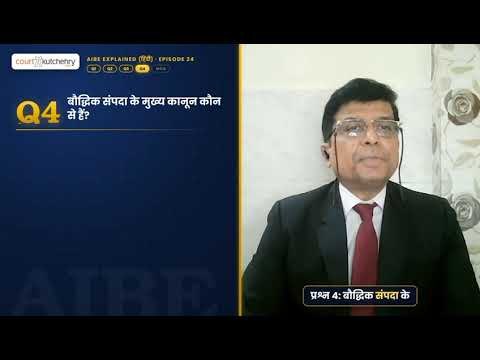
In this 13-minute video, Episode 24 of the CourtKutchehry series “AIBE Explained” (Hindi), the episode explains three small AIBE subjects in Hindi, in four questions: पर्यावरण कानून (Environmental Law), साइबर कानून (Cyber Law) and बौद्धिक संपदा अधिकार (Intellectual Property Rights), and then solves five practice questions in the style of past AIBE papers. This English article for Hindi-medium aspirants turns it into Act-and-year tables, a doctrine-to-case drill and a Hindi–English glossary.
Three Subjects, 2 Marks Each, 6 Marks in All
The episode begins with the marks: Environmental Law, Cyber Law and IPR each carry 2 marks in the AIBE, so this one episode covers 6 marks. As the episode explains, questions on these subjects are predictable. They ask for:
- the name of the Act,
- its year,
- the authority it creates, and
- one or two landmark cases.
So revise four facts per law.
Q1. The Framework of Environmental Law: Act and Year
The constitutional base is Article 48A (a Directive Principle) and Article 51A(g) (a Fundamental Duty), both inserted by the 42nd Amendment in 1976, and the right to a clean environment read into Article 21. In Subhash Kumar v. State of Bihar, (1991) 01 SC CK 0015, the Supreme Court recognised the right to pollution-free water and air as part of the right to life.
| Act | Year | One fact to remember |
|---|---|---|
| Wild Life (Protection) Act | 1972 | Protected areas and species |
| Water (Prevention and Control of Pollution) Act | 1974 | Central and State Pollution Control Boards |
| Air (Prevention and Control of Pollution) Act | 1981 | The Boards’ work extended to air |
| Environment (Protection) Act | 1986 | Umbrella law after the Bhopal gas tragedy |
| Public Liability Insurance Act | 1991 | Insurance for hazardous substances |
| Biological Diversity Act | 2002 | National Biodiversity Authority |
| National Green Tribunal Act | 2010 | राष्ट्रीय हरित अधिकरण (NGT) |
Q2. Environmental Doctrines: The Matching Drill
The AIBE typically gives a doctrine and asks for the case, or the other way round. Learn these pairs:
| Doctrine | Case |
|---|---|
| Absolute liability (पूर्ण दायित्व) | M.C. Mehta v. Union of India (oleum gas leak, 1987) |
| Polluter pays and precautionary principle (प्रदूषक भुगतान करे, एहतियाती सिद्धांत) | Vellore Citizens Welfare Forum v. Union of India, (1996) 08 SC CK 0114 |
| Public trust doctrine (लोक न्यास सिद्धांत) | M.C. Mehta v. Kamal Nath, (1996) 12 SC CK 0025 (reported 1997) |
| Protecting the Taj from industrial pollution | M.C. Mehta (Taj Trapezium Matter) v. Union of India, (1996) 12 SC CK 0162 (reported 1997) |
| “Forest” in its dictionary meaning | T.N. Godavarman Thirumulpad v. Union of India (orders from 1996) |
| Sustainable development (सतत विकास) and large projects | Narmada Bachao Andolan v. Union of India, (2000) 10 SC CK 0040 |
Exam trap: there are many “M.C. Mehta” cases; match the subject, not just the name.
Q3. The Information Technology Act, 2000: Sections to Memorise
- Sections 43 and 43A – civil liability (damage to computer systems; failure to protect sensitive personal data).
- Sections 66 to 67B – offences, from computer-related offences to obscene and sexually explicit material.
- Section 69A – blocking of websites.
- Section 79 – intermediary liability (मध्यस्थ दायित्व) and safe harbour.
The cases: in Shreya Singhal v. Union of India (2015), the Supreme Court struck down Section 66A as violating free speech under Article 19(1)(a), upheld Section 69A and read down Section 79. In K.S. Puttaswamy v. Union of India (2017), a nine-judge bench declared privacy a fundamental right. The Digital Personal Data Protection Act, 2023 followed, establishing the Data Protection Board of India.
Remember this line: 66A struck down, 69A upheld, 79 read down – all in Shreya Singhal.
Q4. Intellectual Property: Terms of Protection
| Right | Term | Key section or fact |
|---|---|---|
| Patent (पेटेंट) | 20 years from the date of filing | Section 3(d); compulsory licence (अनिवार्य लाइसेंस) Section 84 |
| Copyright (कॉपीराइट), literary work | Author’s lifetime + 60 years | Fair dealing (उचित व्यवहार) Section 52 |
| Trade mark | 10 years, renewable indefinitely | Trade Marks Act, 1999 |
| Design | 10 + 5 years | Designs Act, 2000 |
| Geographical indication | – | India’s first GI: Darjeeling tea |
The two IPR cases: Novartis AG v. Union of India, (2013) 04 SC CK 0085, on Section 3(d) and the refusal of a patent for a new form of a known substance without enhanced efficacy; and R.G. Anand v. Delux Films, (1978) 08 SC CK 0028: there is no copyright in an idea, only in its expression.
The IPAB was abolished in 2021; its jurisdiction went to the High Courts.
Key Legal Terms: Hindi ↔ English
| Hindi (as used in the episode) | English |
|---|---|
| पर्यावरण कानून | Environmental law |
| साइबर कानून | Cyber law |
| बौद्धिक संपदा अधिकार | Intellectual property rights |
| प्रदूषक भुगतान करे | Polluter pays |
| एहतियाती सिद्धांत | Precautionary principle |
| पूर्ण दायित्व | Absolute liability |
| लोक न्यास सिद्धांत | Public trust doctrine |
| सतत विकास | Sustainable development |
| राष्ट्रीय हरित अधिकरण | National Green Tribunal |
| मध्यस्थ दायित्व | Intermediary liability |
| अनिवार्य लाइसेंस | Compulsory licence |
| उचित व्यवहार | Fair dealing |
Key Takeaways
- Revise each law as Act, year, authority, case: that is how the 6 marks are asked.
- Environment: Articles 48A, 51A(g) (42nd Amendment) and Article 21; Water 1974, Air 1981, EPA 1986, NGT 2010.
- Doctrine-to-case: oleum gas (absolute liability), Vellore (polluter pays, precaution), Kamal Nath (public trust).
- IT Act: 43/43A civil, 66–67B offences, 69A blocking, 79 intermediaries; Shreya Singhal struck down 66A.
- IPR: patent 20 years, copyright life + 60, trade mark 10 renewable, design 10 + 5; first GI Darjeeling tea; IPAB abolished 2021.
Frequently Asked Questions
What does “लोक न्यास सिद्धांत” mean?
The public trust doctrine: the State holds natural resources such as rivers, forests and the seashore as a trustee for the public. It was applied in M.C. Mehta v. Kamal Nath.
Which Amendment added Articles 48A and 51A(g)?
The 42nd Amendment, in 1976.
Which IT Act section was struck down, and in which case?
Section 66A, in Shreya Singhal v. Union of India (2015).
What is the term of a patent in India?
20 years from the date of filing the application.
Where can I watch the full explanation?
Watch it here: https://youtu.be/j2xD5i0mucg.
Conclusion
Three small subjects can be scored in full with one method: the Act, the year, the authority and the case.
The next and final episode of the series is a rapid-fire review of 25 AIBE-style questions across all 19 subjects.
▶ Watch the video: पर्यावरण कानून, साइबर कानून और बौद्धिक संपदा अधिकार (IPR) | AIBE Explained (हिंदी) Ep 24
▶ Watch in English: Environmental Law, Cyber Law (IT Act) & IPR for AIBE: NGT, Polluter Pays, Section 66A, Patents Ep 24
📖 Read the full article: Environmental Law, IT Act and IPR for AIBE: Polluter Pays, Absolute Liability, Section 66A, Patents and Copyright Explained (Ep 24)
Research Judgments Like These on CourtKutchehry
Every judgment cited in this article, and lakhs more, can be searched and read on CourtKutchehry. Searching and reading judgments is free. A membership adds unlimited summaries, all related judgments, original court PDF downloads, bookmarks, notes and the CourtKutchehry AI assistant.
| Membership | Price | Works out to | AI credits |
|---|---|---|---|
| Monthly (1 month) | ₹599 | ₹599 / month | 1,000 / month |
| Quarterly (3 months) · Save 16% | ₹1,499 | ₹499.67 / month | 1,100 / month |
| Six-monthly (6 months) · Save 33% | ₹2,399 | ₹399.83 / month | 1,200 / month |
| Yearly (12 months) · Save 44% · Best value | ₹3,999 | ₹333.25 / month | 1,300 / month |
Every plan is a one-off purchase for a fixed period: nothing auto-renews and no card is kept on file. Prices are exclusive of applicable tax, which is added at checkout. Extra AI chat credits can be topped up from ₹99. A free verified account gets 5 summaries and 50 AI trial credits.
Prices are as displayed on courtkutchehry.com on 20 November 2026 and are subject to change without notice. Please check the pricing page for the current plans and offers.
For more judgments, legal opinions and case analysis, visit courtkutchehry.com
Visit CourtKutchehry →