
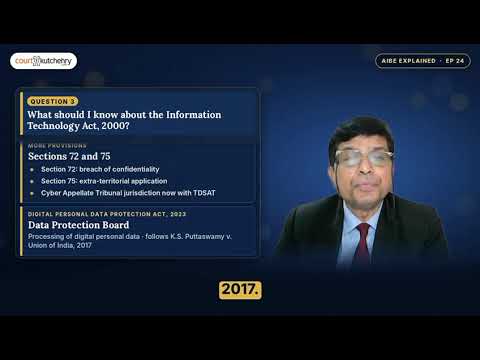
Watch the Video
In this 11-minute video, Episode 24 of the “AIBE Explained” series, the episode covers three subjects that carry 2 marks each in the All India Bar Examination: Environmental Law, Cyber Law and Intellectual Property Rights. That is 6 marks in a single episode. He takes them in four questions and then solves five practice questions in the style of past AIBE papers. This article sets out the same law in writing, with the cases linked to CourtKutchehry where available.
Three Small Subjects, Six Predictable Marks
As the video puts it, the questions on these subjects are predictable: the name of the Act, its year, the authority it creates, and one or two landmark cases. A short table of statutes and a dozen cases will carry most of these 6 marks.
Q1: The Framework of Environmental Law in India
The constitutional base
The 42nd Amendment (1976) added two provisions:
- Article 48A (a Directive Principle): the State shall endeavour to protect and improve the environment and to safeguard forests and wildlife.
- Article 51A(g) (a Fundamental Duty): every citizen must protect and improve the natural environment, including forests, lakes, rivers and wildlife, and have compassion for living creatures.
The Supreme Court then read the right to a clean environment into the right to life under Article 21. In Subhash Kumar vs State of Bihar, (1991) 01 SC CK 0015, the Court recognised that the right to life includes the right to enjoy pollution-free water and air.
The statutes to remember, with years
| Statute | Year | What to remember |
|---|---|---|
| Wild Life (Protection) Act | 1972 | Sanctuaries and national parks |
| Water (Prevention and Control of Pollution) Act | 1974 | Created the Central and State Pollution Control Boards |
| Forest (Conservation) Act | 1980 | Central approval for diverting forest land; renamed in 2023 as the Van (Sanrakshan Evam Samvardhan) Adhiniyam, 1980 |
| Air (Prevention and Control of Pollution) Act | 1981 | Extended the Boards’ work to air pollution |
| Environment (Protection) Act | 1986 | The umbrella law passed after the Bhopal gas tragedy |
| Public Liability Insurance Act | 1991 | Compulsory insurance for hazardous substances |
| Biological Diversity Act | 2002 | National Biodiversity Authority; follows the Rio convention |
| National Green Tribunal Act | 2010 | Created the NGT to decide substantial environmental questions |
Also asked: Stockholm (1972), Rio (1992), Kyoto (1997) and Paris (2015).
Q2: Environmental Doctrines and Landmark Cases
The AIBE usually asks you to match a doctrine with its case.
- Absolute liability. In M.C. Mehta v. Union of India (the oleum gas leak case, (1987) 1 SCC 395), a Constitution Bench held that an enterprise engaged in a hazardous or inherently dangerous activity is absolutely liable for the harm it causes, without the exceptions allowed under the English rule in Rylands v. Fletcher.
- Polluter pays and the precautionary principle. In Vellore Citizens Welfare Forum vs Union of India, (1996) 08 SC CK 0114, the Court dealt with tanneries in Tamil Nadu discharging untreated effluent and held both principles to be part of the law of the land; the burden is on the industry to show that its activity is environmentally benign.
- Public trust. In M.C. Mehta vs Kamal Nath, (1996) 12 SC CK 0025, the Court held that the State holds natural resources such as rivers, forests and the seashore as a trustee for the public, and declared the public trust doctrine to be part of the law of the land.
- Sustainable development. Development and environment must be balanced, as in Narmada Bachao Andolan vs Union of India, (2000) 10 SC CK 0040, where the Court allowed construction of the Sardar Sarovar dam to continue and held that courts should not sit in appeal over policy decisions on large projects.
- Protection of heritage and forests. In M.C. Mehta (Taj Trapezium Matter) vs Union of India, (1996) 12 SC CK 0162, the Court directed industries in the Taj Trapezium Zone to switch to natural gas or relocate. In T.N. Godavarman Thirumulpad v. Union of India, a continuing case with orders since 1996, the Court gave “forest” its dictionary meaning, whatever the ownership of the land.
Remember this line: Oleum gives absolute liability, Vellore gives polluter pays and precaution, Kamal Nath gives public trust.
Q3: The Information Technology Act, 2000
Recognition and civil liability
- Sections 4 and 5: legal recognition of electronic records and electronic signatures.
- Section 43: compensation for unauthorised access, downloading data or introducing a virus.
- Section 43A: compensation where a body corporate is negligent in protecting sensitive personal data. The Digital Personal Data Protection Act, 2023 provides for this section to be omitted once the relevant part of that Act takes effect.
- Section 46: claims up to ₹5 crore go to an adjudicating officer; larger claims go to the competent court.
Offences: Sections 65 to 67B
After Section 65 (tampering with source documents) and Section 66 (computer-related offences), the most asked are identity theft (Section 66C), cheating by personation using a computer (66D), violation of privacy (66E), cyber terrorism (Section 66F), publishing obscene material in electronic form (Section 67), sexually explicit material (67A) and child sexual abuse material (67B).
The constitutional cases
In Shreya Singhal v. Union of India (2015), the Supreme Court struck down Section 66A (sending “grossly offensive” or “menacing” messages) as vague and violative of Article 19(1)(a). In the same judgment it upheld Section 69A (blocking of websites, with procedural safeguards) and read down Section 79, so that an intermediary loses its safe harbour only when it fails to act after a court order or a government notification.
In K.S. Puttaswamy v. Union of India (2017), a nine-judge bench held privacy to be a fundamental right. The Digital Personal Data Protection Act, 2023 followed, creating the Data Protection Board of India; under the DPDP Rules, 2025 it comes into force in phases up to May 2027.
Q4: The Main Intellectual Property Statutes
| Right | Statute | Term and key sections |
|---|---|---|
| Patent | Patents Act, 1970 | 20 years from the date of filing; Section 3(d) bars patents on new forms of known substances without enhanced efficacy; compulsory licence under Section 84 |
| Copyright | Copyright Act, 1957 | Literary works: author’s lifetime plus 60 years; fair dealing under Section 52 |
| Trade mark | Trade Marks Act, 1999 | 10 years, renewable indefinitely for further 10-year periods |
| Design | Designs Act, 2000 | 10 years, extendable by 5 years |
| Geographical indication | GI of Goods (Registration and Protection) Act, 1999 | India’s first GI: Darjeeling tea |
Two cases are standard. In Novartis AG vs Union of India, (2013) 04 SC CK 0085, the Supreme Court refused a patent for the beta crystalline form of imatinib mesylate (Glivec) under Section 3(d) for want of enhanced therapeutic efficacy. In R.G. Anand vs Delux Films, (1978) 08 SC CK 0028, the Court held that there is no copyright in an idea, only in its expression; the test is whether the viewer gets an unmistakable impression that the later work is a copy.
Finally, the Intellectual Property Appellate Board (IPAB) was abolished by the Tribunals Reforms Act, 2021, and its jurisdiction went to the High Courts.
How the AIBE Asks These Questions
The video closes with five practice questions in the style of past papers. Typical one-liners: which case laid down absolute liability, which IT Act section was struck down in 2015, what is the term of a patent, and which was India’s first GI.
Key Takeaways
- Environment rests on Articles 48A, 51A(g) and 21.
- Match the doctrines: absolute liability (oleum gas), polluter pays and precaution (Vellore), public trust (Kamal Nath).
- IT Act: civil liability under Sections 43, 43A and 46; offences from 65 to 67B; 66A struck down, 69A upheld, 79 read down in Shreya Singhal.
- Patent 20 years, copyright life + 60, trade mark 10 renewable, design 10 + 5; first GI Darjeeling tea.
- The IPAB was abolished in 2021.
Frequently Asked Questions
Which constitutional provisions deal with the environment?
Articles 48A and 51A(g), added by the 42nd Amendment in 1976, and the right to a clean environment under Article 21.
Who laid down the polluter pays principle in India?
Vellore Citizens Welfare Forum (1996), which also adopted the precautionary principle.
Is Section 66A of the IT Act still law?
No. It was struck down in Shreya Singhal (2015).
What is Section 3(d) of the Patents Act?
A new form of a known substance is not an invention unless it shows enhanced efficacy, as applied in Novartis (2013).
Where can I watch the full explanation?
Watch the full explanation in 11 minutes: https://youtu.be/xYfKqaiYJdU.
Conclusion
Environmental Law, Cyber Law and IPR are 6 easy marks if you prepare them the way the paper asks: the Act, the year, the authority and the case. Revise the doctrine-to-case pairs until they are automatic.
The linked judgments can be read in full on CourtKutchehry.
▶ Watch the video: Environmental Law, Cyber Law (IT Act) & IPR for AIBE: NGT, Polluter Pays, Section 66A, Patents Ep 24
📖 Read more: Polluter Pays Needs Proof of Pollution: Supreme Court Sets Aside NGT Order Over Yamuna Floodplain Festival
Research Judgments Like These on CourtKutchehry
Every judgment cited in this article, and lakhs more, can be searched and read on CourtKutchehry. Searching and reading judgments is free. A membership adds unlimited summaries, all related judgments, original court PDF downloads, bookmarks, notes and the CourtKutchehry AI assistant.
| Membership | Price | Works out to | AI credits |
|---|---|---|---|
| Monthly (1 month) | ₹599 | ₹599 / month | 1,000 / month |
| Quarterly (3 months) · Save 16% | ₹1,499 | ₹499.67 / month | 1,100 / month |
| Six-monthly (6 months) · Save 33% | ₹2,399 | ₹399.83 / month | 1,200 / month |
| Yearly (12 months) · Save 44% · Best value | ₹3,999 | ₹333.25 / month | 1,300 / month |
Every plan is a one-off purchase for a fixed period: nothing auto-renews and no card is kept on file. Prices are exclusive of applicable tax, which is added at checkout. Extra AI chat credits can be topped up from ₹99. A free verified account gets 5 summaries and 50 AI trial credits.
Prices are as displayed on courtkutchehry.com on 20 November 2026 and are subject to change without notice. Please check the pricing page for the current plans and offers.
For more judgments, legal opinions and case analysis, visit courtkutchehry.com
Visit CourtKutchehry →