
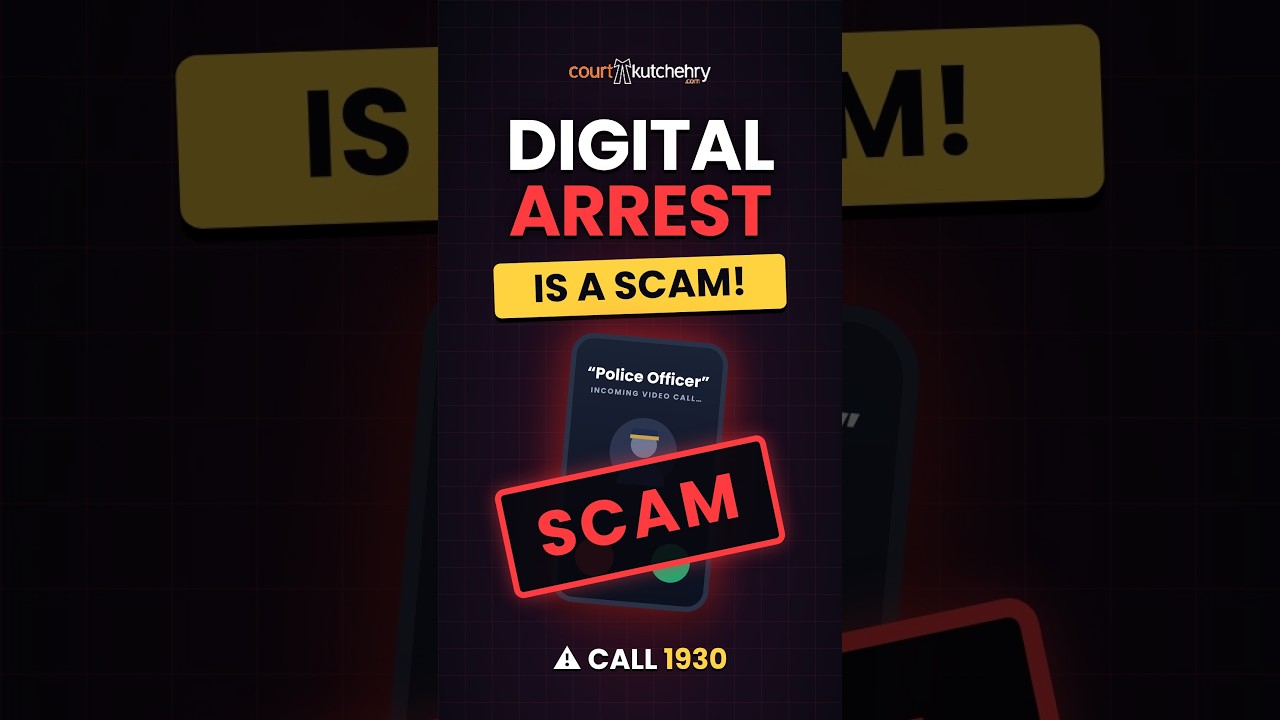
Watch the Video
In this 2-minute video, Advocate Vinayak Pawar explains in simple words what the Supreme Court has said about “digital arrest” scams, why there is no such thing as a digital arrest in Indian law, what a real arrest looks like and your rights, and exactly what to do if you get such a call or have already lost money. This article covers the same points in writing.
The Fake Video Call Scam
A video call. A man in police uniform. “A parcel in your name had drugs. You are under digital arrest. Stay on the call. Transfer money to a safe account to clear your name.” Sometimes there is a fake courtroom, a fake judge and a fake order on official-looking letterhead. Victims, often senior citizens, are kept on camera for hours or days while their savings are emptied.
Stop. This is a scam.
What the Supreme Court Has Said
The Supreme Court has taken these frauds up on its own, in In Re: Victims of Digital Arrest Related to Forged Documents, and now treats them as among the most serious crimes in the country:
- Late 2025: on 1 December 2025, the Court handed the nationwide investigation of digital arrest scams to the CBI, and asked the States to give their consent.
- July 2026: the Court called these scams among the worst kinds of crime, especially against senior citizens, said bail should be granted only on extraordinary grounds, and suggested that “digital arrest” be made a separate offence with harsher punishment.
- 29 October 2026: the Court urged the RBI to require banks to compensate victims where the bank’s own negligence or failure of due diligence is established.
There Is No Such Thing as a “Digital Arrest”
No police, CBI or ED officer, and no judge, will ever arrest you on a video call. An arrest is a physical act, and the law surrounds it with safeguards:
- You must be told the grounds of arrest (Article 22(1) of the Constitution; Section 47 of the BNSS).
- You have the right to consult a lawyer of your choice (Article 22(1)).
- You must be produced before a magistrate within 24 hours (Article 22(2); Section 58 of the BNSS).
- The police must prepare an arrest memo and inform a relative or friend, safeguards first laid down in D.K. Basu Vs State of West Bengal, (1996) 12 SC CK 0089, and now built into the BNSS.
And no genuine agency asks you to transfer money to “verify” it or to “clear your name”. No court arrests anyone, or demands money, over a WhatsApp message or a video call.
Remember this line: a real arrest happens in person, with reasons, a lawyer and a magistrate. A video call demanding money is a crime, not an arrest.
What Should You Do?
If you get such a call
- Cut the call.
- Never share OTPs or bank details.
- Speak to a family member immediately. Scammers rely on keeping you isolated.
If money has already gone
- Call the Cyber Helpline 1930 at once.
- Report on cybercrime.gov.in.
- Inform your bank. The first few hours matter most, because money can be frozen before it moves further.
Share This With Your Family
Please share the video with your parents and grandparents. Awareness is the strongest protection.
Key Takeaways
- There is no “digital arrest” in Indian law. It is a scam.
- The Supreme Court handed the nationwide probe to the CBI (December 2025), suggested a separate offence and bail only on extraordinary grounds (July 2026), and pressed for bank compensation (October 2026).
- A real arrest is physical: grounds of arrest, a lawyer, and a magistrate within 24 hours.
- Cut the call, never share OTPs, and call 1930 immediately if money is lost.
Frequently Asked Questions
Is “digital arrest” legal in India?
No. There is no such procedure in Indian law. Anyone claiming to arrest you on a video call is a fraudster.
Can the CBI, ED or police arrest someone on a video call?
No. An arrest is a physical act, with grounds of arrest, access to a lawyer and production before a magistrate within 24 hours.
What has the Supreme Court done about these scams?
It took up the issue on its own, handed the nationwide investigation to the CBI, suggested a separate offence with harsher punishment, and urged the RBI to make banks compensate victims where banks are negligent.
I have already transferred money. What now?
Call 1930, report on cybercrime.gov.in and inform your bank at once. Speed improves the chance of freezing the money.
Where can I watch the video?
Watch Advocate Vinayak Pawar explain it here: https://youtu.be/gLoPginFEN8.
Conclusion
“Digital arrest” works only because it frightens people into silence. The law is simple: no one can be arrested on a video call, and no real officer asks for money to clear your name. The Supreme Court is treating these scams as grave crimes.
Cut the call, talk to your family, and report at once on 1930.
▶ Watch the video: "Digital Arrest" Is a SCAM! Supreme Court’s Big Warning | Know Your Rights | Courtkutchehry
📖 Read more: There Is No Such Thing as a “Digital Arrest”: The Supreme Court’s Suo Motu War on India’s Fastest-Growing Fraud
Research Judgments Like These on CourtKutchehry
Every judgment cited in this article, and lakhs more, can be searched and read on CourtKutchehry. Searching and reading judgments is free. A membership adds unlimited summaries, all related judgments, original court PDF downloads, bookmarks, notes and the CourtKutchehry AI assistant.
| Membership | Price | Works out to | AI credits |
|---|---|---|---|
| Monthly (1 month) | ₹599 | ₹599 / month | 1,000 / month |
| Quarterly (3 months) · Save 16% | ₹1,499 | ₹499.67 / month | 1,100 / month |
| Six-monthly (6 months) · Save 33% | ₹2,399 | ₹399.83 / month | 1,200 / month |
| Yearly (12 months) · Save 44% · Best value | ₹3,999 | ₹333.25 / month | 1,300 / month |
Every plan is a one-off purchase for a fixed period: nothing auto-renews and no card is kept on file. Prices are exclusive of applicable tax, which is added at checkout. Extra AI chat credits can be topped up from ₹99. A free verified account gets 5 summaries and 50 AI trial credits.
Prices are as displayed on courtkutchehry.com on 20 November 2026 and are subject to change without notice. Please check the pricing page for the current plans and offers.
For more judgments, legal opinions and case analysis, visit courtkutchehry.com
Visit CourtKutchehry →