
Demonstrative Legacies: Balancing Specificity and Flexibility in Wills
When Bequests Point to a Fund but Remain General
How Succession Law Resolves Overlaps Between Specific and Demonstrative Legacies
By Vishwas Kumar
New Delhi: April 20, 2026:
The Indian Succession Act, 1925, provides a detailed framework for interpreting wills and legacies. Among its nuanced provisions are Sections 150 and 151, which deal with demonstrative legacies. These rules clarify how legacies tied to specific funds or assets should be treated, especially when they overlap with specific bequests. The law ensures fairness and predictability in succession, balancing the testator’s intent with the rights of beneficiaries.
Section 150: Defining Demonstrative Legacies
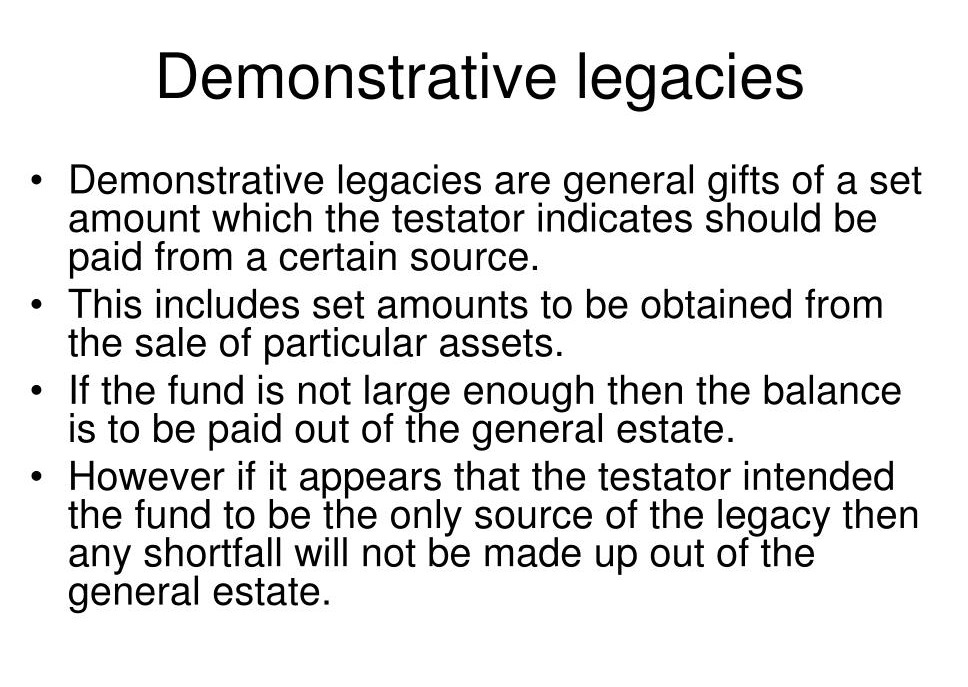
A demonstrative legacy arises when a testator bequeaths a certain sum of money or quantity of a commodity and refers to a particular fund or stock as the primary source of payment. Unlike a specific legacy, which gives the legatee ownership of a defined asset, a demonstrative legacy is essentially a general bequest with a designated fund for payment.
Key Distinction:
- Specific Legacy: Direct transfer of a particular asset (e.g., “my gold ring to B”).
- Demonstrative Legacy: A sum or commodity payable from a specified fund (e.g., “₹10,000 out of my estate at Ramnagar”).
The law recognizes demonstrative legacies as more flexible than specific ones. If the designated fund is insufficient, the balance is payable from the testator’s general assets.
Illustrations:
- If A bequeaths ₹1,000 to B, being part of a debt due from W, it is specific.
- If A bequeaths ₹1,000 to C, to be paid out of the debt due from W, it is demonstrative.
This distinction ensures clarity in execution and prevents disputes over whether a legacy is tied strictly to an asset or is payable more generally.
Section 151: Order of Payment
Section 151 addresses situations where both specific and demonstrative legacies are charged on the same fund. The rule is straightforward: specific legacies take priority. The portion specifically bequeathed must first be paid to the legatee, and the demonstrative legacy is satisfied from the residue of the fund. If the residue is insufficient, the shortfall is met from the general assets of the estate.
Illustration:
Suppose A bequeaths ₹1,000 to B, being part of a debt due from W, and also ₹1,000 to C, to be paid out of the same debt. If the debt amounts to only ₹1,500, B receives ₹1,000 (specific legacy), while C receives ₹500 from the debt and ₹500 from the general assets.
This rule reflects the principle that specific ownership rights must be honoured first, while demonstrative legacies retain flexibility by drawing upon general assets if necessary.
[Read Supreme Court probate rulings here. Click the link here: https://www.courtkutchehry.com/pages/blog/123-supreme-court-judgments-on-wills/]
Key Legal Principles
- Priority of Specific Legacies: Specific bequests are honoured before demonstrative ones.
- Flexibility of Demonstrative Legacies: They are payable from general assets if the designated fund is insufficient.
- Clarity in Drafting Wills: Testators must carefully distinguish between specific and demonstrative legacies to avoid disputes.
- Equitable Distribution: The law ensures that beneficiaries are not unfairly deprived due to fund shortages.
Practical Implications
- For Testators: Precision in language is crucial. Ambiguity between specific and demonstrative legacies can lead to litigation.
- For Executors: Executors must prioritize specific legacies and then allocate demonstrative ones, ensuring compliance with Section 151.
- For Beneficiaries: Understanding the distinction helps beneficiaries assert their rights, especially when funds are insufficient.
Broader Significance
These provisions highlight the Indian Succession Act’s commitment to balancing testamentary intent with beneficiary protection. By distinguishing between specific and demonstrative legacies, the law ensures that estates are distributed fairly and predictably. It also underscores the importance of careful estate planning to minimize conflicts.
[RESEARCH RESOURCES
EXTRACTS FROM BOOK, WILL WRITING SIMPLIFIED, By Dr Ravinder Kumar Anand. [📘 Buy Will Writing Simplified online: Amazon | Flipkart ]
OF DEMONSTRATIVE LEGACIES
150. Demonstrative legacy defined. — Where a testator bequeaths a certain sum of money, or a certain quantity of any other commodity and refers to a particular fund or stock so as to constitute the same the primary fund or stock out of which payment is to be made, the legacy is said to be demonstrative.
Explanation.—The distinction between a specific legacy and a demonstrative legacy consists in this, that—where specified property is given to the legatee, the legacy is specific; where the legacy is directed to be paid out of specified property, it is demonstrative.
Illustrations
(i) A bequeaths to B 1,000 rupees, being part of a debt due to him from W. He also bequeaths to C 1,000 rupees to be paid out of the debt due to him from W. The legacy to B is specific, the legacy to C is demonstrative.
(ii) A bequeaths to B—
“ten bushels of the corn which shall grow in my field of Green Acre”:
“80 chests of the indigo which shall be made at my factory of Rampur”:
“10,000 rupees out of my five per cent. promissory notes of the Central Government”: “An annuity of 500 rupees from my funded property”:
“1,000 rupees out of the sum of 2,000 rupees due to me by C”:
An annuity and directs it to be paid “out of the rents arising from my taluk of Ramnagar”.
(iii) A bequeaths to B—
“10,000 rupees out of my estate at Ramnagar,” or charges it on his estate at Ramnagar: “10,000 rupees, being my share of the capital embarked in a certain business.”
Each of these bequests is demonstrative.
151. Order of payment when legacy directed to be paid out of fund the subject of specific legacy.—Where a portion of a fund is specifically bequeathed and a legacy is directed to be paid out of the same fund, the portion specifically bequeathed shall first be paid to the legatee and the demonstrative legacy shall be paid out of the residue of the fund and, so far as the residue shall be deficient, out of the general assets of the testator.
Illustration
A bequeaths to B 1,000 rupees, being part of a debt due to him from W. He also bequeaths to C 1,000 rupees to be paid out of the debt due to him from W. The debt due to A from W is only 1,500 rupees; of these 1,500 rupees, 1,000 rupees belong to B. and 500 rupees are to be paid to C. C is also to receive 500 rupees out of the general assets of the testator
FAQs: Quick Guide to Demonstrative Legacies
Q1. What is a demonstrative legacy?
It is a bequest of money or commodities directed to be paid out of a particular fund, but not tied strictly to that fund.
Q2. How is it different from a specific legacy?
A specific legacy gives ownership of a defined asset, while a demonstrative legacy is a general bequest payable from a designated source.
Q3. What happens if the designated fund is insufficient?
The balance is paid from the general assets of the testator’s estate.
Q4. Which legacy has priority if both are charged on the same fund?
Specific legacies are paid first; demonstrative legacies are satisfied from the residue and then general assets.
Q5. Can demonstrative legacies fail if the fund is exhausted?
No, they survive by drawing upon general assets, unlike specific legacies which fail if the asset no longer exists.
Q6. Why does the law favor specific legacies in priority?
Because they represent direct ownership rights, whereas demonstrative legacies are more flexible in nature.
Q7. How can testators avoid disputes?
By drafting wills with clear language distinguishing between specific and demonstrative legacies.
Key Takeaway
Sections 150 and 151 of the Indian Succession Act provide a structured approach to handling demonstrative legacies. They ensure that specific ownership rights are respected while maintaining flexibility for general bequests. This balance protects beneficiaries and upholds testamentary intent, reinforcing the clarity and fairness of succession law.