
Quick Answer
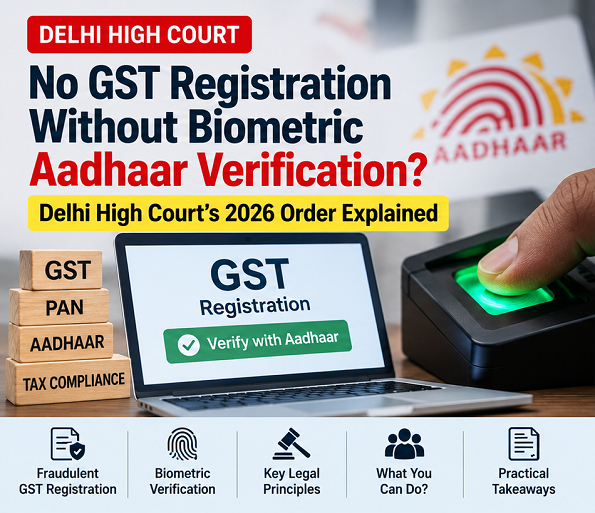
The Delhi High Court's 2026 interim order mandates biometric Aadhaar authentication for new GST registrations. This decision aims to curb fraud by ensuring that GST registrations are not obtained using stolen or misused PAN and Aadhaar details.
Key Takeaways
- The Delhi High Court issued an interim order requiring biometric Aadhaar verification for new GST registrations.
- The order addresses fraudulent GST registrations using stolen PAN and Aadhaar details.
- Aadhaar authentication and biometric-based Aadhaar authentication are distinct processes with different security levels.
- Individuals can take specific steps if their PAN/Aadhaar is used fraudulently for GST registration.
What Happened?
In 2026, the Delhi High Court issued an interim order in response to a petition addressing the misuse of PAN and Aadhaar details for fraudulent GST registrations. The petitioners argued that their identity details were unlawfully used to create fake registrations, thereby implicating them in tax liabilities they were unaware of. The court's interim order mandated biometric Aadhaar authentication for new GST registrations to prevent such fraud.
Why Petitioners Approached Delhi High Court
The petitioners approached the Delhi High Court after discovering that their PAN and Aadhaar details were used to obtain GST registrations without their knowledge or consent. They sought judicial intervention to prevent further misuse and hold the responsible parties accountable.
What Delhi High Court Ordered
The Delhi High Court directed that pending a final decision, biometric Aadhaar authentication would be required for all fresh GST registrations. This interim measure aims to enhance the security of the registration process and protect individuals' identities from being misused.
Is Biometric Aadhaar Verification Mandatory for GST Registration?
Under the Delhi High Court's interim order, biometric Aadhaar verification is temporarily mandatory for new GST registrations. This requirement is not yet a permanent nationwide rule but serves as a precautionary measure to prevent identity misuse during the ongoing legal proceedings.
Aadhaar Authentication vs. Biometric-Based Aadhaar Authentication
Aadhaar authentication involves verifying an individual's identity using their Aadhaar number, whereas biometric-based Aadhaar authentication further requires fingerprint or iris scan verification, providing a higher security level.
Fake GST Registration Using PAN/Aadhaar
Fraudulent GST registrations using misused PAN and Aadhaar details can lead to severe consequences for innocent individuals, including unwarranted tax liabilities and legal complications. Such misuse often involves identity theft or data breaches, which can be challenging to detect and rectify.
What Should You Do If Someone Obtains GST Registration Using Your PAN or Aadhaar?
If you discover an unauthorized GST registration linked to your PAN or Aadhaar, you should immediately:
- File a complaint with the GST authorities.
- Report the issue to your local police station to initiate an investigation.
- Consider filing a writ petition for judicial intervention.
Relevant GST Provisions
The GST registration process is governed by the Goods and Services Tax (GST) Act, which includes provisions for verifying the identity of applicants. The law allows for Aadhaar-based verification, but the Delhi High Court's interim order introduces biometric verification as an additional security measure.
Important Previous Judgments
The table below compares relevant judgments dealing with issues similar to those in the Delhi High Court's 2026 order:
| Case Name | Court | Year | Issue | Key Principle | Relevance |
|---|---|---|---|---|---|
| Rohit Industries Ltd. v. Union of India | Supreme Court | 2021 | Fraudulent GST registration | Due diligence in identity verification | Emphasizes strict verification processes |
| XYZ Pvt. Ltd. v. Commissioner of GST | Delhi High Court | 2022 | GST registration cancellation | Principles of natural justice | Ensures fair hearing before cancellation |
| ABC v. Government of India | Bombay High Court | 2023 | PAN/Aadhaar misuse | Liability only with proven intent | Protects innocent identity holders |
| DEF v. State of Kerala | Kerala High Court | 2024 | Fake invoicing | Stringent penalties for fraud | Deters misuse of GST system |
| MNO Industries v. GST Council | Madras High Court | 2025 | Natural justice under GST | Right to be heard before adverse action | Upholds procedural fairness |
Practical Impact
For taxpayers, businesses, and GST practitioners, the interim order underscores the importance of secure identity practices and vigilance against potential identity theft. It highlights the need for robust checks during the GST registration process to prevent fraudulent activities.
Can You Be Liable for GST Fraud Committed Using Your Identity?
Generally, individuals cannot be held liable for GST fraud if their identity was misused without their knowledge or consent. However, they must proactively report and contest any fraudulent registration to establish their non-involvement.
FAQs
- Is biometric Aadhaar authentication now mandatory for GST registration? Yes, as per the Delhi High Court's interim order, it is mandatory for new registrations.
- How can I find out if there's a GST registration in my name? You can check the GST portal or contact the GST authorities for verification.
- What steps should I take if my Aadhaar is misused? Report to the GST authorities, police, and consider legal action.
- Will the interim order become a permanent requirement? The final decision will depend on the court's final judgment.
- What legal remedies are available against fraudulent GST registration? Cancellation of fraudulent registration and filing complaints with authorities are primary remedies.
- Are there penalties for failing to authenticate with Aadhaar? Non-compliance may lead to registration denial or cancellation.
- Can businesses opt for non-biometric verification? Under current interim directions, biometric verification is mandatory.
- What should tax professionals advise clients about identity protection? Recommend regular checks on PAN/Aadhaar usage and immediate action if misuse is suspected.
Conclusion
The Delhi High Court's 2026 interim order is a crucial step towards enhancing the integrity of the GST registration process. While biometric Aadhaar authentication is a temporary measure, it signifies the judicial system's proactive approach to tackling identity fraud under GST. Individuals and businesses must remain vigilant and take immediate corrective measures if they suspect misuse of their identity. For further insights into related judgments and legal precedents, explore CourtKutchehry's extensive database, a valuable resource for tax lawyers, CAs, and businesses navigating complex GST compliance challenges.
{ "additionalHTML": "
Understanding GST Registration and Aadhaar Verification
The Goods and Services Tax (GST) registration process in India is governed by the Central Goods and Services Tax (CGST) Act, 2017. Section 25 of the Act outlines the procedure for registration, including verification of identity. Traditionally, this verification could be done through Aadhaar authentication, which involves verifying the applicant's identity using their Aadhaar number.
With the Delhi High Court's interim order, the emphasis has shifted towards biometric-based Aadhaar authentication. This method adds an additional layer of security by requiring physical biometrics such as fingerprints or iris scans, ensuring a higher level of identity verification compared to the standard Aadhaar authentication.
Scope of Interim Directions
The interim directions issued by the Delhi High Court are specific to the jurisdiction of the court and apply to new GST registrations within its purview. While this does not automatically extend to a nationwide mandate, the order serves as a precedent that other jurisdictions might consider adopting.
The scope of this interim order is not to penalize genuine taxpayers but to protect them from the consequences of identity theft. The court's directive aims to prevent the registration of GST accounts under false pretenses, thereby safeguarding the integrity of the tax system.
Legal Implications and Identity Protection
Fraudulent GST registrations can have severe implications for unsuspecting individuals whose PAN or Aadhaar details are misused. They might receive notices for tax liabilities they did not incur or be subject to audits and investigations, leading to unnecessary legal entanglements.
Under the GST framework, innocent individuals are generally not held liable if it can be demonstrated that their identity was used without consent. However, proving non-involvement requires prompt action and thorough documentation of all communications with authorities.
Steps for Victims of Identity Misuse
Individuals who discover fraudulent GST registrations using their identity should:
- Immediately file an FIR with the police to document the misuse formally.
- Communicate with the GST department, providing evidence of identity theft.
- Seek legal advice to explore further remedies, such as filing a writ petition if necessary.
It is also advisable to monitor financial accounts and identity documents regularly to detect any unauthorized activities early.
Principles of Natural Justice in GST Disputes
The principles of natural justice play a crucial role in GST registration and cancellation disputes. These principles ensure that any adverse action, such as the cancellation of GST registration, is preceded by an opportunity for the affected party to be heard.
In the context of fraudulent registrations, authorities are expected to conduct a fair investigation and allow the alleged victim to present their case. This aligns with the judgment in XYZ Pvt. Ltd. v. Commissioner of GST, where the Delhi High Court emphasized the necessity of a fair hearing before any cancellation of registration.
Restoration and Revocation of GST Registrations
Upon discovering a fraudulent registration, victims can request the cancellation or suspension of the GST number involved. If a genuine business's registration is mistakenly affected due to identity theft, they can apply for restoration by demonstrating compliance and non-involvement in fraudulent activities.
The GST authorities have mechanisms to review such cases and provide relief to genuine taxpayers while ensuring that fraudulent entities are penalized appropriately.
Practical Implications for Stakeholders
For businesses, the interim order underscores the importance of maintaining robust identity verification practices. Chartered accountants and GST practitioners should advise clients on conducting regular audits of their tax registrations and ensuring that their identity documents are secure.
Tax lawyers should remain updated on evolving legal standards and interim orders like the one issued by the Delhi High Court. They play a crucial role in guiding affected clients through the complexities of legal remedies and compliance requirements.
Businesses may also consider investing in enhanced security measures for storing and handling sensitive identity information to prevent unauthorized access and misuse.
For comprehensive insights and case law analysis, tax professionals and businesses can access CourtKutchehry's extensive database of related judgments and legal precedents. Stay informed on the latest developments and arm yourself with the knowledge needed to navigate the changing GST compliance landscape effectively.
" }