
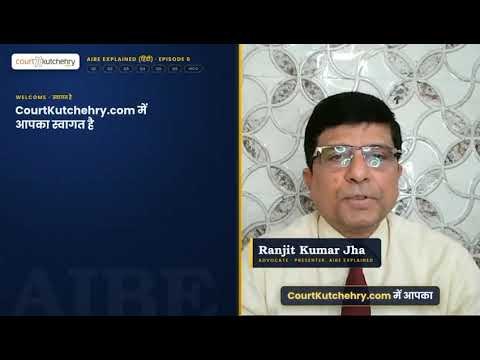
Watch the Video
In this 10-minute video in Hindi, Episode 6 of the CourtKutchehry series “AIBE Explained”, the episode takes up the first half of the Code of Civil Procedure, 1908 (सिविल प्रक्रिया संहिता) in six questions: the definitions in Section 2, which court hears a suit, res sub judice and res judicata, foreign judgments, the parties to a suit and the rules of pleading, followed by practice questions. This English article, written for Hindi-medium aspirants, sets out the episode as revision notes and links each Hindi term to the English words of the bare act.
Sections and Orders: How to Read the CPC
The CPC carries 10 marks in the AIBE, and, as the episode points out, most questions simply ask for the number of a section (धारा) or an Order (आदेश). So know its layout:
- the Sections in the body of the Code state the principles: jurisdiction, res judicata, appeals, execution;
- the Orders and Rules in the First Schedule state the step-by-step procedure: parties, pleadings, summons, written statement.
Note that the Hindi word “आदेश” is used both for an Order of the First Schedule and for an order of the court defined in Section 2(14).
Q1. Decree, Order and Judgment (Section 2)
| Hindi | English | Section | Exam point |
|---|---|---|---|
| डिक्री | Decree | 2(2) | Preliminary or final; rejection of a plaint is a deemed decree |
| निर्णय | Judgment | 2(9) | The statement of the grounds of a decree or order |
| आदेश | Order | 2(14) | The formal expression of a decision that is not a decree |
Exam trap: rejection of a plaint (वादपत्र का अस्वीकार) is a deemed decree, so it is appealable as a decree.
Q2. Which Court Will Hear the Suit?
The episode answers this with five sections and one case:
- Section 9: civil courts try all suits of a civil nature (सिविल प्रकृति के वाद) unless their cognizance is barred, expressly or impliedly.
- Section 15: the suit is filed in the court of the lowest grade competent to try it.
- Section 16: a suit about immovable property is filed where the property is situated.
- Section 20: other suits lie where the defendant resides or carries on business, or where the cause of action arises.
- Section 21: an objection to territorial (प्रादेशिक) or pecuniary (आर्थिक) jurisdiction must be raised at the first opportunity; later, only on a failure of justice.
Subject-matter jurisdiction (विषय-वस्तु का क्षेत्राधिकार) is different. It cannot be conferred by consent or waived. In Kiran Singh v. Chaman Paswan, (1954) 04 SC CK 0020, the Supreme Court held that a decree passed without such jurisdiction is a nullity (शून्य), and its invalidity can be raised whenever and wherever it is sought to be enforced.
Q3. Res Sub Judice and Res Judicata (Sections 10 and 11)
The difference is one of time:
| Doctrine | Section | The earlier matter is… | Effect |
|---|---|---|---|
| Res sub judice (रेस सब ज्यूडिस) | 10 | still pending | the later suit is stayed |
| Res judicata (रेस ज्यूडिकाटा) | 11 | finally decided | the later suit is barred |
Constructive res judicata (रचनात्मक रेस ज्यूडिकाटा) is in Explanation IV to Section 11: a matter that might and ought to have been raised in the former suit is treated as if it had been directly and substantially in issue.
The doctrine reaches beyond suits. In Daryao v. State of Uttar Pradesh, (1961) 03 SC CK 0045, the Supreme Court applied res judicata to writ petitions: a decision on merits by a High Court under Article 226 bars a fresh petition under Article 32 on the same facts and for the same relief.
Remember this line: Section 10 stops a parallel trial; Section 11 stops a second trial.
Q4. Foreign Judgments (Sections 13, 14 and 44A)
- Section 13: a foreign judgment (विदेशी निर्णय) is conclusive, except in six cases: no competent jurisdiction; not on the merits; an incorrect view of international law or refusal to recognise Indian law where applicable; breach of natural justice; fraud; and a claim founded on a breach of Indian law.
- Section 14: a certified copy raises a presumption that the foreign court was competent.
- Section 44A: a decree of a superior court of a reciprocating territory (पारस्परिक क्षेत्र) can be executed in India directly, as if it were the decree of an Indian District Court.
Q5. Parties to a Suit (Orders I to V)
- Order I Rule 8: a representative suit, on behalf of many with the same interest, with the court’s permission.
- Order I Rule 9: misjoinder or non-joinder of parties does not defeat a suit, except non-joinder of a necessary party.
- Order II Rule 2: the whole claim from one cause of action must be included; an omitted part cannot be sued for later without the court’s leave.
Q6. Rules of Pleading (Orders VI, VII and VIII)
- Order VI governs pleadings (अभिवचन) generally; Rule 17 allows amendment, but after the trial has begun only if the party could not have raised the matter earlier despite due diligence.
- Order VII is about the plaint (वादपत्र); Rule 11 lists the grounds for rejecting it, such as no cause of action or a suit barred by law on the face of the plaint.
- Order VIII is about the written statement (लिखित कथन): to be filed within 30 days of service of summons, extendable to 90 days. Rules 6 and 6A deal with set-off and counter-claim.
For commercial suits the limit is stricter. In SCG Contracts India Pvt. Ltd. v. K.S. Chamankar Infrastructure Pvt. Ltd., (2019) 02 SC CK 0139, the Supreme Court held that the 120-day outer limit is mandatory: after it expires, the defendant loses the right to file the written statement.
Key Legal Terms: Hindi ↔ English
| Hindi (as used in the episode) | English |
|---|---|
| धारा / आदेश | Section / Order |
| डिक्री | Decree |
| निर्णय | Judgment |
| क्षेत्राधिकार | Jurisdiction |
| प्रादेशिक / आर्थिक क्षेत्राधिकार | Territorial / pecuniary jurisdiction |
| वाद | Suit |
| पक्षकार | Parties |
| अभिवचन | Pleadings |
| वादपत्र | Plaint |
| लिखित कथन | Written statement |
| विदेशी निर्णय | Foreign judgment |
| पारस्परिक क्षेत्र | Reciprocating territory |
Key Takeaways
- Decree 2(2), judgment 2(9), order 2(14); rejection of a plaint is a deemed decree.
- Sections 9, 15, 16, 20 and 21 decide the forum; lack of subject-matter jurisdiction makes a decree a nullity (Kiran Singh).
- Section 10 stays, Section 11 bars; constructive res judicata is Explanation IV; Daryao extends it to writs.
- Foreign judgments: six exceptions in Section 13; direct execution under Section 44A.
- Order I Rules 8 and 9, Order II Rule 2, Order VI Rule 17, Order VII Rule 11 and Order VIII (30/90 days; 120 days mandatory in commercial suits).
Frequently Asked Questions
What does “रेस ज्यूडिकाटा” mean in simple words?
A matter finally decided between the same parties by a competent court cannot be tried again. It is Section 11 of the CPC.
Is a decree passed without jurisdiction valid until set aside?
Not where subject-matter jurisdiction was lacking: Kiran Singh (1954) holds such a decree a nullity. Territorial and pecuniary objections must be raised early (Section 21).
Which Order deals with rejection of a plaint?
Order VII Rule 11.
How long does a defendant have to file a written statement?
Thirty days from service of summons, extendable to 90 days in ordinary suits; in commercial suits, 120 days is the mandatory outer limit.
Where can I watch the full explanation?
Watch the Hindi episode here: https://youtu.be/jTHq9WcPhIk.
Conclusion
The first half of the CPC is about the right suit, in the right court, between the right parties, in the right form, and never a repeat of a case already decided.
Revise the tables, match each Hindi term to its English equivalent, and attach one case to each idea. The next episode is Civil Procedure Part 2.
▶ Watch the video: सिविल प्रक्रिया भाग 1: क्षेत्राधिकार, रेस ज्यूडिकाटा, पक्षकार और अभिवचन (CPC) | AIBE Explained Ep 6
▶ Watch in English: CPC Part 1: Decree, Jurisdiction, Res Judicata, Foreign Judgments, Parties & Pleadings | AIBE Ep 6
📖 Read the full article: CPC Part 1: Decree, Jurisdiction, Res Judicata, Foreign Judgments, Parties and Pleadings | AIBE Explained Ep 6
Research Judgments Like These on CourtKutchehry
Every judgment cited in this article, and lakhs more, can be searched and read on CourtKutchehry. Searching and reading judgments is free. A membership adds unlimited summaries, all related judgments, original court PDF downloads, bookmarks, notes and the CourtKutchehry AI assistant.
| Membership | Price | Works out to | AI credits |
|---|---|---|---|
| Monthly (1 month) | ₹599 | ₹599 / month | 1,000 / month |
| Quarterly (3 months) · Save 16% | ₹1,499 | ₹499.67 / month | 1,100 / month |
| Six-monthly (6 months) · Save 33% | ₹2,399 | ₹399.83 / month | 1,200 / month |
| Yearly (12 months) · Save 44% · Best value | ₹3,999 | ₹333.25 / month | 1,300 / month |
Every plan is a one-off purchase for a fixed period: nothing auto-renews and no card is kept on file. Prices are exclusive of applicable tax, which is added at checkout. Extra AI chat credits can be topped up from ₹99. A free verified account gets 5 summaries and 50 AI trial credits.
Prices are as displayed on courtkutchehry.com on 20 November 2026 and are subject to change without notice. Please check the pricing page for the current plans and offers.
For more judgments, legal opinions and case analysis, visit courtkutchehry.com
Visit CourtKutchehry →