
Watch the Video
In this 9-minute video, Episode 6 of the CourtKutchehry series “AIBE Explained”, the episode covers the first half of the Code of Civil Procedure, 1908 in six questions: the key definitions, jurisdiction, res sub judice and res judicata, foreign judgments, parties to a suit and the rules of pleading, and then solves five practice questions. This article explains each point in writing.
How the CPC Is Built
The Code of Civil Procedure, 1908 carries 10 marks in the AIBE. The Code has two parts: the Sections, which lay down principles, and the Orders and Rules in the First Schedule, which lay down procedure. Most AIBE questions simply ask for a section or an Order number. The episode covers the first half of the Code in six questions: definitions, jurisdiction, res sub judice and res judicata, foreign judgments, parties and pleadings.
Q1. Important Definitions in Section 2
| Term | Section | In short |
|---|---|---|
| Decree | 2(2) | Formal expression of an adjudication that conclusively determines the rights of the parties |
| Judgment | 2(9) | The statement of the grounds of a decree or order |
| Legal representative | 2(11) | A person who in law represents the estate of a deceased person |
| Mesne profits | 2(12) | Profits a person in wrongful possession actually received or might have received |
| Order | 2(14) | Formal expression of a decision that is not a decree |
A classic exam point: the rejection of a plaint is a deemed decree under Section 2(2), and so it is appealable as a decree. An order dismissing a suit for default, by contrast, is not a decree.
Q2. Which Court Can Entertain a Civil Suit?
- Section 9: civil courts can try all suits of a civil nature unless their cognizance is expressly or impliedly barred.
- Section 15: every suit must be instituted in the court of the lowest grade competent to try it.
- Section 16: suits relating to immovable property are filed where the property is situated.
- Section 20: other suits are filed where the defendant resides or carries on business, or where the cause of action arises, wholly or in part.
- Section 21: objections to territorial or pecuniary jurisdiction must be taken at the earliest opportunity, and an appellate or revisional court will not entertain them unless there has been a failure of justice.
But a defect of subject-matter jurisdiction cannot be waived or cured by consent. In Kiran Singh v. Chaman Paswan, (1954) 04 SC CK 0020, the Supreme Court held that a decree passed by a court without jurisdiction is a nullity, and its invalidity can be set up whenever and wherever it is sought to be enforced.
Q3. Res Sub Judice vs Res Judicata
These two are the most-asked doctrines in the CPC.
- Res sub judice (Section 10): where a matter directly and substantially in issue is pending in an earlier suit between the same parties, the court shall stay the later suit. It prevents two parallel trials.
- Res judicata (Section 11): where a matter directly and substantially in issue has been heard and finally decided in a former suit between the same parties by a competent court, it cannot be tried again. It prevents a second trial.
- Constructive res judicata (Section 11, Explanation IV): any matter that might and ought to have been raised in the former suit is deemed to have been directly and substantially in issue.
- Section 12: where a plaintiff is barred from instituting a further suit, he cannot do so in any court.
Res judicata is not confined to civil suits. In Daryao v. State of Uttar Pradesh, (1961) 03 SC CK 0045, the Supreme Court held that a decision on merits by a High Court under Article 226 bars a fresh petition under Article 32 on the same facts and for the same relief.
Remember this line: Section 10 stays the later suit; Section 11 bars it.
Q4. Foreign Judgments
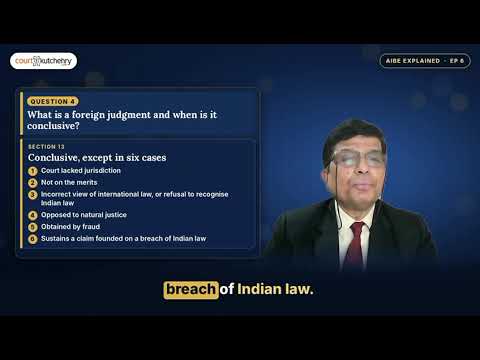
Under Section 13, a foreign judgment is conclusive between the parties on any matter it decides, except in six cases:
- where it was not pronounced by a court of competent jurisdiction;
- where it was not given on the merits of the case;
- where it is founded on an incorrect view of international law or a refusal to recognise Indian law where applicable;
- where the proceedings were opposed to natural justice;
- where it was obtained by fraud; and
- where it sustains a claim founded on a breach of any law in force in India.
Section 14 raises a presumption that a certified copy of a foreign judgment was pronounced by a competent court. Section 44A allows a decree of a superior court of a reciprocating territory to be executed in India as if it were a decree of an Indian District Court.
Q5. Who Are the Parties to a Suit?
- Order I Rule 8: a representative suit, where one or more persons sue or are sued on behalf of many with the same interest, with the court’s permission and notice to all interested.
- Order I Rule 9: a suit is not defeated by misjoinder or non-joinder of parties, except non-joinder of a necessary party.
- Order II Rule 2: a plaintiff must include the whole claim arising from a cause of action. A portion omitted or relinquished cannot be sued for later, without the court’s leave.
Orders III to V deal with recognised agents and pleaders, the institution of suits, and the issue and service of summons.
Q6. Rules of Pleading
- Order VI governs pleadings generally. Order VI Rule 17 permits amendment of pleadings at any stage, but after the trial has commenced, only if the party could not have raised the matter earlier despite due diligence.
- Order VII deals with the plaint. Order VII Rule 11 lists the grounds for rejection of a plaint, such as where it does not disclose a cause of action, or where the suit appears from the statement in the plaint to be barred by any law.
- Order VIII deals with the written statement. It must be filed within 30 days of service of summons, extendable up to 90 days. Rules 6 and 6A provide for set-off and counter-claim.
In commercial suits, the outer limit of 120 days is mandatory. In SCG Contracts India Pvt. Ltd. v. K.S. Chamankar Infrastructure Pvt. Ltd., (2019) 02 SC CK 0139, the Supreme Court held that once 120 days from service of summons have expired, the defendant forfeits the right to file the written statement and the court cannot take it on record.
AIBE Practice Questions
The video ends with five practice questions. Try these on the same lines:
- Which Section defines a decree? Answer: Section 2(2).
- Where must a suit for immovable property be filed? Answer: where the property is situated, Section 16.
- Constructive res judicata is found in which Explanation to Section 11? Answer: Explanation IV.
- In how many cases is a foreign judgment not conclusive under Section 13? Answer: six.
- Which provision deals with rejection of a plaint? Answer: Order VII Rule 11.
Key Takeaways
- Decree: Section 2(2); rejection of a plaint is a deemed decree and is appealable.
- Jurisdiction: Sections 9, 15, 16, 20 and 21; a decree without subject-matter jurisdiction is a nullity (Kiran Singh).
- Res sub judice: Section 10; res judicata: Section 11, with constructive res judicata in Explanation IV (Daryao applies it to writs).
- Foreign judgments: Section 13 (six exceptions), Section 14 and Section 44A.
- Parties and pleadings: Order I Rules 8 and 9, Order II Rule 2, Order VI Rule 17, Order VII Rule 11, Order VIII; 120 days is mandatory in commercial suits (SCG Contracts).
Frequently Asked Questions
What is the difference between res sub judice and res judicata?
Res sub judice (Section 10) applies to a matter still pending and stays the later suit. Res judicata (Section 11) applies to a matter already finally decided and bars a fresh trial.
Can an objection to territorial jurisdiction be raised in appeal?
Only if it was taken at the earliest opportunity in the trial court and there has been a consequent failure of justice (Section 21). A defect of subject-matter jurisdiction, however, can be raised at any stage.
Is the rejection of a plaint appealable?
Yes. It is a deemed decree under Section 2(2), and an appeal lies as from a decree.
What is the time limit for a written statement?
Thirty days from service of summons, extendable up to 90 days in ordinary suits. In commercial suits, 120 days is the outer limit and it is mandatory.
When can a foreign decree be executed directly in India?
When it is a decree of a superior court of a reciprocating territory, under Section 44A.
Where can I watch the full explanation?
Watch the full explanation in 9 minutes: https://youtu.be/EnZ9XdrQ6Xk.
Conclusion
The first half of the CPC is about getting a suit into the right court, between the right parties, in the right form, and making sure it is not a repeat of something already decided. That is why definitions, jurisdiction, res judicata, Order I, Order II and Orders VI to VIII dominate the questions.
Learn the numbers and attach one case to each idea. The next episode completes the Code: ex parte decrees, temporary injunctions, execution, appeals, reference, review and revision.
▶ Watch the video: CPC Part 1: Decree, Jurisdiction, Res Judicata, Foreign Judgments, Parties & Pleadings | AIBE Ep 6
Research Judgments Like These on CourtKutchehry
Every judgment cited in this article, and lakhs more, can be searched and read on CourtKutchehry. Searching and reading judgments is free. A membership adds unlimited summaries, all related judgments, original court PDF downloads, bookmarks, notes and the CourtKutchehry AI assistant.
| Membership | Price | Works out to | AI credits |
|---|---|---|---|
| Monthly (1 month) | ₹599 | ₹599 / month | 1,000 / month |
| Quarterly (3 months) · Save 16% | ₹1,499 | ₹499.67 / month | 1,100 / month |
| Six-monthly (6 months) · Save 33% | ₹2,399 | ₹399.83 / month | 1,200 / month |
| Yearly (12 months) · Save 44% · Best value | ₹3,999 | ₹333.25 / month | 1,300 / month |
Every plan is a one-off purchase for a fixed period: nothing auto-renews and no card is kept on file. Prices are exclusive of applicable tax, which is added at checkout. Extra AI chat credits can be topped up from ₹99. A free verified account gets 5 summaries and 50 AI trial credits.
Prices are as displayed on courtkutchehry.com on 20 November 2026 and are subject to change without notice. Please check the pricing page for the current plans and offers.
For more judgments, legal opinions and case analysis, visit courtkutchehry.com
Visit CourtKutchehry →