
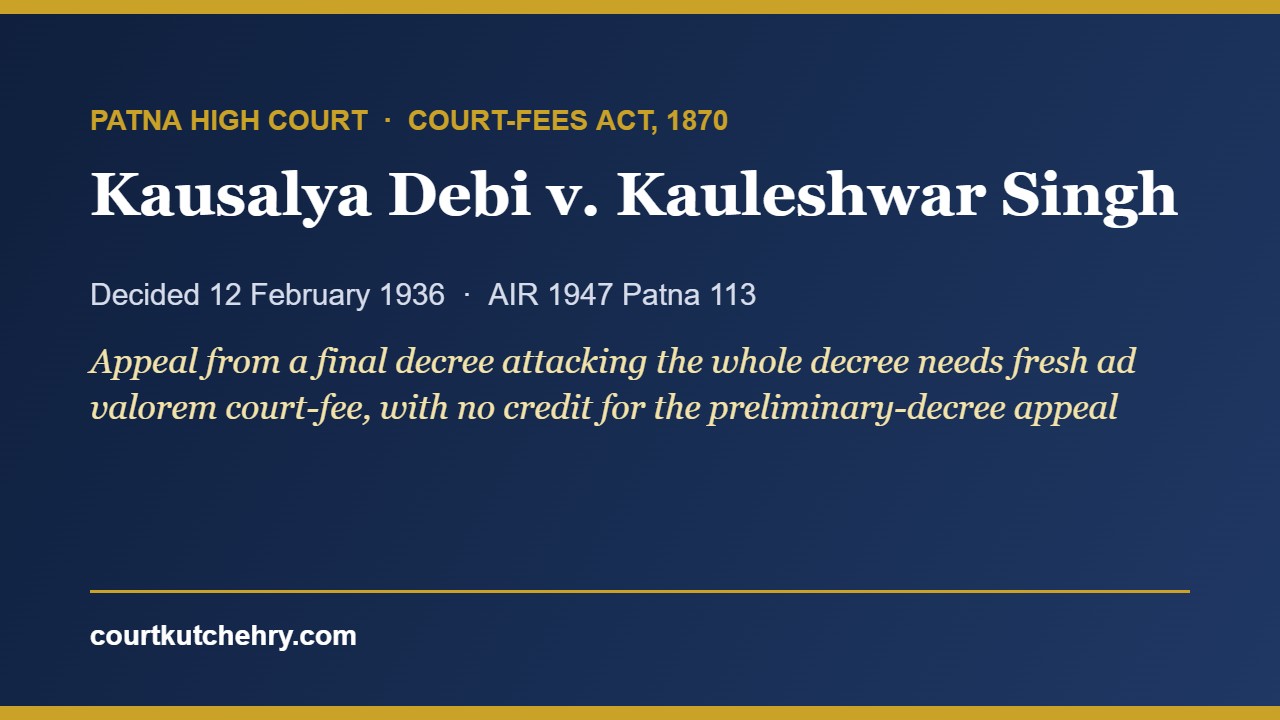
A family loses a mortgage suit, appeals the preliminary decree, pays the full ad valorem court-fee on that appeal and wins only a small cut in interest. When the final decree follows, they appeal again, this time on completely new grounds, and file the memorandum without paying any further fee. Their argument was simple: why should anyone pay ad valorem court-fee twice in the same suit? On 12 February 1936, the Patna High Court said they must. This article explains Sm. Kausalya Debi and Others v. Kauleshwar Singh and Others and what it teaches about court-fee on appeals from preliminary and final decrees.
Case at a Glance
| Case | Sm. Kausalya Debi and Others v. Kauleshwar Singh and Others |
|---|---|
| Court | Patna High Court (Meredith, J., deciding as Taxing Judge under Section 5 of the Court-fees Act, 1870) |
| Citation | (1936) 02 PAT CK 0020; AIR 1947 Patna 113 |
| Decided on | 12 February 1936 |
| Provisions | Sections 4, 7(i), 7(iv)(f), 19 and 35 and Schedule I, Article 1 and Schedule II, Articles 11 and 17(vi), Court-fees Act, 1870; Section 97, Code of Civil Procedure, 1908 |
| Result | Full ad valorem court-fee payable on the appeal from the final decree, on Rs. 88,419-12-0; no credit for the fee paid on the earlier appeal |
The Facts
The case arose out of a suit on a mortgage. A preliminary decree was passed. The appellants appealed against it and paid the full ad valorem court-fee on that appeal. The appeal succeeded only partly: the rate of interest was reduced, and the rest of the decree stood.
A final decree was then passed. The appellants filed a second appeal, this time against the final decree. They did not repeat their earlier grounds. Instead, they attacked the final decree as a whole on new points:
- that the suit had abated, because one of the parties had died and no substitution had been made; and
- that the application for the final decree had been filed in the wrong court.
The memorandum of appeal was filed without any further court-fee. The stamp report put the fee payable at Rs. 2,559-60, calculated on the amount of the final decree, Rs. 88,419-12-0. The question of court-fee went to the Taxing Judge under Section 5 of the Court-fees Act, 1870.
The Question Before the Court
The court had to decide two connected questions:
- Is any court-fee payable on an appeal from a final decree, when full ad valorem fee has already been paid on an appeal from the preliminary decree in the same suit?
- If a fee is payable, is it a fixed fee under Schedule II (Article 11 or Article 17(vi)), or an ad valorem fee under Schedule I, Article 1, and if ad valorem, should credit be given for the fee already paid?
What the Appellants Argued
- No double fee: the Legislature could not have intended ad valorem fee to be paid twice in one suit.
- Fee only on the increase: at most, fee should be charged on the amount by which the sum due had grown since the first appeal.
- Fixed fee: less forcefully, that the appeal was really against an "order", or that its subject-matter could not be valued, so a fixed fee under Schedule II would do.
The Law on Court-Fee in Appeals
Section 4 of the Court-fees Act, 1870 says that a document of the kind listed in the Schedules cannot be filed or acted on unless the proper fee is paid. Schedule I, Article 1 charges an ad valorem fee on a plaint or memorandum of appeal, based on the value of the subject-matter in dispute. Schedule II lists documents that carry a fixed fee, including memoranda of appeal from certain orders (Article 11) and plaints or appeals in suits whose subject-matter cannot be valued in money (Article 17(vi)). Section 7(i) governs the valuation of suits for money, which covers a mortgage suit for the sum due; Section 7(iv)(f) governs suits for accounts.
The Code of Civil Procedure adds an important rule. Under Section 97 CPC, a party aggrieved by a preliminary decree who does not appeal against it cannot dispute its correctness in an appeal from the final decree. That makes appeals from preliminary decrees practically compulsory, and it also means the two appeals usually raise different points.
The Court’s Reasoning
1. Two appeals, two different subjects
The court began with Section 97 CPC. A party who does not appeal a preliminary decree is, in the words of the judgment, "precluded from disputing its correctness in any appeal which may be preferred from the final decree" (para 1). So the points decided in the preliminary decree cannot be reopened in the final-decree appeal. The second appeal is about something else, and it is not a repeat of the first.
2. The subject-matter can be valued
The court rejected the argument that the subject-matter of the appeal could not be valued. The appellants were attacking the whole final decree, so the value of the subject-matter was the amount of that decree. The Patna decision in Durga Prasad v. Sri Niwas Surekha, AIR 1934 Pat 473, was distinguished (para 2).
3. A final decree is not an "order"
Next, the court held that an appeal from a final decree is an appeal from a decree, not from an order, so the fixed fee for appeals from orders does not apply. It noted that the Madras view in Ranga Raju v. Ethirajammal, AIR 1930 Mad 20, was against the weight of authority and had been dissented from in Ramchandra Rao v. Rattayya, AIR 1934 Mad 198. It relied on the Allahabad Full Bench in Bajrangi Lal v. Mahabir Kunwar, (1913) 35 All 476, which pointed out that "the Legislature had deliberately altered the words "order absolute" and replaced them by the words "final decree"" (para 3). Since a final decree is a decree, the memorandum of appeal attracts ad valorem fee.
4. The Act says so in plain words
Section 4 requires the proper fee on a memorandum of appeal, and "Schedule I, Article 1, covers a case like the present, namely, a memorandum of appeal" (para 4). Nothing in the Act exempts a second appeal in the same suit.
5. No real hardship, and no room for equity
The court did not accept that charging two fees was unfair. The two appeals dealt with different questions, and it would be rare for a party to attack an entire final decree after an unsuccessful appeal from the preliminary decree (para 5). More importantly, "ethical considerations do not really enter into the picture. It is a question merely of construing the Court-fees Act" (para 6). Neither Section 19 (exemptions) nor Section 35 (power to reduce or remit fees) gave any credit or exemption, and no rule of the Local Government covered the situation.
6. Account suits and mesne-profit cases are different
The appellants relied on decisions in suits for accounts and mesne profits. The court distinguished them (para 7). Suits for accounts are valued under Section 7(iv)(f), where the amount really in dispute often becomes clear only at the final stage, while a mortgage suit is valued under Section 7(i). In a mortgage suit, by contrast, the preliminary decree settles the parties’ liabilities, and the final decree largely carries that decision into effect. The court also distinguished Budhu Ram v. Niamat Rai, AIR 1923 Lah 632.
The Final Decision
The appellants’ contention was rejected. The court ordered that "the appellants must pay the ad valorem court-fees upon the sum of Rs. 88,419-12-0" (para 8), and gave them three months from the date of the judgment to pay. No credit was allowed for the fee already paid on the appeal from the preliminary decree.
Why This Case Still Matters
The Court-fees Act, 1870 has been replaced or heavily amended in many States, and court-fee rates and the scheme of fixed and ad valorem fees now vary from State to State. So the exact figures and articles in this judgment may not apply to your case. But the principles are still useful:
- Section 97 CPC still applies, so an appeal from a preliminary decree remains essential, and it costs money.
- Appeals from preliminary and final decrees are separate proceedings, each needing its own court-fee under the law in force.
- Questions of court-fee are decided by reading the statute, not by arguments of fairness.
- Exemptions and remissions must be found in the Act or in rules made under it.
Before filing an appeal from a final decree, check the court-fee law of your State and the latest decisions of your High Court on the point.
Key Takeaways
- An appeal from a final decree in a mortgage suit that attacks the whole decree attracts ad valorem court-fee on the decretal amount.
- The fee paid on an earlier appeal from the preliminary decree is not credited against it.
- A final decree is a decree, not an "order", so the fixed fee for appeals from orders does not apply (following Bajrangi Lal, Allahabad Full Bench).
- Because of Section 97 CPC, the two appeals raise different questions, so paying two fees is not treated as double taxation.
- Court-fee is a matter of statutory construction; equity cannot create an exemption the Act does not give.
Practical Lessons for Lawyers and Litigants
- Appeal the preliminary decree. If you don't, you lose the right to challenge what it decided.
- Budget for two court-fees where both decrees may need to be challenged.
- Value the appeal correctly. If you attack the whole final decree, the decretal amount is usually the value; if you attack only part, value only that part.
- Look for real exemptions. Check your State’s court-fee Act and rules for any remission before arguing hardship.
- Raise deficit court-fee objections early. A stamp report can stop an appeal from being registered until the deficit is paid.
Frequently Asked Questions
Is court-fee payable again on an appeal from a final decree?
Yes. In this case the Patna High Court held that full ad valorem fee was payable on an appeal attacking the whole final decree in a mortgage suit, even though ad valorem fee had been paid on the earlier appeal from the preliminary decree.
Can I get credit for the court-fee paid on the preliminary-decree appeal?
Not under this judgment. The court found no provision in the Court-fees Act allowing such credit.
Is an appeal from a final decree an appeal from an order?
No. The court held that a final decree is a decree, following the Allahabad Full Bench in Bajrangi Lal v. Mahabir Kunwar, so the fixed fee for appeals from orders does not apply.
What if I don't appeal the preliminary decree?
Under Section 97 CPC, you cannot later dispute the correctness of the preliminary decree in an appeal from the final decree.
Is the Court-fees Act, 1870 still the law everywhere?
No. Many States have their own court-fee laws or amendments, so always check the statute in force in the State where the case is filed.
Conclusion
Kausalya Debi is a short ruling on a practical question that still arises in civil litigation: what does it cost to appeal twice in one suit? The answer was that each appeal stands on its own feet. Section 97 CPC makes the first appeal necessary, and the Court-fees Act charges ad valorem fee on the second when it attacks the whole final decree.
For litigants, the lesson is to plan both appeals, and their cost, from the start. For lawyers, it is a reminder that court-fee disputes are won on the words of the statute, not on fairness.
Research Judgments Like These on CourtKutchehry
Every judgment cited in this article, and lakhs more, can be searched and read on CourtKutchehry. Searching and reading judgments is free. A membership adds unlimited summaries, all related judgments, original court PDF downloads, bookmarks, notes and the CourtKutchehry AI assistant.
| Membership | Price | Works out to | AI credits |
|---|---|---|---|
| Monthly (1 month) | ₹599 | ₹599 / month | 1,000 / month |
| Quarterly (3 months) · Save 16% | ₹1,499 | ₹499.67 / month | 1,100 / month |
| Six-monthly (6 months) · Save 33% | ₹2,399 | ₹399.83 / month | 1,200 / month |
| Yearly (12 months) · Save 44% · Best value | ₹3,999 | ₹333.25 / month | 1,300 / month |
Every plan is a one-off purchase for a fixed period: nothing auto-renews and no card is kept on file. Prices are exclusive of applicable tax, which is added at checkout. Extra AI chat credits can be topped up from ₹99. A free verified account gets 5 summaries and 50 AI trial credits.
Prices are as displayed on courtkutchehry.com on 20 November 2026 and are subject to change without notice. Please check the pricing page for the current plans and offers.
For more judgments, legal opinions and case analysis, visit courtkutchehry.com
Visit CourtKutchehry →