
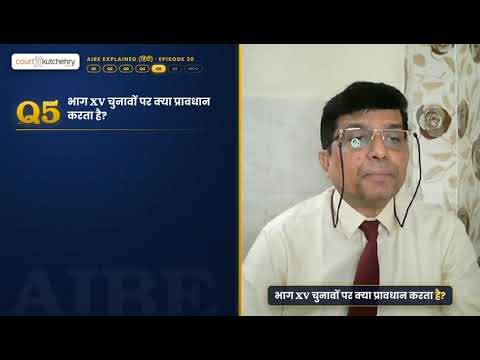
Watch the Video
In this 14-minute video in Hindi, Episode 30 of “AIBE Explained” (Hindi), the episode returns to Constitutional Law, which carries 10 marks in the AIBE, the most of any subject. Episodes 2 and 3 covered fundamental rights, directive principles, the Union, emergencies and the amending power. This episode covers the remaining parts of the Constitution on which the AIBE asks questions: citizenship, Centre-State relations, panchayats and municipalities, protection of civil servants, elections and the Schedules. He covers them in six questions and then solves five practice questions with answers. This article explains the same law in English.
Q1: How Is Citizenship Acquired and Lost? (Articles 5 to 11 and the Citizenship Act, 1955)
Articles 5 to 10 decided who was a citizen when the Constitution began, including those who migrated to or from Pakistan. Article 11 left everything after that to Parliament, which enacted the Citizenship Act, 1955.
| Mode | Section |
|---|---|
| By birth | 3 |
| By descent | 4 |
| By registration | 5 |
| By naturalisation | 6 |
| Overseas Citizen of India (OCI) cardholder | 7A |
| Renunciation | 8 |
| Termination (voluntarily acquiring another country’s citizenship) | 9 |
| Deprivation by the Government | 10 |
India does not allow dual citizenship; an OCI card is not citizenship. The Citizenship (Amendment) Act, 2019 added Section 6B, providing a route to citizenship for Hindu, Sikh, Buddhist, Jain, Parsi and Christian migrants from Afghanistan, Bangladesh and Pakistan who entered India on or before 31 December 2014.
Q2: Centre-State Relations (Articles 245 to 293)
Legislative power is divided by Article 246 and the three Lists of the Seventh Schedule. The provisions the AIBE asks about:
- Article 248 (residuary power): Parliament alone can legislate on any matter not in the State or Concurrent List, including taxes not listed.
- Article 249: if the Rajya Sabha resolves, by two-thirds of members present and voting, that it is necessary in the national interest, Parliament may legislate on a State List matter. The resolution lasts up to one year and can be renewed.
- Article 254 (repugnancy): where a State law on a Concurrent List matter conflicts with a central law, the central law prevails; but a State law reserved for and given the President’s assent prevails in that State.
- Article 262: Parliament may provide for the adjudication of inter-State river water disputes and exclude the jurisdiction of courts.
- Article 280: the Finance Commission, constituted every five years, recommends how taxes are shared between the Union and the States.
- Article 131: the Supreme Court has exclusive original jurisdiction over disputes between the Union and the States, or between States.
Q3: Parts IX and IXA: Panchayats and Municipalities
- 73rd Amendment (1992): added Part IX on panchayats and the Eleventh Schedule with 29 subjects.
- 74th Amendment (1992): added Part IXA on municipalities and the Twelfth Schedule with 18 subjects.
- Both provide a five-year term, reservation of at least one-third of seats for women, State Election Commissions and State Finance Commissions.
- 97th Amendment (2011): added Part IXB on co-operative societies.
In Union of India vs Rajendra N. Shah, (2021) 07 SC CK 0017, the Supreme Court held that Part IXB, in so far as it dealt with co-operative societies within a State, required ratification by half the State legislatures under Article 368(2) because co-operatives are a State List subject. Without that ratification, those provisions were struck down; Part IXB survives only for multi-State co-operative societies.
Q4: Protection of Civil Servants (Articles 308 to 323)
- Article 310 (doctrine of pleasure): civil servants of the Union and the States hold office during the pleasure of the President or the Governor.
- Article 311: the pleasure is limited by two safeguards. No civil servant can be dismissed or removed by an authority subordinate to the one that appointed him (Article 311(1)). And no one can be dismissed, removed or reduced in rank without an inquiry in which he is told the charges and given a reasonable opportunity of being heard (Article 311(2)).
- Exceptions to the inquiry (second proviso): (a) conduct that has led to conviction on a criminal charge, (b) where the authority records in writing that holding an inquiry is not reasonably practicable, and (c) where the President or Governor is satisfied that it is not expedient in the interest of the security of the State.
- Article 312: new all-India services can be created if the Rajya Sabha so resolves by two-thirds of members present and voting.
In Union of India vs Tulsiram Patel, (1985) 07 SC CK 0029, a Constitution Bench held that when a case falls within the second proviso to Article 311(2), the inquiry, and with it the hearing, can be dispensed with. The action remains open to judicial review on whether the clause was rightly invoked.
Q5: Part XV: Elections (Articles 324 to 329)
- Article 324: superintendence, direction and control of elections vest in the Election Commission.
- Article 325: one general electoral roll; no one is excluded on grounds of religion, race, caste or sex.
- Article 326: elections on the basis of adult suffrage. The 61st Amendment (1988) lowered the voting age from 21 to 18 years.
- Article 329: courts cannot interfere in electoral matters during the process; an election can be questioned only by an election petition.
In Anoop Baranwal vs Union of India, (2023) 03 SC CK 4108, a Constitution Bench held that, until Parliament made a law, the Chief Election Commissioner and Election Commissioners would be appointed on the advice of a committee of the Prime Minister, the Leader of the Opposition (or of the largest opposition party) and the Chief Justice of India. Parliament then enacted the Chief Election Commissioner and other Election Commissioners Act, 2023, under which the committee has a Union Minister in place of the Chief Justice.
Q6: Which Schedules Are Asked?
| Schedule | Contents |
|---|---|
| Seventh | Union, State and Concurrent Lists |
| Eighth | 22 languages |
| Ninth | Laws protected under Article 31B (added by the First Amendment, 1951) |
| Tenth | Anti-defection law (added by the 52nd Amendment, 1985) |
| Eleventh / Twelfth | Panchayats (29 subjects) / Municipalities (18 subjects) |
The Ninth Schedule is the favourite. In I.R. Coelho vs State of Tamil Nadu, (2007) 01 SC CK 0025, a nine-judge bench held that laws placed in the Ninth Schedule after 24 April 1973, the date of the Kesavananda Bharati judgment, can be challenged on the ground that they damage the basic structure of the Constitution.
Remember this line: the Ninth Schedule is a shield, but after 24 April 1973 it is no shield against the basic structure.
Key Takeaways
- Citizenship Act: birth (3), descent (4), registration (5), naturalisation (6), OCI (7A); loss by renunciation (8), termination (9) and deprivation (10).
- Article 248 residuary power, Article 249 Rajya Sabha resolution, Article 254 repugnancy, Article 280 Finance Commission, Article 131 Union-State disputes.
- 73rd and 74th Amendments: 29 and 18 subjects; Part IXB survives only for multi-State co-operatives after Rajendra N. Shah.
- Article 311 protects civil servants, subject to the second proviso upheld in Tulsiram Patel.
- Voting age 18 by the 61st Amendment; Ninth Schedule laws after 24 April 1973 are open to basic-structure review (I.R. Coelho).
Frequently Asked Questions
Does India allow dual citizenship?
No. A citizen who voluntarily acquires another country’s citizenship ceases to be an Indian citizen under Section 9. An OCI card gives certain benefits, but it is not citizenship.
Which Article gives Parliament residuary power?
Article 248, read with Entry 97 of the Union List.
How many subjects are in the Eleventh and Twelfth Schedules?
29 in the Eleventh (panchayats) and 18 in the Twelfth (municipalities).
Can a civil servant be dismissed without an inquiry?
Only in the three situations in the second proviso to Article 311(2): conviction on a criminal charge, inquiry not reasonably practicable, or the security of the State.
Are Ninth Schedule laws immune from challenge?
Not fully. After I.R. Coelho (2007), laws added after 24 April 1973 can be tested against the basic structure.
Where can I watch the video?
Watch the full explanation in Hindi in 14 minutes: https://youtu.be/PYCUMmh9O0k.
Conclusion
With this episode, the parts of the Constitution that the AIBE asks about are complete. These questions are mostly about numbers: Articles, Amendments and the count of subjects and languages. Make a one-page table of them and revise it in the last week.
The next episode moves to Criminal Procedure Part 3: summons and warrants, search and seizure, public order, and the new electronic procedures under the BNSS.
▶ Watch the video: संवैधानिक कानून भाग 3: नागरिकता, केंद्र-राज्य संबंध, पंचायतें, सेवाएँ, चुनाव और अनुसूचियाँ | Ep 30
▶ Watch in English: Constitutional Law Part 3: Citizenship, Centre-State Relations, Panchayats, Article 311 Ep 30
Research Judgments Like These on CourtKutchehry
Every judgment cited in this article, and lakhs more, can be searched and read on CourtKutchehry. Searching and reading judgments is free. A membership adds unlimited summaries, all related judgments, original court PDF downloads, bookmarks, notes and the CourtKutchehry AI assistant.
| Membership | Price | Works out to | AI credits |
|---|---|---|---|
| Monthly (1 month) | ₹599 | ₹599 / month | 1,000 / month |
| Quarterly (3 months) · Save 16% | ₹1,499 | ₹499.67 / month | 1,100 / month |
| Six-monthly (6 months) · Save 33% | ₹2,399 | ₹399.83 / month | 1,200 / month |
| Yearly (12 months) · Save 44% · Best value | ₹3,999 | ₹333.25 / month | 1,300 / month |
Every plan is a one-off purchase for a fixed period: nothing auto-renews and no card is kept on file. Prices are exclusive of applicable tax, which is added at checkout. Extra AI chat credits can be topped up from ₹99. A free verified account gets 5 summaries and 50 AI trial credits.
Prices are as displayed on courtkutchehry.com on 20 November 2026 and are subject to change without notice. Please check the pricing page for the current plans and offers.
For more judgments, legal opinions and case analysis, visit courtkutchehry.com
Visit CourtKutchehry →