
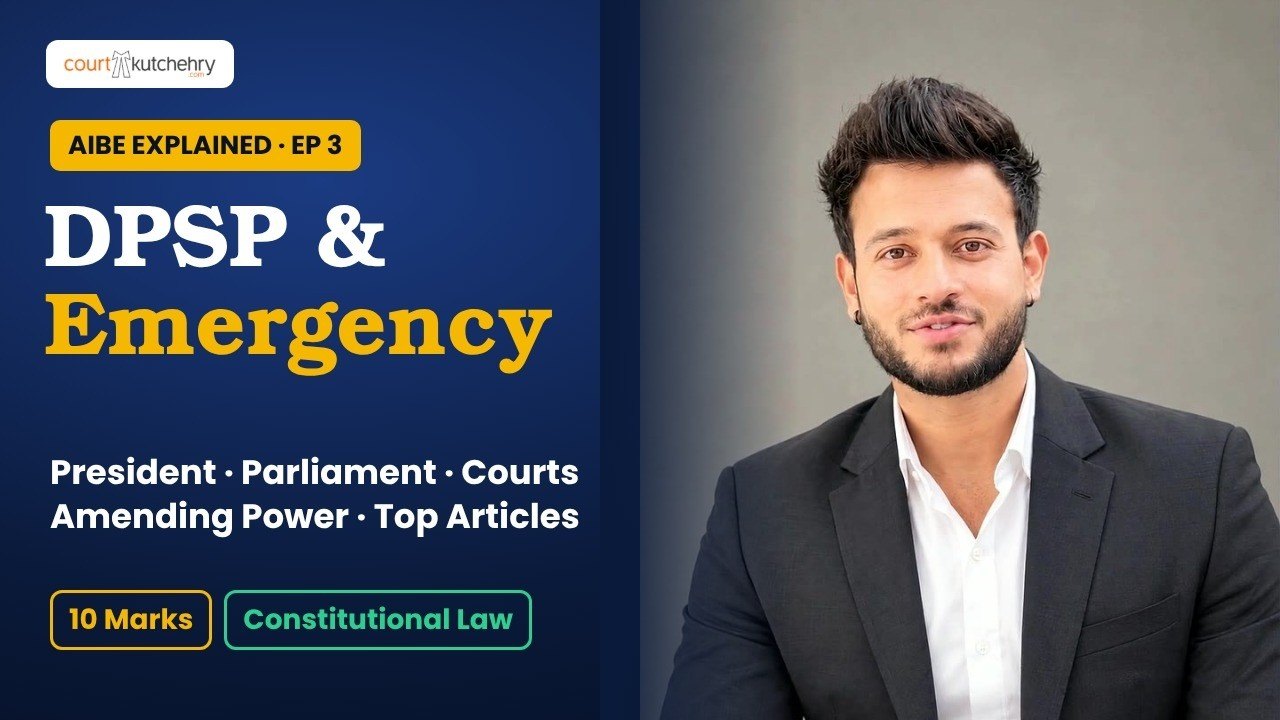
Watch the Video
In this 5-minute video, Advocate Vinayak Pawar runs through Episode 3 of “AIBE Explained”, the second half of Constitutional Law (10 marks in the AIBE), at revision speed: six quick questions from the Directive Principles to the judiciary. This article is the same episode as a five-minute read: key points, one table and the common exam traps.
1. Directive Principles and Fundamental Duties in One Minute
- Article 37: the Directive Principles in Part IV are not enforceable by any court, but they are fundamental in the governance of the country and the State must apply them in making laws.
- The balance: in Minerva Mills v. Union of India (1980), the Supreme Court held that the harmony and balance between Fundamental Rights and Directive Principles is itself part of the basic structure.
- Articles to remember: 39A (equal justice and free legal aid), 44 (uniform civil code), 48A (protection of the environment), 50 (separation of the judiciary from the executive).
- Article 51A: Fundamental Duties were inserted by the 42nd Amendment, 1976.
2. The President: Election, Pardon and Ordinances
- Article 54: election by an electoral college of elected MPs and elected MLAs.
- Article 61: impeachment.
- Article 72: the President’s power to pardon, which extends to sentences of death. Article 161 is the Governor’s parallel power.
- Article 123: the President may promulgate an ordinance when Parliament is not in session; Article 213 is the Governor’s equivalent.
- The case: in D.C. Wadhwa v. State of Bihar, (1986) 12 SC CK 0032, the Supreme Court held that repeatedly re-promulgating ordinances without placing them before the legislature is a fraud on the Constitution.
3. Parliament: Money Bill, Joint Sitting, Defection, Repugnancy
- Money Bill: introduced only in the Lok Sabha.
- Joint sitting (Article 108): available to resolve a deadlock on an ordinary Bill, but not for a Money Bill or a Constitution Amendment Bill.
- Anti-defection: the Tenth Schedule. In Kihoto Hollohan v. Zachillhu, (1992) 02 SC CK 0070, the Court upheld the Schedule and held that the Speaker’s decision on disqualification is open to judicial review.
- Article 254: where a State law on a Concurrent List subject is repugnant to a Central law, the Central law prevails, unless the State law was reserved for and received the President’s assent.
4. The Three Kinds of Emergency
- Article 352: National Emergency.
- Article 356: President’s Rule in a State, on failure of the constitutional machinery.
- Article 360: Financial Emergency, which has never been imposed.
- Protected rights: Articles 20 and 21 cannot be suspended.
- The case: in S.R. Bommai v. Union of India (1994), a nine-judge Bench held that a proclamation under Article 356 is subject to judicial review.
5. Amending the Constitution
Article 368 gives Parliament the power to amend the Constitution. In Kesavananda Bharati v. State of Kerala, (1973) 04 SC CK 0051, a 13-judge Bench held that this power is wide but cannot be used to destroy the basic structure of the Constitution. That one sentence answers most AIBE questions on amendment.
6. The Judiciary: Eight Articles
124 establishes the Supreme Court; 131 original jurisdiction in Centre–State disputes; 136 special leave; 141 its law binds all courts; 142 complete justice; 143 advisory opinions on a Presidential reference; 226 High Court writs; 227 High Court superintendence over courts and tribunals.
The Whole Episode in One Table
| Topic | Article(s) | Case to quote |
|---|---|---|
| DPSP not enforceable | 37 | Minerva Mills (1980) |
| Pardon | 72 (President), 161 (Governor) | – |
| Ordinances | 123 (President), 213 (Governor) | D.C. Wadhwa (1986) |
| Anti-defection | Tenth Schedule | Kihoto Hollohan (1992) |
| Emergency | 352, 356, 360 | S.R. Bommai (1994) |
| Amendment | 368 | Kesavananda Bharati (1973) |
Common Exam Traps
- “Joint sitting for a Money Bill.” Wrong. There is no joint sitting for a Money Bill or a Constitution Amendment Bill.
- “Financial Emergency was declared in 1991.” Wrong. Article 360 has never been invoked.
- “All Fundamental Rights can be suspended in an Emergency.” Wrong. Articles 20 and 21 cannot be suspended.
Key Takeaways
- DPSP: not enforceable (Article 37), but the FR–DPSP balance is basic structure (Minerva Mills).
- Pardon 72/161; ordinances 123/213; re-promulgation is a fraud on the Constitution (D.C. Wadhwa).
- No joint sitting for Money Bills or Amendment Bills; Tenth Schedule upheld (Kihoto Hollohan).
- Emergency 352/356/360; Articles 20 and 21 survive; Article 356 is reviewable (S.R. Bommai).
- Article 368 cannot destroy the basic structure (Kesavananda Bharati).
Frequently Asked Questions
Which Article says Directive Principles are not enforceable?
Article 37. It also says they are fundamental in the governance of the country.
Can the Rajya Sabha reject a Money Bill?
No. It can only make recommendations.
Which rights cannot be suspended during an Emergency?
The enforcement of Articles 20 and 21 cannot be suspended.
What is the basic structure doctrine?
The rule from Kesavananda Bharati (1973) that the amending power under Article 368 cannot destroy the basic structure.
Where can I watch the video?
Watch Advocate Vinayak Pawar’s quick revision here: https://youtu.be/j4m5O2BWhCs.
Conclusion
This half of Constitutional Law is mostly numbers plus a handful of cases. Learn them as pairs and most questions answer themselves.
Use this version for revision and the full episode for the reasons. Next: Criminal Procedure under the BNSS.
▶ Watch the video: Constitutional Law for AIBE: DPSP, President, Parliament, Emergency, Amendment & Judiciary | Ep 3
▶ Watch the full episode: DPSP, President, Parliament, Emergency & Amendment for AIBE | Constitutional Law Part 2 | Ep 3
📖 Read the full article: DPSP, President, Parliament, Emergency, Amendment and Judiciary for AIBE | Constitutional Law Part 2 | AIBE Explained Ep 3
Research Judgments Like These on CourtKutchehry
Every judgment cited in this article, and lakhs more, can be searched and read on CourtKutchehry. Searching and reading judgments is free. A membership adds unlimited summaries, all related judgments, original court PDF downloads, bookmarks, notes and the CourtKutchehry AI assistant.
| Membership | Price | Works out to | AI credits |
|---|---|---|---|
| Monthly (1 month) | ₹599 | ₹599 / month | 1,000 / month |
| Quarterly (3 months) · Save 16% | ₹1,499 | ₹499.67 / month | 1,100 / month |
| Six-monthly (6 months) · Save 33% | ₹2,399 | ₹399.83 / month | 1,200 / month |
| Yearly (12 months) · Save 44% · Best value | ₹3,999 | ₹333.25 / month | 1,300 / month |
Every plan is a one-off purchase for a fixed period: nothing auto-renews and no card is kept on file. Prices are exclusive of applicable tax, which is added at checkout. Extra AI chat credits can be topped up from ₹99. A free verified account gets 5 summaries and 50 AI trial credits.
Prices are as displayed on courtkutchehry.com on 20 November 2026 and are subject to change without notice. Please check the pricing page for the current plans and offers.
For more judgments, legal opinions and case analysis, visit courtkutchehry.com
Visit CourtKutchehry →