
Watch the Video
In this 10-minute video, Episode 3 of the CourtKutchehry series “AIBE Explained” and Part 2 of Constitutional Law, the episode covers the Directive Principles and Fundamental Duties, the President and the Governor, Parliament and the State Legislatures, the three kinds of Emergency, the amending power and the judiciary in six questions, and then solves five practice questions. This article explains each point in writing.
The Rest of Constitutional Law
Constitutional Law carries 10 marks in the AIBE. Episode 2 covered the Fundamental Rights. This episode covers everything else the Bar Council keeps testing: the Directive Principles and Fundamental Duties, the President and the Governor, Parliament and the State Legislatures, the three kinds of Emergency, the amending power and the judiciary. The episode takes it in six questions and then solves five practice questions.
Q1. Are the Directive Principles Enforceable?
No. Article 37 says the Directive Principles of State Policy in Part IV shall not be enforceable by any court, but they are nevertheless fundamental in the governance of the country, and the State has a duty to apply them in making laws.
So what happens when Part III and Part IV pull in different directions? In Minerva Mills v. Union of India, the Supreme Court held that the Constitution rests on the balance and harmony between Fundamental Rights and Directive Principles, and that this balance is itself part of the basic structure. Neither can be given absolute primacy over the other.
Fundamental Duties
The Fundamental Duties are in Article 51A, inserted by the 42nd Amendment, 1976. There are now 11 duties; the eleventh, the duty of a parent or guardian to provide opportunities for education to a child between 6 and 14, was added by the 86th Amendment, 2002.
Q2. Election and Powers of the President
- Article 54: the President is elected by an electoral college of the elected members of both Houses of Parliament and the elected members of the State Legislative Assemblies.
- Article 55: the manner of election, by proportional representation by means of the single transferable vote.
- Article 61: the procedure for impeachment of the President for violation of the Constitution.
- Article 72: the power to grant pardons, reprieves, respites or remissions, and to suspend, remit or commute sentences. The Governor’s corresponding power is in Article 161.
- Article 123: the power to promulgate Ordinances when Parliament is not in session.
Ordinances
An Ordinance by the President (Article 123) or the Governor (Article 213) has the same force as a law, but it lapses six weeks after the legislature reassembles unless approved earlier. In D.C. Wadhwa v. State of Bihar, (1986) 12 SC CK 0032, the Court held that repeatedly re-promulgating Ordinances without placing them before the legislature is a fraud on the Constitution.
Q3. Parliament and the State Legislatures
- Article 108: a joint sitting of both Houses resolves a deadlock on an ordinary Bill.
- Article 110: a Money Bill can be introduced only in the Lok Sabha; the Rajya Sabha can only make recommendations.
- There is no joint sitting for a Money Bill or for a Constitution Amendment Bill.
- Article 254: when a State law on a Concurrent List subject is repugnant to a Central law, the Central law prevails, unless the State law has received the President’s assent, in which case it prevails in that State.
Anti-defection: the Tenth Schedule
The Tenth Schedule was added by the 52nd Amendment, 1985. It disqualifies a legislator who voluntarily gives up party membership or votes against the party whip. In Kihoto Hollohan v. Zachillhu, (1992) 02 SC CK 0070, the Court upheld the Schedule, but held that the Speaker’s decision on disqualification is subject to judicial review.
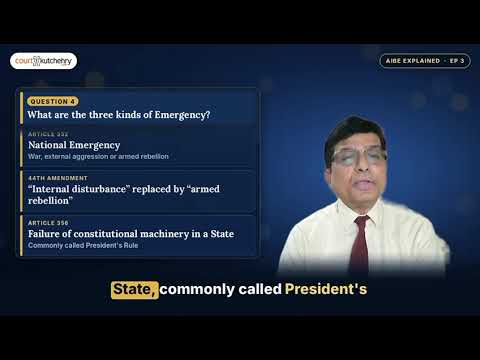
Q4. The Three Kinds of Emergency
| Article | Emergency | Ground |
|---|---|---|
| 352 | National Emergency | War, external aggression or armed rebellion |
| 356 | President’s Rule in a State | Failure of constitutional machinery in the State |
| 360 | Financial Emergency | Threat to the financial stability or credit of India |
A proclamation under Article 352 must be approved by both Houses of Parliament within one month. Even during a National Emergency, the enforcement of Articles 20 and 21 cannot be suspended.
In S.R. Bommai v. Union of India, a nine-judge Bench held that a proclamation under Article 356 is subject to judicial review, that the majority of a government must be tested on the floor of the House, and that secularism is part of the basic structure.
Remember this line: Article 356 is not a political weapon; it is open to judicial review.
Q5. How Is the Constitution Amended?
Article 368 contains the amending power. There are three ways to change the Constitution:
- Simple majority: some provisions, such as the creation of new States under Articles 2 to 4, are changed by an ordinary law and are expressly not treated as amendments under Article 368.
- Special majority: a majority of the total membership of each House and two-thirds of the members present and voting.
- Special majority plus ratification by half the States: for provisions on the federal structure, such as the election of the President, the Union and State judiciary, and the representation of States in Parliament.
The limit on this power comes from Kesavananda Bharati v. State of Kerala, (1973) 04 SC CK 0051: Parliament can amend any part of the Constitution, but it cannot destroy its basic structure.
Q6. The Judiciary
- Article 124: establishment and constitution of the Supreme Court.
- Article 141: the law declared by the Supreme Court is binding on all courts in India.
- Article 142: the Supreme Court may pass any order necessary for doing complete justice.
- Article 226: writ jurisdiction of the High Courts.
- Article 227: superintendence of the High Court over all courts and tribunals in its territory.
The Judges cases
Appointments of judges are a favourite topic. In Supreme Court Advocates-on-Record Association v. Union of India, (1993) 10 SC CK 0045, the Second Judges Case, the Court gave primacy to the opinion of the Chief Justice of India formed collectively with senior judges, the origin of the collegium. The Third Judges Case (an advisory opinion of 1998) settled the collegium as the Chief Justice with the four senior-most judges for Supreme Court appointments. In the NJAC case (2015), the Court struck down the 99th Amendment and the National Judicial Appointments Commission Act, and the collegium continued.
AIBE Practice Questions
The video ends with five practice questions. Try these:
- Which Article says Directive Principles are not enforceable? Answer: Article 37.
- Which amendment inserted the Fundamental Duties? Answer: the 42nd Amendment, 1976.
- Within what time must a National Emergency be approved by Parliament? Answer: one month.
Key Takeaways
- Directive Principles are not enforceable (Article 37), but the balance between Parts III and IV is part of the basic structure (Minerva Mills).
- Ordinances lapse six weeks after the legislature reassembles; repeated re-promulgation is a fraud on the Constitution (D.C. Wadhwa).
- Money Bills start only in the Lok Sabha (Article 110), and there is no joint sitting for Money Bills or Amendment Bills.
- Emergency under Article 352 needs Parliament’s approval within one month; President’s Rule under Article 356 is open to judicial review (S.R. Bommai).
- Amendment needs a simple majority, a special majority, or a special majority plus ratification by half the States; the basic structure cannot be destroyed.
Frequently Asked Questions
How many Fundamental Duties are there?
Eleven, in Article 51A. Ten were inserted by the 42nd Amendment in 1976 and the eleventh by the 86th Amendment in 2002.
Can the Rajya Sabha reject a Money Bill?
No. A Money Bill is introduced only in the Lok Sabha, and the Rajya Sabha can only make recommendations, which the Lok Sabha may accept or reject.
Is President’s Rule under Article 356 open to challenge in court?
Yes. S.R. Bommai v. Union of India held that the proclamation is subject to judicial review.
Which case gave us the collegium system?
The Second Judges Case, Supreme Court Advocates-on-Record Association v. Union of India (1993), followed by the Third Judges Case advisory opinion in 1998.
What does Article 142 allow?
It allows the Supreme Court to pass any decree or order necessary for doing complete justice in a matter before it.
Where can I watch the full explanation?
Watch the full explanation in 10 minutes: https://youtu.be/XY9GhYOjUJE.
Conclusion
With Episode 2 on Fundamental Rights and this episode on the rest of the Constitution, the whole of the AIBE’s highest-scoring subject is covered. The Bar Council asks for Article numbers, amendment numbers and case names, so learn them as pairs: Article 37 and Minerva Mills, Article 123 and D.C. Wadhwa, the Tenth Schedule and Kihoto Hollohan, Article 356 and S.R. Bommai, Article 368 and Kesavananda Bharati.
The next episode moves to Criminal Procedure, the second 10-mark subject, beginning with the FIR, arrest, remand and bail under the Bharatiya Nagarik Suraksha Sanhita.
▶ Watch the video: DPSP, President, Parliament, Emergency & Amendment for AIBE | Constitutional Law Part 2 | Ep 3
📖 Read more: Kesavananda Bharati Sripadagalvaru Vs State of Kerala (1973)
Research Judgments Like These on CourtKutchehry
Every judgment cited in this article, and lakhs more, can be searched and read on CourtKutchehry. Searching and reading judgments is free. A membership adds unlimited summaries, all related judgments, original court PDF downloads, bookmarks, notes and the CourtKutchehry AI assistant.
| Membership | Price | Works out to | AI credits |
|---|---|---|---|
| Monthly (1 month) | ₹599 | ₹599 / month | 1,000 / month |
| Quarterly (3 months) · Save 16% | ₹1,499 | ₹499.67 / month | 1,100 / month |
| Six-monthly (6 months) · Save 33% | ₹2,399 | ₹399.83 / month | 1,200 / month |
| Yearly (12 months) · Save 44% · Best value | ₹3,999 | ₹333.25 / month | 1,300 / month |
Every plan is a one-off purchase for a fixed period: nothing auto-renews and no card is kept on file. Prices are exclusive of applicable tax, which is added at checkout. Extra AI chat credits can be topped up from ₹99. A free verified account gets 5 summaries and 50 AI trial credits.
Prices are as displayed on courtkutchehry.com on 20 November 2026 and are subject to change without notice. Please check the pricing page for the current plans and offers.
For more judgments, legal opinions and case analysis, visit courtkutchehry.com
Visit CourtKutchehry →