
Quick Answer
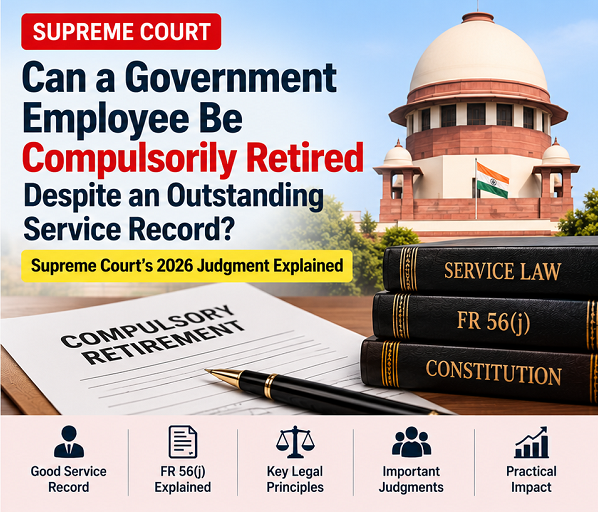
Yes, a government employee can be compulsorily retired despite having an outstanding service record if the competent authority deems it necessary based on considerations under FR 56(j). However, such decisions can be challenged, especially if they appear arbitrary or mala fide.
Key Takeaways
- The Supreme Court's 2026 judgment in S.S. Das v. Union of India clarifies the application of FR 56(j) in compulsory retirements.
- Compulsory retirement is not considered a punishment but a measure to maintain efficiency in public service.
- Judicial review is limited but possible in cases of arbitrariness or lack of bona fide reasons.
Case Background
In the landmark case S.S. Das v. Union of India (2026), the Supreme Court addressed the issue of compulsory retirement under FR 56(j). S.S. Das, a senior government officer, was compulsorily retired despite a commendable service record. The Union of India justified the retirement based on the need for maintaining efficiency within the service.
Why Employee Was Compulsorily Retired
S.S. Das was compulsorily retired under FR 56(j), which allows the government to retire an employee in the interest of public service. Despite Das's outstanding service record, the government cited the need to remove 'deadwood' from the administration to maintain efficiency.
What Supreme Court Decided
The Supreme Court upheld the retirement, emphasizing that compulsory retirement is not punitive but a measure to ensure efficiency in public service. The Court noted that while an outstanding service record is significant, it does not preclude compulsory retirement if deemed necessary by the competent authority.
What Is Compulsory Retirement?
Compulsory retirement is a provision under which a government employee can be retired before the actual superannuation. It is invoked to maintain the efficiency and integrity of the service. Unlike dismissal, it does not carry stigma or forfeiture of retirement benefits.
FR 56(j) Explained
FR 56(j) empowers the government to compulsorily retire employees in the interest of public service. It is a tool to weed out inefficient or corrupt officers, often referred to as 'deadwood.'
Good Service Record & Promotion
An employee with a good service record can still be retired if the overall interest of the service demands it. Promotions after adverse entries do not negate the possibility of compulsory retirement if such entries indicate a decline in efficiency.
Adverse Entries
Adverse entries in the service record play a crucial role in decisions of compulsory retirement. However, old or uncommunicated adverse entries hold less weight, especially if promotions followed thereafter.
When Courts Can Interfere
Courts can interfere with a compulsory retirement order under FR 56(j) if it is found to be arbitrary, mala fide, or without consideration of the entire service record. Judicial review does not typically involve reassessment of the authority's decision unless procedural lapses or bias are evident.
Compulsory Retirement vs Dismissal
While compulsory retirement is not punitive and does not carry stigma, dismissal or removal from service is a disciplinary action that results from proven misconduct or inefficiency.
Important Supreme Court Judgments
| Case Name | Court | Year | Issue | Key Principle | Relevance |
|---|---|---|---|---|---|
| S.S. Das v. Union of India | Supreme Court | 2026 | Compulsory Retirement | Efficiency in Service | Clarified application of FR 56(j) |
| Baikuntha Nath Das v. C.D.M.O. | Supreme Court | 1992 | Compulsory Retirement | Entire Service Record | Consideration of entire record essential |
| State of Gujarat v. Umedbhai M. Patel | Supreme Court | 2001 | Judicial Review | Scope of Judicial Review | Outlined grounds for interference |
| R.L. Butail v. UOI | Supreme Court | 1970 | Adverse Entries | Effect of Adverse Entries | Role of adverse entries in retirement |
| R.C. Chandel v. High Court of M.P. | Supreme Court | 2012 | Mala fide Actions | Arbitrary Retirement | Prohibition of mala fide retirements |
Practical Impact
This judgment underscores the importance of maintaining efficiency in government service and clarifies the limited scope of judicial review in such matters. It serves as a crucial reference for service-law advocates and government employees in understanding compulsory retirement.
FAQs
- Can a government employee challenge compulsory retirement? Yes, if the retirement appears arbitrary, mala fide, or based on incomplete evaluation.
- Is compulsory retirement considered a punishment? No, it's a measure to ensure service efficiency, not a disciplinary action.
- What is the role of adverse entries in compulsory retirement? They are significant but should be evaluated in the context of the entire service record.
- Can promotion negate adverse entries? Promotions do not automatically negate adverse entries but can influence overall assessment.
- What is the scope of judicial review in compulsory retirement cases? Courts examine procedural fairness, bona fide reasons, and absence of arbitrariness.
- Can compulsory retirement occur without adverse records? Yes, if deemed necessary for efficiency, even with a good service record.
For more in-depth analysis on government employment disputes and related judgments, consider subscribing to CourtKutchehry.
{ "additionalContent": "
Can a Government Employee Challenge Compulsory Retirement?
While compulsory retirement is not considered a punitive measure, government employees do have the right to challenge such decisions if they believe the retirement was unjust. The grounds for challenging compulsory retirement typically include allegations of arbitrariness, a lack of bona fide reasons, or failure to consider the entire service record.
Employees can file a writ petition under Article 226 or 32 of the Constitution of India in the respective High Court or Supreme Court. The courts will then examine the procedural fairness and the bona fides of the retirement decision. However, it is important to note that the scope of judicial review in such cases is limited to checking procedural irregularities and ensuring that the decision was not arbitrary or based on extraneous considerations.
Grounds for Challenge
- Arbitrariness: If the decision appears to lack a reasonable basis or is capricious.
- Lack of Bona Fide: If there is evidence to suggest that the decision was made with ulterior motives.
- Inadequate Consideration: If the entire service record was not duly considered or if the decision relied solely on outdated adverse entries.
Case Law on Challenging Compulsory Retirement
In State of Gujarat v. Umedbhai M. Patel (2001), the Supreme Court held that the decision to compulsorily retire an employee must be based on the entire service record, and any decision appearing to be arbitrary or mala fide could be subject to judicial review.
Can an Employee With a Good Service Record Still Be Compulsorily Retired?
Yes, even an employee with an exemplary service record can be compulsorily retired if it is deemed necessary in the interest of public service. The reasoning behind this is to maintain the overall efficiency and integrity of the service. As observed in Baikuntha Nath Das v. C.D.M.O. (1992), the Supreme Court emphasized that the entire service record must be considered, and the decision should be made in public interest.
However, the presence of a good service record necessitates a thorough examination to ensure that the decision is not arbitrary. Promotions or awards received during service can be indicative of good performance, but they do not automatically shield an employee from compulsory retirement if there are concerns about current efficiency or integrity.
Is Compulsory Retirement a Punishment?
Compulsory retirement under FR 56(j) is not considered punitive. It does not imply any stigma or forfeiture of retirement benefits. Instead, it serves as a mechanism to ensure that public service remains efficient and effective. This concept was reiterated in the judgment of R.C. Chandel v. High Court of M.P. (2012), where the court clarified that compulsory retirement is a step to remove inefficiency and not a penalty for misconduct.
When Can Courts Interfere With an FR 56(j) Retirement Order?
The courts possess the authority to intervene in cases of compulsory retirement if there is evidence of arbitrariness, mala fide intent, or procedural violations. However, judicial interference is not a matter of routine and occurs only when there is a clear violation of principles.
Courts generally avoid substituting their own judgment for that of the administrative authority unless the retirement decision is evidently unjust. According to the Supreme Court in R.L. Butail v. UOI (1970), judicial review is permissible if the decision is found to be based on inadequate or irrelevant considerations.
Principles Guiding Judicial Review
- Procedural Fairness: Ensuring that the decision-making process adhered to established rules and principles.
- Absence of Mala Fide: The decision must be made in good faith, without any extraneous considerations.
- Non-Arbitrariness: The decision should be reasonable and based on relevant material.
Important Supreme Court Judgments
| Case Name | Court | Year | Issue | Key Principle | Relevance |
|---|---|---|---|---|---|
| S.S. Das v. Union of India | Supreme Court | 2026 | Compulsory Retirement | Efficiency in Service | Clarified application of FR 56(j) |
| Baikuntha Nath Das v. C.D.M.O. | Supreme Court | 1992 | Compulsory Retirement | Entire Service Record | Consideration of entire record essential |
| State of Gujarat v. Umedbhai M. Patel | Supreme Court | 2001 | Judicial Review | Scope of Judicial Review | Outlined grounds for interference |
| R.L. Butail v. UOI | Supreme Court | 1970 | Adverse Entries | Effect of Adverse Entries | Role of adverse entries in retirement |
| R.C. Chandel v. High Court of M.P. | Supreme Court | 2012 | Mala fide Actions | Arbitrary Retirement | Prohibition of mala fide retirements |
Practical Impact
This judgment underscores the importance of maintaining efficiency in government service and clarifies the limited scope of judicial review in such matters. It serves as a crucial reference for service-law advocates and government employees in understanding compulsory retirement. For further insights into government employment disputes and related judgments, consider subscribing to CourtKutchehry for access to comprehensive legal research and analysis.
" }