
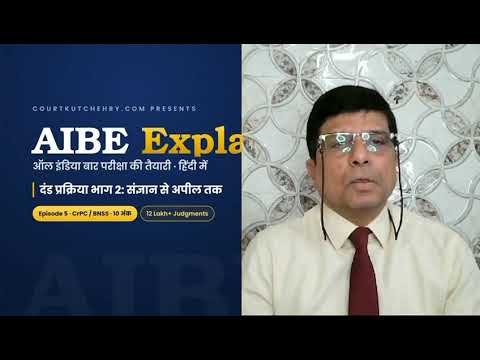
Watch the Video
In this 10-minute video in Hindi, Episode 5 of “AIBE Explained” and Part 2 of Criminal Procedure, the episode takes a criminal case from the Magistrate’s table to the appellate court: cognizance, the four kinds of trial, plea bargaining, examination of the accused and compounding, appeals and revision, the High Court’s inherent power under Section 528 and maintenance, always with the new BNSS section and the old CrPC section side by side. This English article gives Hindi-medium aspirants the episode in revision form, with a Hindi-English table of its legal terms.
Why This Episode Matters for Hindi-Medium Candidates
Criminal Procedure is one of the three 10-mark subjects of the AIBE. The episode teaches the Hindi term, the English term and both section numbers together; this article does the same, BNSS first and CrPC in brackets.
Key Legal Terms: Hindi ↔ English
These are the terms the episode uses. Learn them as pairs, because the AIBE paper is bilingual and the options may use either.
| Hindi term | English term | Where it appears |
|---|---|---|
| संज्ञान | Cognizance | BNSS 210 (CrPC 190) |
| विचारण | Trial | Sessions, warrant, summons and summary trials |
| संक्षिप्त विचारण | Summary trial | BNSS 283 to 288 |
| आरोप विरचित करना | Framing of charge | BNSS 251, 263 |
| फरार उद्घोषित अपराधी | Proclaimed offender | Trial in absentia, BNSS 356 |
| अभियुक्त की परीक्षा | Examination of the accused | BNSS 351 (CrPC 313) |
| शमन | Compounding | BNSS 359 (CrPC 320) |
| दोषमुक्ति | Acquittal | Victim’s appeal, BNSS 413 proviso |
| पुनरीक्षण | Revision | BNSS 438 (CrPC 397) |
| अंतर्वर्ती आदेश | Interlocutory order | No revision against it, BNSS 438(2) |
| अंतर्निहित शक्ति | Inherent power | BNSS 528 (CrPC 482) |
| भरण-पोषण | Maintenance | BNSS 144 (CrPC 125) |
Cognizance (संज्ञान): Revision Notes
- Cognizance by a Magistrate: BNSS 210 (CrPC 190), on a complaint, a police report or other information.
- New safeguard: under the proviso to BNSS 223 (CrPC 200), a Magistrate cannot take cognizance of an offence on a complaint without giving the accused an opportunity of being heard.
- Copies to the accused: the police report and documents must be supplied within 14 days (BNSS 230, CrPC 207).
The Four Kinds of Trial (विचारण)
| Kind of trial | Used for |
|---|---|
| Sessions trial | Offences triable by the Court of Session |
| Warrant trial | Warrant cases: offences punishable with death, life imprisonment or imprisonment for more than 2 years |
| Summons trial | Summons cases: offences punishable with imprisonment up to 2 years |
| Summary trial (संक्षिप्त) | Petty cases tried summarily; no sentence of imprisonment above 3 months can be passed (BNSS 285(2)) |
Two further points from the episode:
- Trial in absentia of a proclaimed offender who has absconded to evade trial is new, under BNSS 356.
- Judgment must be delivered within 30 days of the end of arguments, extendable to 45 days for recorded reasons (BNSS 392, CrPC 353).
Plea Bargaining: The Three Numbers
Plea bargaining is in BNSS 289 to 300 (CrPC 265A to 265L). For the exam, three limits are enough:
- 7 years: it is available only for offences punishable with imprisonment up to seven years.
- Not against a woman or a child, and not for offences affecting the socio-economic condition of the country.
- 30 days: the application is to be made within thirty days of the framing of charge (BNSS 290).
Examination of the Accused, Compounding and Withdrawal
- अभियुक्त की परीक्षा (BNSS 351, CrPC 313): the court questions the accused so that he can explain the circumstances appearing against him. He is not put on oath.
- शमन (BNSS 359, CrPC 320): only the offences listed in the section can be compounded, some by the parties and some only with the court’s permission.
- अभियोजन से वापसी (BNSS 360, CrPC 321): the Public Prosecutor may withdraw from the prosecution, but only with the consent of the court.
Appeal, Revision and Section 528
- Victim’s appeal: under the proviso to BNSS 413 (CrPC 372), the victim may appeal against an acquittal, a conviction for a lesser offence or inadequate compensation.
- Revision: BNSS 438 (CrPC 397). No revision lies against an interlocutory order.
- Inherent power of the High Court: now BNSS 528, formerly CrPC 482.
The two cases on Section 528
In State of Haryana v. Bhajan Lal, (1990) 11 SC CK 0008 (reported in 1992), the Supreme Court gave illustrative categories in which an FIR or criminal proceeding may be quashed. In Gian Singh v. State of Punjab, (2012) 09 SC CK 0145, it held that the High Court may quash proceedings on settlement even in a non-compoundable offence where the dispute is essentially private, but not in heinous or serious offences.
Remember this line: धारा 482 अब धारा 528 है: CrPC 482 is now BNSS 528, and Bhajan Lal still applies.
Maintenance (भरण-पोषण) under BNSS 144
BNSS 144 (CrPC 125) lets a wife, children and parents who cannot maintain themselves claim a monthly allowance from a person with sufficient means who neglects or refuses to maintain them. It is secular. Three cases:
- Mohd. Ahmed Khan v. Shah Bano Begum, (1985) 04 SC CK 0007: a divorced Muslim wife can claim maintenance under the secular provision.
- Danial Latifi v. Union of India, (2001) 09 SC CK 0013: the 1986 Act on Muslim women was upheld and read to require a fair provision that goes beyond the iddat period.
- Rajnesh v. Neha, (2020) 11 SC CK 0009: guidelines for maintenance cases, including affidavits disclosing assets and liabilities.
Quick Self-Test
Answers in brackets:
- पुनरीक्षण किस धारा में है? Which BNSS section deals with revision? (Section 438)
- Summary trial: what is the maximum sentence of imprisonment? (3 months)
- Plea bargaining application: within how many days of framing of charge? (30 days)
Key Takeaways
- संज्ञान = cognizance: BNSS 210; on a complaint, the accused must be heard first (BNSS 223 proviso); copies within 14 days (BNSS 230).
- Four trials: sessions, warrant (above 2 years), summons (up to 2 years) and summary (sentence up to 3 months); trial in absentia under BNSS 356 is new.
- Plea bargaining: up to 7 years, not against women or children, within 30 days of charge.
- No revision against an interlocutory order (BNSS 438); inherent power is now BNSS 528.
- भरण-पोषण = maintenance: BNSS 144 (CrPC 125), with Shah Bano, Danial Latifi and Rajnesh v. Neha.
Frequently Asked Questions
What does संज्ञान mean in English?
Cognizance: the stage at which a Magistrate first applies judicial mind to an offence with a view to proceeding. It is in BNSS 210 (old CrPC 190).
What is the old CrPC number for BNSS 528?
Section 482. The inherent power of the High Court to prevent abuse of process and secure the ends of justice is the same; only the number has changed.
Can a revision be filed against an interlocutory order?
No. BNSS 438 bars revision against interlocutory orders, as the old CrPC 397 did.
Which section of the BNSS deals with maintenance?
Section 144, which replaced CrPC Section 125. It is a secular remedy available to persons of all religions.
Where can I watch the video?
Watch the Hindi episode in 10 minutes: https://youtu.be/_2eNGDTcW4U.
Conclusion
The Hindi Episode 5 completes the life of a criminal case under the BNSS. The marks come from a handful of numbers, and from knowing each idea in both languages: संज्ञान and cognizance, पुनरीक्षण and revision, भरण-पोषण and maintenance.
The next episode moves to the Code of Civil Procedure.
▶ Watch the video: दंड प्रक्रिया भाग 2: संज्ञान, विचारण, अपील, भरण-पोषण और धारा 528 (BNSS) | AIBE Explained Ep 5
▶ Watch in English: Cognizance, Trial, Plea Bargaining, Appeals, Section 528 & Maintenance under BNSS | Part 2 | Ep 5
📖 Read the full article: Cognizance, Trial, Plea Bargaining, Appeals, Section 528 and Maintenance under BNSS | Criminal Procedure Part 2 | AIBE Ep 5
Research Judgments Like These on CourtKutchehry
Every judgment cited in this article, and lakhs more, can be searched and read on CourtKutchehry. Searching and reading judgments is free. A membership adds unlimited summaries, all related judgments, original court PDF downloads, bookmarks, notes and the CourtKutchehry AI assistant.
| Membership | Price | Works out to | AI credits |
|---|---|---|---|
| Monthly (1 month) | ₹599 | ₹599 / month | 1,000 / month |
| Quarterly (3 months) · Save 16% | ₹1,499 | ₹499.67 / month | 1,100 / month |
| Six-monthly (6 months) · Save 33% | ₹2,399 | ₹399.83 / month | 1,200 / month |
| Yearly (12 months) · Save 44% · Best value | ₹3,999 | ₹333.25 / month | 1,300 / month |
Every plan is a one-off purchase for a fixed period: nothing auto-renews and no card is kept on file. Prices are exclusive of applicable tax, which is added at checkout. Extra AI chat credits can be topped up from ₹99. A free verified account gets 5 summaries and 50 AI trial credits.
Prices are as displayed on courtkutchehry.com on 20 November 2026 and are subject to change without notice. Please check the pricing page for the current plans and offers.
For more judgments, legal opinions and case analysis, visit courtkutchehry.com
Visit CourtKutchehry →