
Watch the Video
In this 10-minute video, Episode 5 of the CourtKutchehry series “AIBE Explained” and Part 2 of Criminal Procedure, the episode covers cognizance, the kinds of trial, plea bargaining, compounding, appeals and revision, the inherent powers of the High Court and maintenance in seven questions, giving the BNSS section first and the old CrPC section alongside it, and then solves five practice questions. This article explains each point in writing.
From the Magistrate’s Table to the Appellate Court
Criminal Procedure carries 10 marks in the AIBE. Episode 4 showed how a criminal case begins. This episode follows it from cognizance to appeal. The episode covers cognizance, the kinds of trial, plea bargaining, compounding, appeals and revision, the inherent powers of the High Court and maintenance in seven questions, giving the BNSS section first and the old CrPC section alongside it.
Q1. What Is Cognizance?
Cognizance is the point at which a Magistrate first applies judicial mind to the facts of an offence with a view to proceeding against it. The provisions are:
- Cognizance by Magistrates: BNSS 210 (CrPC 190), on a complaint, a police report or other information.
- Examination of the complainant: BNSS 223 (CrPC 200). The proviso is new: the Magistrate cannot take cognizance on a complaint without giving the accused an opportunity of being heard.
- Postponement of process and inquiry: BNSS 225 (CrPC 202). Issue of process: BNSS 227 (CrPC 204).
- Supply of police report and documents to the accused within 14 days: BNSS 230 (CrPC 207).
Q2. The Four Kinds of Trial
Criminal trials are of four kinds: sessions trials, warrant trials, summons trials and summary trials. The questions usually ask about discharge and charge:
| Stage | Sessions trial | Warrant trial (police report) |
|---|---|---|
| Discharge | BNSS 250 (CrPC 227) | BNSS 262 (CrPC 239) |
| Framing of charge | BNSS 251 (CrPC 228) | BNSS 263 (CrPC 240) |
Two other provisions are new or changed. BNSS 356 allows the trial in absentia of a proclaimed offender who has absconded to evade trial. And BNSS 392 (CrPC 353) requires the judgment to be pronounced within 30 days of the conclusion of arguments, extendable to 45 days for reasons to be recorded.
Q3. Plea Bargaining
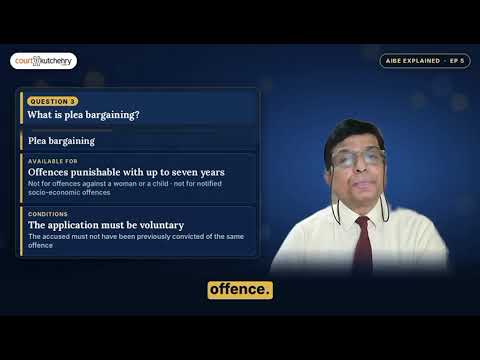
Plea bargaining is in BNSS 289 to 300 (CrPC 265A to 265L). An accused may apply for it where the offence is punishable with imprisonment of up to seven years. It is not available where the offence affects the socio-economic condition of the country, or is committed against a woman or a child.
Under BNSS 290, the application is to be filed within thirty days from the date of framing of charge. If a mutually satisfactory disposition is reached, the court may sentence the accused to a lower punishment, and the accused gets the benefit of set-off for the period already undergone.
Q4. Examination of the Accused, Compounding and Withdrawal
- Examination of the accused: BNSS 351 (CrPC 313). The court questions the accused to let him explain circumstances appearing against him in the evidence. He is not on oath and cannot be punished for refusing to answer.
- Compounding: BNSS 359 (CrPC 320). Only the offences listed in the section can be compounded, some without and some with the permission of the court.
- Withdrawal from prosecution: BNSS 360 (CrPC 321), by the Public Prosecutor with the consent of the court.
Q5. Appeals, Revision and Inherent Powers
- No appeal except as provided, and the victim’s right to appeal against acquittal, a conviction for a lesser offence or inadequate compensation: BNSS 413 and its proviso (CrPC 372).
- Appeal from conviction: BNSS 415 (CrPC 374).
- State appeals against inadequate sentence and against acquittal: BNSS 418 and 419 (CrPC 377 and 378).
- Revision: BNSS 438 (CrPC 397).
- Inherent powers of the High Court: BNSS 528 (CrPC 482).
Section 528: quashing
The inherent power exists to prevent abuse of the process of any court and to secure the ends of justice. In State of Haryana v. Bhajan Lal, (1990) 11 SC CK 0008, the Supreme Court set out seven illustrative categories in which an FIR or criminal proceeding may be quashed, such as where the allegations, even taken at face value, disclose no offence, or where the proceeding is manifestly attended with mala fides.
In Gian Singh v. State of Punjab, (2012) 09 SC CK 0145, the Court held that the High Court may quash even a non-compoundable offence on the basis of a settlement, where the dispute is essentially private, such as commercial, financial or matrimonial disputes, but not in heinous or serious offences that affect society.
Remember this line: CrPC 482 is now BNSS 528, and the Bhajan Lal categories still apply.
Q6. Maintenance
Maintenance of wives, children and parents is in BNSS 144 (CrPC 125). A person with sufficient means who neglects or refuses to maintain them can be ordered to pay a monthly allowance. The remedy is secular and applies to persons of every religion.
- Mohd. Ahmed Khan v. Shah Bano Begum, (1985) 04 SC CK 0007: a divorced Muslim wife who cannot maintain herself can claim maintenance under the secular provision.
- Danial Latifi v. Union of India, (2001) 09 SC CK 0013: the Court upheld the Muslim Women (Protection of Rights on Divorce) Act, 1986, reading it to require a reasonable and fair provision for the divorced wife that extends beyond the iddat period.
- Rajnesh v. Neha, (2020) 11 SC CK 0009: the Court laid down guidelines for maintenance cases across laws, including disclosure of assets and liabilities by affidavit, and held that maintenance is to be awarded from the date of the application.
Q7. Other Frequently Asked Provisions
- Victim compensation scheme: BNSS 396 (CrPC 357A).
- Limitation for cognizance: BNSS 514 (CrPC 468).
- Transfer by the Supreme Court: BNSS 446 (CrPC 406).
AIBE Practice Questions
The video ends with five practice questions. Try these on the same lines:
- Which BNSS section corresponds to CrPC 482? Answer: Section 528.
- Plea bargaining is available for offences punishable with up to how many years? Answer: seven years.
- Which BNSS section deals with maintenance? Answer: Section 144 (CrPC 125).
- Within how many days of arguments must judgment ordinarily be delivered? Answer: 30 days, extendable to 45 (BNSS 392).
- Which case laid down the categories for quashing? Answer: State of Haryana v. Bhajan Lal.
Key Takeaways
- Cognizance: BNSS 210 (CrPC 190); on a complaint, the accused must now be heard before cognizance under BNSS 223.
- Charge and discharge: BNSS 250, 251 (sessions) and 262, 263 (warrant); trial in absentia under BNSS 356 is new.
- Plea bargaining: BNSS 289 to 300, offences up to seven years, not against women or children.
- Appeals and revision: BNSS 413 to 438; inherent powers: BNSS 528 (CrPC 482), with Bhajan Lal and Gian Singh.
- Maintenance: BNSS 144 (CrPC 125), with Shah Bano, Danial Latifi and Rajnesh v. Neha.
Frequently Asked Questions
Must the accused be heard before cognizance on a complaint?
Yes. The proviso to BNSS 223 requires that the accused be given an opportunity of being heard before the Magistrate takes cognizance on a complaint.
Can a non-compoundable offence be quashed on settlement?
The High Court may do so under its inherent powers in essentially private disputes, as held in Gian Singh v. State of Punjab, but not for heinous or serious offences.
Can a victim appeal against an acquittal?
Yes. The proviso to BNSS 413 (CrPC 372) gives the victim a right of appeal against acquittal, conviction for a lesser offence or inadequate compensation.
Does Section 144 BNSS apply to Muslim women?
It is a secular provision. Shah Bano held that the corresponding CrPC provision applies to a divorced Muslim wife, and Danial Latifi read the 1986 Act to secure a fair provision for her.
What is trial in absentia?
Under BNSS 356, a proclaimed offender who absconds to evade trial can be tried and judgment pronounced in his absence, subject to the safeguards in the section.
Where can I watch the full explanation?
Watch the full explanation in 10 minutes: https://youtu.be/1Kntr0_3fbs.
Conclusion
Between them, Episodes 4 and 5 cover the life of a criminal case under the BNSS, from FIR to appeal. This half is about the court’s role: when it takes cognizance, how it frames charge, how it disposes of a case by trial, plea bargaining or compounding, and how higher courts correct errors through appeal, revision and Section 528.
Learn the BNSS and CrPC numbers side by side, and the five judgments in one line each. The next episode turns to the Code of Civil Procedure, the third 10-mark subject.
▶ Watch the video: Cognizance, Trial, Plea Bargaining, Appeals, Section 528 & Maintenance under BNSS | Part 2 | Ep 5
Research Judgments Like These on CourtKutchehry
Every judgment cited in this article, and lakhs more, can be searched and read on CourtKutchehry. Searching and reading judgments is free. A membership adds unlimited summaries, all related judgments, original court PDF downloads, bookmarks, notes and the CourtKutchehry AI assistant.
| Membership | Price | Works out to | AI credits |
|---|---|---|---|
| Monthly (1 month) | ₹599 | ₹599 / month | 1,000 / month |
| Quarterly (3 months) · Save 16% | ₹1,499 | ₹499.67 / month | 1,100 / month |
| Six-monthly (6 months) · Save 33% | ₹2,399 | ₹399.83 / month | 1,200 / month |
| Yearly (12 months) · Save 44% · Best value | ₹3,999 | ₹333.25 / month | 1,300 / month |
Every plan is a one-off purchase for a fixed period: nothing auto-renews and no card is kept on file. Prices are exclusive of applicable tax, which is added at checkout. Extra AI chat credits can be topped up from ₹99. A free verified account gets 5 summaries and 50 AI trial credits.
Prices are as displayed on courtkutchehry.com on 20 November 2026 and are subject to change without notice. Please check the pricing page for the current plans and offers.
For more judgments, legal opinions and case analysis, visit courtkutchehry.com
Visit CourtKutchehry →