
Watch the Video
In this 14-minute video, Episode 32 of “AIBE Explained” completes the Code of Civil Procedure, 1908, which carries 10 marks in the AIBE. In six questions it covers execution under Order XXI, attachment and sale, Government suits, special suits, caveat and the Commercial Courts Act, 2015, then solves five practice questions. This article turns the episode into revision notes: the numbers to memorise, the exam traps, and fresh practice questions.
Note 1: Starting Execution and the Judgment-Debtor’s Objections
- Order XXI Rules 10 and 11: application to the court that passed the decree or to which it was sent, ordinarily in writing.
- Sections 39 to 42: transfer of a decree to another court, e.g. where the judgment-debtor lives or holds property.
- Section 44A: decrees of superior courts of reciprocating territories are executable as if passed by the District Court.
- Section 47: all questions between the parties on execution, discharge or satisfaction go to the executing court, not a separate suit.
- Section 51: modes: delivery, attachment and sale, arrest and detention, receiver, or otherwise as the relief requires.
The executing court cannot go behind the decree. In Vasudev Dhanjibhai Modi v. Rajabhai Abdul Rehman, (1970) 03 SC CK 0051, the Supreme Court held that an objection to the correctness of a decree cannot be raised in execution; only a decree that is a nullity, for example one passed by a court with no inherent jurisdiction, can be challenged there.
Trap: the executing court cannot correct an erroneous decree; erroneous is not void.
Note 2: Arrest and Detention in Execution
Arrest and detention in civil prison (Sections 51, 55 to 59) are a last resort for a money decree.
Numbers to remember: Section 56 – a woman cannot be arrested or detained in execution of a decree for the payment of money.
Note 3: Attachment and Sale
- Section 60: attachable property and exemptions, e.g. necessary wearing apparel, artisans’ tools, a right to sue for damages, parts of salary.
- Section 64: once property is attached, a private transfer or delivery of it is void against all claims enforceable under the attachment.
- Order XXI Rule 46A: garnishee order, calling on a person who owes money to the judgment-debtor to pay it into court.
- Order XXI Rule 89: a sale may be set aside on deposit of the amount due under the proclamation plus five per cent of the purchase money for the purchaser.
- Order XXI Rule 90: a sale may be set aside for material irregularity or fraud in publishing or conducting it, only if substantial injury is shown.
- Order XXI Rules 97 to 103: resistance to possession is decided by the executing court; the order is treated as a decree.
Trap: Rule 89 is about deposit; Rule 90 is about irregularity or fraud. Students often swap them.
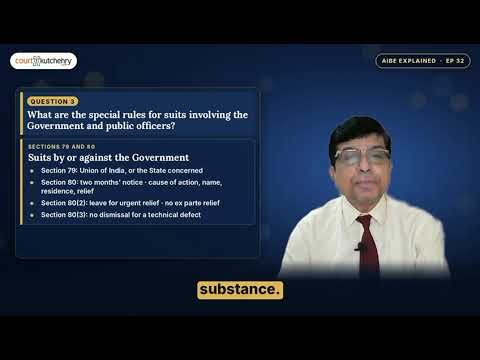
Note 4: Suits Involving the Government and Public Officers
| Provision | Rule |
|---|---|
| Section 79 | Suits by or against the Union of India or the State |
| Section 80(1) | Two months’ written notice before suing the Government or a public officer for an act in official capacity |
| Section 80(2) | Leave to sue without notice where urgent or immediate relief is needed; but no relief without giving the Government a chance to show cause |
| Section 82 | A decree against the Government is executed only if it remains unsatisfied for three months after it is reported |
In State of Punjab v. Geeta Iron and Brass Works Ltd., (1977) 10 SC CK 0019 (decided in 1977, reported in 1978), the Supreme Court said the Section 80 notice exists so the Government can settle just claims without litigation, not to defeat them on technicalities.
Remember this line: Section 80 is two months before the suit; Section 82 is three months before execution.
Note 5: Interpleader, Indigent Persons and Other Special Suits
- Interpleader (Section 88, Order 35): a stakeholder claiming no interest asks the court to decide between rival claimants.
- Indigent persons (Orders 33, 44): sue or appeal without paying court fee.
- Minors (Order 32), firms (Order 30), mortgages (Order 34): next friend and guardian; suits in the firm name; preliminary and final decrees.
- Summary suits (Order 37): the defendant cannot defend without leave of the court.
On leave to defend in a summary suit, IDBI Trusteeship Services Ltd. v. Hubtown Ltd., (2016) 11 SC CK 0064 (reported 2017), restated the Order 37 Rule 3 principles: substantial defence, unconditional leave; triable issue, leave possibly on conditions; frivolous defence, none.
Note 6: Caveat (Section 148A)
A caveat lets a person who expects an application insist on being heard first; the applicant must serve notice on the caveator.
Numbers to remember: a caveat remains in force for 90 days from the date it is lodged, unless the application is made within that time.
Note 7: The Commercial Courts Act, 2015
- Specified value: commercial disputes of at least ₹3 lakh.
- Section 12A: pre-institution mediation is mandatory unless the suit contemplates urgent interim relief.
- Written statement: 120 days is the outer limit in commercial suits.
- Section 13: appeals within 60 days.
Two judgments complete this note. In Patil Automation Pvt. Ltd. v. Rakheja Engineers Pvt. Ltd., (2022) 08 SC CK 0041, the Supreme Court held Section 12A mandatory: a suit filed without it is liable to rejection under Order 7 Rule 11 (declared prospectively). In SCG Contracts India Pvt. Ltd. v. K.S. Chamankar Infrastructure Pvt. Ltd., (2019) 02 SC CK 0139, the Court held that the 120-day limit cannot be extended.
Trap: in an ordinary civil suit, courts have treated the time for the written statement as directory; in a commercial suit, 120 days is final.
Practice Questions
The episode solves five practice questions. These five are written for this article on the same pattern (answers in brackets):
- Which section requires all questions relating to execution to be decided by the executing court? (Section 47)
- For how long does a caveat remain in force? (90 days)
- Notice period before suing the Government under Section 80? (Two months)
- Which provision provides for a garnishee order? (Order XXI Rule 46A)
- Minimum specified value of a commercial dispute? (₹3 lakh)
Key Takeaways
- The executing court decides all execution questions (Section 47) but cannot go behind the decree (Vasudev Dhanjibhai Modi).
- No arrest of a woman in execution of a money decree (Section 56); private transfer after attachment is void (Section 64).
- Section 80: two months’ notice; Section 82: three months before executing a decree against the Government.
- Commercial suits: ₹3 lakh, mandatory pre-institution mediation (Patil Automation), 120 days for the written statement (SCG Contracts), 60-day appeal.
Frequently Asked Questions
Can an executing court refuse to execute a decree it thinks is wrong?
No. Only a decree that is a nullity can be objected to in execution.
Can a suit be filed against the Government without the Section 80 notice?
Only with the leave of the court under Section 80(2), where urgent or immediate relief is needed.
What is the difference between Order XXI Rules 89 and 90?
Rule 89 is on deposit; Rule 90 is for material irregularity or fraud causing substantial injury.
Is pre-institution mediation always required in a commercial suit?
Yes, unless the suit contemplates urgent interim relief.
What is the next episode about?
BNS Part 3: offences against the State and public servants, false evidence, documents, marriage offences and defamation.
Where can I watch the full explanation?
Watch the English episode here: https://youtu.be/76GkBSors34.
Conclusion
The last part of the CPC is a collection of numbers: two months, three months, 90 days, 120 days, 60 days, ₹3 lakh. Learn them with their sections and the five judgments, and most of the 10 CPC marks are within reach.
Revise the traps the day before: Rule 89 v. Rule 90, erroneous v. void decrees, ordinary v. commercial written statements.
▶ हिंदी में देखें: सिविल प्रक्रिया भाग 3: निष्पादन (Order XXI), सरकार के विरुद्ध वाद, Interpleader, Caveat Ep 32
📖 Read the full article: Civil Procedure Part 3 for AIBE: Execution Under Order XXI, Suits Against Government, Interpleader, Caveat and Commercial Courts (Hindi Ep 32)
Research Judgments Like These on CourtKutchehry
Every judgment cited in this article, and lakhs more, can be searched and read on CourtKutchehry. Searching and reading judgments is free. A membership adds unlimited summaries, all related judgments, original court PDF downloads, bookmarks, notes and the CourtKutchehry AI assistant.
| Membership | Price | Works out to | AI credits |
|---|---|---|---|
| Monthly (1 month) | ₹599 | ₹599 / month | 1,000 / month |
| Quarterly (3 months) · Save 16% | ₹1,499 | ₹499.67 / month | 1,100 / month |
| Six-monthly (6 months) · Save 33% | ₹2,399 | ₹399.83 / month | 1,200 / month |
| Yearly (12 months) · Save 44% · Best value | ₹3,999 | ₹333.25 / month | 1,300 / month |
Every plan is a one-off purchase for a fixed period: nothing auto-renews and no card is kept on file. Prices are exclusive of applicable tax, which is added at checkout. Extra AI chat credits can be topped up from ₹99. A free verified account gets 5 summaries and 50 AI trial credits.
Prices are as displayed on courtkutchehry.com on 20 November 2026 and are subject to change without notice. Please check the pricing page for the current plans and offers.
For more judgments, legal opinions and case analysis, visit courtkutchehry.com
Visit CourtKutchehry →