
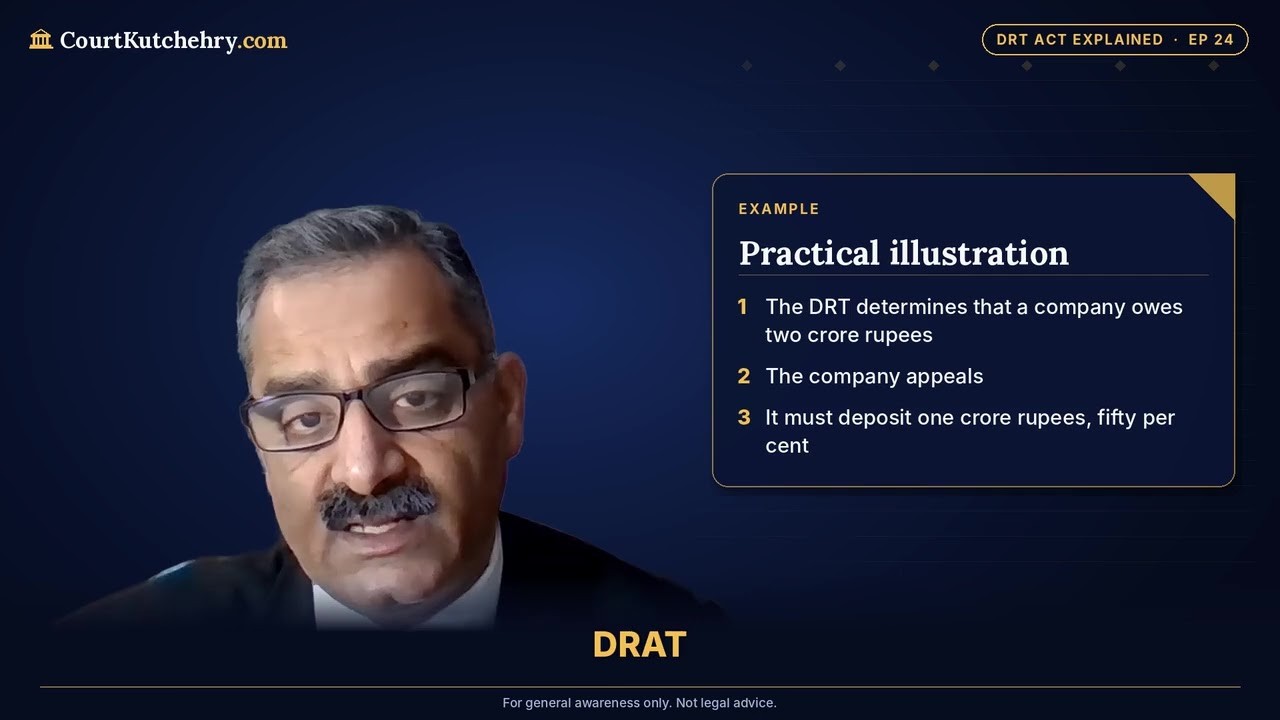
Watch the Video
In this 5-minute video, Vineet Kohli, Advocate looks closely at the pre-deposit under Section 21 of the Recovery of Debts and Bankruptcy Act, 1993 in Episode 24 of “DRT Act Explained with Judgments”. He takes up two Supreme Court judgments, Narayan Chandra Ghosh v. UCO Bank (2011) and Kotak Mahindra Bank v. Ambuj A. Kasliwal (2021), and a 2025 Delhi High Court judgment, Suman Srivastava v. Union Bank of India. This article covers the same ground, with links to the judgments on CourtKutchehry.
The Biggest Hurdle in a DRAT Appeal
For a borrower or guarantor who has lost before the DRT, the hardest part of an appeal is often not the law but the money. Before the DRAT will even hear the appeal, Section 21 of the Recovery of Debts and Bankruptcy Act, 1993 requires a pre-deposit. Two questions come up again and again: can the deposit be waived altogether? And does a guarantor’s legal heir have to pay it? Three judgments answer them.
Section 21: A Quick Recap
- An appeal by any person from whom the amount of debt is due will not be entertained unless 50% of the debt as determined by the DRT is deposited.
- The DRAT may, for reasons recorded in writing, reduce the deposit, but not below 25%.
Narayan Chandra Ghosh v. UCO Bank (2011)
In Narayan Chandra Ghosh v. UCO Bank and Others, (2011) 4 SCC 548, decided on 18 March 2011, the Supreme Court held that the pre-deposit is mandatory: it is a condition precedent, and an appeal cannot be entertained without it.
The case arose under Section 18 of the SARFAESI Act, which has a similar pre-deposit for appeals against DRT orders on securitisation applications. But the reasoning applies equally to Section 21 of the DRT Act, as the Supreme Court itself later confirmed.
Kotak Mahindra Bank v. Ambuj A. Kasliwal (2021)
The question of a complete waiver was settled in Kotak Mahindra Bank Pvt. Ltd. v. Ambuj A. Kasliwal & Ors., (2021) 02 SC CK 0033, (2021) 3 SCC 549, decided on 16 February 2021 by a three-judge Bench of Chief Justice S.A. Bobde, Justice A.S. Bopanna and Justice V. Ramasubramanian.
What happened
The DRAT had directed a pre-deposit of 50%. The Delhi High Court set that order aside and allowed the appeal to proceed without any pre-deposit, reasoning that the bank had already received a large sum before the DRT’s final judgment.
What the Supreme Court held
- The High Court erred. Section 21 makes the pre-deposit mandatory.
- The DRAT can only reduce the deposit, for reasons recorded in writing, to not less than 25%. It cannot waive it in full.
- The Court relied on Narayan Chandra Ghosh, noting that it had taken the same view under the SARFAESI Act.
- It modified the DRAT’s order and allowed the appellants to deposit 25% within eight weeks, failing which the appeal would not survive.
Remember this line: after Kasliwal, 25% is the floor, for the DRAT and for the High Court.
Suman Srivastava v. Union Bank of India (2025)
What if the person appealing never borrowed or guaranteed anything, but inherited the mortgaged property? The Delhi High Court answered this in Suman Srivastava v. Union Bank of India & Ors., (2025) 07 DEL CK 2111, decided on 24 July 2025 by a Division Bench of Subramonium Prasad and Harish Vaidyanathan Shankar, JJ.
- The appellant’s late husband had mortgaged his property as security for a company’s loan. After his death, the property passed to her and her sons, who were brought on record in the recovery proceedings.
- She argued that she was neither a borrower nor a guarantor, so Section 21 did not apply to her.
- The High Court disagreed. The liability of the deceased guarantor fell on the heir, and because she was seeking to save the mortgaged property, Section 21 applied to her. Relying on Kasliwal and Narayan Chandra Ghosh, it held that the pre-deposit could not be waived, and dismissed her writ petition.
So the requirement applies to anyone from whom the debt is due, including through inheritance.
Practice Points for Advocates
- Calculate on the right figure. Under Section 21, the deposit is calculated on the amount determined by the DRT, not on the larger amount the bank claimed in its application. (The SARFAESI Act’s Section 18 uses a different base, so do not mix up the two.)
- Prove hardship with documents. An application to reduce the deposit must show genuine financial hardship, supported by bank statements, balance sheets and proof of frozen accounts. A bare plea of inability will not do.
- Manage expectations. Never tell a client that the High Court can grant a full waiver. After Kasliwal, the 25% minimum is firm.
Practical Illustration: Reducing the Deposit
The DRT finds that a company owes ₹2 crore.
- To appeal, it must deposit ₹1 crore (50%).
- It files an application showing frozen accounts and losses, with documents. The DRAT reduces the deposit to ₹50 lakh (25%), giving written reasons.
- If the company instead asks for a full waiver, the DRAT must refuse, and a writ petition to the High Court will not change that.
Key Takeaways
- Section 21 requires a pre-deposit of 50% of the debt determined by the DRT; the DRAT can reduce it, with reasons, to no less than 25%.
- Narayan Chandra Ghosh v. UCO Bank (2011): the pre-deposit is a condition precedent; the reasoning under SARFAESI applies to Section 21.
- Kotak Mahindra Bank v. Ambuj A. Kasliwal (2021): no full waiver; the Supreme Court set aside a High Court order allowing an appeal without deposit.
- Suman Srivastava v. Union Bank of India (Delhi HC, 2025): a legal heir of a deceased guarantor who seeks to save the mortgaged property must also deposit.
- Calculate on the amount determined, and support any reduction application with real financial documents.
Frequently Asked Questions
Can the DRAT waive the pre-deposit under Section 21?
No. In Kotak Mahindra Bank v. Ambuj A. Kasliwal (2021), the Supreme Court held that the DRAT can only reduce it, with reasons, to not less than 25%.
Can the High Court allow a DRAT appeal without any pre-deposit?
No. In Kasliwal, the Supreme Court set aside exactly such an order of the Delhi High Court and directed a 25% deposit.
Does a legal heir of a deceased guarantor have to make the pre-deposit?
Yes, where the heir steps into the guarantor’s liability and seeks to save the mortgaged property, as the Delhi High Court held in Suman Srivastava v. Union Bank of India (2025).
Is the pre-deposit calculated on the bank’s claim or on the DRT’s order?
Under Section 21 of the DRT Act, on the amount of debt determined by the DRT under Section 19.
What must I show to get the deposit reduced?
Genuine financial hardship, supported by documents such as bank statements and balance sheets. The DRAT must record its reasons for any reduction.
Where can I watch the full explanation?
Watch Vineet Kohli, Advocate explain it in 5 minutes: https://youtu.be/v16OGjBgyic.
Conclusion
The pre-deposit under Section 21 is not a formality. The Supreme Court has held, in Narayan Chandra Ghosh and again in Kasliwal, that it is mandatory and can be reduced only to 25%, never waived.
And the Delhi High Court in Suman Srivastava has made clear that it binds anyone from whom the debt is due, including a legal heir who wants to save inherited, mortgaged property. Advise clients early, and plan for the deposit before filing the appeal.
▶ Watch the video: Can DRAT Waive Pre-deposit? Section 21 | Kotak v. Kasliwal & Suman Srivastava | DRT Act Ep 24
Research Judgments Like These on CourtKutchehry
Every judgment cited in this article, and lakhs more, can be searched and read on CourtKutchehry. Searching and reading judgments is free. A membership adds unlimited summaries, all related judgments, original court PDF downloads, bookmarks, notes and the CourtKutchehry AI assistant.
| Membership | Price | Works out to | AI credits |
|---|---|---|---|
| Monthly (1 month) | ₹599 | ₹599 / month | 1,000 / month |
| Quarterly (3 months) · Save 16% | ₹1,499 | ₹499.67 / month | 1,100 / month |
| Six-monthly (6 months) · Save 33% | ₹2,399 | ₹399.83 / month | 1,200 / month |
| Yearly (12 months) · Save 44% · Best value | ₹3,999 | ₹333.25 / month | 1,300 / month |
Every plan is a one-off purchase for a fixed period: nothing auto-renews and no card is kept on file. Prices are exclusive of applicable tax, which is added at checkout. Extra AI chat credits can be topped up from ₹99. A free verified account gets 5 summaries and 50 AI trial credits.
Prices are as displayed on courtkutchehry.com on 20 November 2026 and are subject to change without notice. Please check the pricing page for the current plans and offers.
For more judgments, legal opinions and case analysis, visit courtkutchehry.com
Visit CourtKutchehry →