
Watch the Video
In this 7-minute video, Episode 23 of “RERA Act Explained with Judgments”, we study one sentence of the Real Estate (Regulation and Development) Act, 2016 that has changed how builders litigate: the pre-deposit rule in the proviso to Section 43(5). Before a promoter can be heard in a RERA appeal, he must first put money on the table. This article explains the rule, the Supreme Court’s reasons for upholding it in Newtech, and two 2025 Delhi High Court judgments that show how strictly it is enforced.
The Proviso to Section 43(5)
Section 43(5) gives any aggrieved person a right of appeal to the Real Estate Appellate Tribunal. Its proviso adds a condition for one class of appellant. Where a promoter files an appeal, it shall not be entertained unless the promoter first deposits with the Tribunal:
- at least 30% of the penalty, or such higher percentage as the Tribunal may determine; or
- the total amount to be paid to the allottee, including interest and compensation imposed on him, if any; or
- both, as the case may be,
before the appeal is heard.
The condition applies only to promoters. An allottee who appeals does not have to make this pre-deposit.
What the Deposit Covers
- If the order under appeal is a penalty order, the promoter deposits at least 30% of the penalty, or a higher percentage fixed by the Tribunal.
- If the order directs the promoter to pay the allottee, the promoter deposits the full amount payable, with interest and compensation.
- If the order does both, the promoter deposits both.
The Exact Words That Matter
The proviso says the appeal “shall not be entertained” without the deposit. Courts read these words as mandatory. The Tribunal has no power to waive the deposit and hear the promoter anyway. Its discretion is limited to what the proviso itself allows, such as fixing a percentage of the penalty higher than 30%.
Remember this line: no deposit, no appeal, for promoters.
Newtech: The Rule Is Valid
The constitutional challenge to the proviso was decided in M/s Newtech Promoters and Developers Pvt. Ltd. v. State of U.P., (2021) 11 SC CK 0015, on 11 November 2021, by a Bench of Justices Uday Umesh Lalit, Ajay Rastogi and Aniruddha Bose. The Supreme Court upheld the pre-deposit rule. Its reasoning runs in three steps:
- Appeal is a creature of statute. There is no inherent right of appeal. Because Parliament creates it, Parliament may attach reasonable conditions to it. The Court drew support from earlier decisions upholding pre-deposit conditions in other statutes.
- Promoters are a distinct class. Promoters carry far heavier obligations under the Act than allottees, and they hold the allottees’ money. Treating them differently has an intelligible basis, so there is no violation of Article 14.
- The purpose is legitimate. The deposit secures the amount already found due to the allottee, so that recovery does not become difficult if the promoter’s appeal fails, and it reflects the promoter’s bona fides in appealing.
The Court held the condition was not onerous and did not offend Article 14 or Article 19(1)(g). It then gave the appellant promoters 30 days to approach the Appellate Tribunal, subject to complying with the pre-deposit.
Why Parliament Made This Rule
Before RERA, a builder who lost a consumer case could file an appeal and keep the buyer’s money for years while it was pending. Many buyers settled for less, just to get something back. The pre-deposit removes that incentive. If a promoter wants to appeal, the buyer’s money is secured first.
CJ Infrastructure v. Real Estate Appellate Tribunal (Delhi HC, 2025)
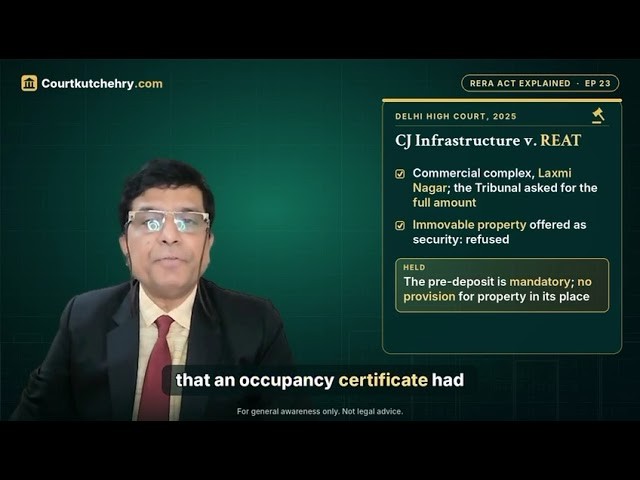
The Delhi High Court applied the rule strictly in CJ Infrastructure Pvt. Ltd. & Anr. v. Real Estate Appellate Tribunal for NCT of Delhi and UT Chandigarh & Ors., (2025) 08 DEL CK 1866, decided on 29 August 2025 by a Division Bench of Justices Anil Kshetarpal and Harish Vaidyanathan Shankar.
The facts
The promoter of a commercial complex at Laxmi Nagar, Delhi lost before Delhi RERA in complaints by individual buyers. In its appeals, the Appellate Tribunal made continuance conditional on depositing the full amounts adjudicated. The promoter did not deposit them, and the Tribunal dismissed the appeals for non-compliance, relying on Section 43(5) and Newtech.
What the High Court held
- The pre-deposit is mandatory. The proviso bars even entertaining a promoter’s appeal without it, and the condition is not onerous.
- Property cannot replace the deposit. The Act contains no provision allowing a promoter to offer immovable property as security instead of depositing the amount with the Tribunal.
- RERA applied to the project. The promoter argued that its occupancy certificate should be treated as deemed granted before RERA came into force. The Court rejected this on the facts, noting among other things that the development authority had rejected the application in 2021, so the Act applied.
- A last chance, on deposit. The appeals were dismissed, but the promoters were given liberty to seek revival before the Tribunal within 30 days, only on complying with the pre-deposit.
Note also that the proviso itself contains no exception for financial hardship. A promoter who pleads that he cannot afford the deposit is, in substance, asking the Tribunal to do what the Act does not allow.
Sansadiya Adhikari Welfare Society (Delhi HC, 30 July 2025)
In Sansadiya Adhikari Welfare Society (SAWS) v. Utpal Kumar Tripathi & Ors., (2025) 07 DEL CK 1921, the same Bench dealt with a welfare society that had collected contributions from members for a housing project. Delhi RERA allowed the members’ refund complaint with interest. The Appellate Tribunal dismissed the society’s appeal because it had not pre-deposited the amount, as Section 43(5) requires.
The society argued that it was not a promoter at all. The High Court disagreed: a society that acquires land to build apartments for its members falls within the definition of “promoter” in Section 2(zk), and being non-profit makes no difference. Once it was a promoter, the pre-deposit rule, already upheld in Newtech, applied to it too, and the appeal was dismissed.
What Happens to the Deposit
The deposit sits with the Tribunal while the appeal is pending. As the video explains, if the promoter loses, the Tribunal may direct the amount to be released to the allottee; if the promoter succeeds, it can be returned. Either way, the buyer’s money is secured during the appeal, which is exactly what Newtech said the rule is for.
Practice points
- For a promoter’s lawyer: budget for the pre-deposit before advising an appeal, and make the actual deposit with the Tribunal on time. Do not plan on offering property or other security in its place.
- For an allottee’s lawyer: check at the first hearing whether the deposit has been made, and press for dismissal if it has not.
Quick Test
- Does the pre-deposit rule apply to allottees? No, only to promoters.
- Can a promoter offer immovable property instead of the pre-deposit? No (CJ Infrastructure).
- Which Supreme Court judgment upheld the rule? Newtech Promoters and Developers Pvt. Ltd. v. State of U.P. (2021).
Key Takeaways
- A promoter’s appeal shall not be entertained without depositing at least 30% of the penalty, or the full amount payable to the allottee with interest and compensation, or both.
- The rule applies only to promoters; allottees appeal without a pre-deposit.
- Newtech (11 November 2021) upheld the rule: appeal is a statutory right, promoters are a distinct class holding buyers’ money, and there is no violation of Article 14.
- CJ Infrastructure (Delhi HC, 29 August 2025): the deposit is mandatory and property cannot be offered instead.
- Sansadiya Adhikari Welfare Society (Delhi HC, 30 July 2025): a society that is a promoter must also make the pre-deposit.
Frequently Asked Questions
How much must a builder deposit to appeal a RERA order?
At least 30% of any penalty (or a higher percentage set by the Tribunal), and/or the total amount payable to the allottee including interest and compensation, depending on what the order imposes.
Does a homebuyer have to deposit anything to appeal?
No. The proviso to Section 43(5) applies only to appeals by promoters.
Can the Tribunal waive the pre-deposit because the builder is in financial difficulty?
The proviso makes no exception for hardship, and the courts treat the words “shall not be entertained” as mandatory.
Can a builder offer a flat or land as security instead of cash?
No. In CJ Infrastructure, the Delhi High Court held that the Act has no provision for furnishing property in place of the deposit.
Is the pre-deposit rule constitutional?
Yes. The Supreme Court upheld it in Newtech Promoters (2021), rejecting the challenge under Article 14.
Where can I watch the full explanation?
Watch Episode 23 of RERA Act Explained with Judgments here: https://youtu.be/VNJz_DgmqgM.
Conclusion
The proviso to Section 43(5) is short, but it ends a familiar delaying tactic. A promoter who has been ordered to pay a buyer must secure that money before his appeal is entertained. The Supreme Court upheld the rule in Newtech, and the Delhi High Court has refused to dilute it, whether by accepting property in place of cash or by excusing a society that turns out to be a promoter.
For buyers, the rule means their money is protected while the appeal runs. For promoters, it means an appeal is a financial decision as much as a legal one. In the next episode, we read Sections 45 to 57: the composition and powers of the Appellate Tribunal and how its orders are executed.
▶ Watch the video: Builder Must Pay Before Appeal: RERA Section 43(5) Pre-deposit, Newtech | RERA Explained Ep 23
Research Judgments Like These on CourtKutchehry
Every judgment cited in this article, and lakhs more, can be searched and read on CourtKutchehry. Searching and reading judgments is free. A membership adds unlimited summaries, all related judgments, original court PDF downloads, bookmarks, notes and the CourtKutchehry AI assistant.
| Membership | Price | Works out to | AI credits |
|---|---|---|---|
| Monthly (1 month) | ₹599 | ₹599 / month | 1,000 / month |
| Quarterly (3 months) · Save 16% | ₹1,499 | ₹499.67 / month | 1,100 / month |
| Six-monthly (6 months) · Save 33% | ₹2,399 | ₹399.83 / month | 1,200 / month |
| Yearly (12 months) · Save 44% · Best value | ₹3,999 | ₹333.25 / month | 1,300 / month |
Every plan is a one-off purchase for a fixed period: nothing auto-renews and no card is kept on file. Prices are exclusive of applicable tax, which is added at checkout. Extra AI chat credits can be topped up from ₹99. A free verified account gets 5 summaries and 50 AI trial credits.
Prices are as displayed on courtkutchehry.com on 20 November 2026 and are subject to change without notice. Please check the pricing page for the current plans and offers.
For more judgments, legal opinions and case analysis, visit courtkutchehry.com
Visit CourtKutchehry →