

COURTKUTCHEHRY SPECIAL SERIES ON LANDMARKS JUDGEMENTS ON WILLS, CODICIL & PROBATE
Seth Beni Chand (Deceased) v. Smt Kamla Kunwar & Ors.: Supreme Court Upholds Validity of Will Excluding Son
Forgery and Unconsciousness Allegations Rejected
Probate Granted as Suspicious Circumstances Explained
By Vishwas Kumar
New Delhi: March 28, 2026:
On 14 September 1976, the Supreme Court of India in Seth Beni Chand (since deceased) now represented by his legal representatives v. Smt Kamla Kunwar & Ors. (Civil Appeal No. 2259 of 1972) delivered a landmark ruling on the validity of a contested will. The Full Bench comprising Hon’ble Mr. Justice Y.V. Chandrachud, Hon’ble Mr. Justice V.R. Krishna Iyer, and Hon’ble Mr. Justice N.L. Untwalia examined whether the will executed by an aged testatrix, who excluded her only son, was genuine.
The son had alleged that the will was forged and that his mother was unconscious at the time of execution. However, the Court found these claims unsupported by evidence. The propounder of the will successfully discharged the burden under Sections 63 of the Indian Succession Act and 68 of the Indian Evidence Act, demonstrating that the testatrix was of sound mind, executed the will voluntarily, and that it was duly attested. The Court emphasized that while suspicious circumstances must be carefully scrutinized, they were satisfactorily explained in this case.
Rejecting the allegations of fraud and incapacity, the Supreme Court upheld the High Court’s decision granting probate to Smt Kamla Kunwar. The appeal was dismissed, confirming the validity of the will and reinforcing the principle that testamentary freedom cannot be curtailed without strong proof of coercion or forgery.
This ruling remains a significant precedent in succession law, underscoring the judiciary’s approach in balancing suspicion with evidence. It highlights that exclusion of natural heirs, though unusual, does not by itself invalidate a will if the testator’s intent and capacity are clearly established.
For More, Read Here the Summary of the Judgement from the Book: WILL WRITING SIMPLIFIED, read below or open page no 436, Chapter 14.1 in the book. (Online book purchase link available here on: Buy online: Amazon | Flipkart
|
|
Case Summary |
: |
Seth Beni Chand (since deceased) now represented by his legal representatives v. Smt Kamla Kunwar and Others. |
|
|
Court |
: |
Supreme Court of India |
|
|
Citations |
: |
(1976) 09 SC CK 0025: Civil Appeal No. 2259 of 1972. |
|
|
Link |
: |
|
|
|
Decided on |
: |
14 September 1976 |
|
|
Coram |
: |
Hon’ble Mr. Justice Y.V. Chandrachud Hon’ble Mr. Justice V.R. Krishna Iyer and Hon’ble Mr. Justice N.L. Untwalia. (Full Bench) |
|
|
Relevant Paragraphs |
: |
Para Nos.2–16 |
1. Facts of the Case:
The dispute concerned the validity of a will executed by Smt. Jaggo Bai, aged 80, five days before her death (26 Oct 1961). She disinherited her only son Beni Chand and his third wife Ved Kumari’s children, bequeathing her extensive stridhan properties to the progeny of Beni Chand’s first wife Chameli Bai and to his second wife Kamla Kunwar and her children. After Jaggo Bai’s death (31 Oct 1961), Kamla Kunwar sought probate of the will. Beni Chand entered a caveat alleging forgery and unconsciousness of the testatrix. A Single Judge of the Allahabad High Court dismissed the probate petition for failure to remove suspicious circumstances. On appeal, a Division Bench reversed and upheld the will’s validity. Beni Chand appealed to the Supreme Court.
2. Law Points Involved:
Proof of execution and attestation of wills under Section 68 of the Evidence Act, 1872 and Section 63 of the Indian Succession Act, 1925; burden of proof on propounder of a will when execution is surrounded by suspicious circumstances; sound and disposing mind of testator; effect of unattested or unproved attestation; requirement of removal of suspicion by satisfactory evidence; entitlement of alienee to citation in probate proceedings.
3. Acts / Provisions / Articles Referred:
(i). Evidence Act, 1872 — Section 68
(ii). Indian Succession Act, 1925 — Section 63(c)
(iii). Hindu Succession Act, 1956 — Section 15(1)
4. Judgments Referred:
(i). H. Venkatachala Iyengar v. B.N. Thimmajamma, (1958) 11 SC CK 0008.
(ii). Harmes v. Hinkson (1946) 05 PRI CK 0001.
5. Obiter Dicta:
The Court reiterated that in testamentary matters the judge must adopt “reasonable scepticism, not obdurate disbelief.” The judicial mind must remain open, vigilant and circumspect in evaluating evidence relating to wills.
6. Ratio Decidendi:
Where a will is executed under circumstances that raise suspicion — advanced age of testatrix, unnatural disinheritance, and execution close to death — the propounder must dispel suspicion by satisfactory evidence. If the propounder proves sound disposal of mind, due execution, and attestation as required by law, and offers a credible explanation for all apparent suspicions, the will must be accepted as valid. Absence of endorsement of left or right thumb is immaterial if properly explained. A signatory who witnesses execution in the presence of the testator qualifies as an attesting witness though not so described.
7. Final Ruling:
Appeal dismissed. The Supreme Court affirmed the Division Bench judgment upholding Jaggo Bai’s will as her last valid testament. The Receiver was directed to hand over property to executrix Kamla Kunwar after four months, subject to any interim orders in a suit by the alienee. An undertaking was recorded that Kamla Kunwar and others would make ex gratia payments of ₹ 20,000 each to four children of Beni Chand by Ved Kumari. Costs to be shared equally by Vikram Chander and alienee Sadhu Prasad.
8. Gist / Dispute & Final Decision:
Central issue - validity of a will by an aged testatrix excluding her only son. Alleged forgery and unconsciousness rejected for want of proof;
propounder discharged burden under Sections 63 and 68 by showing sound mind, voluntary execution and attestation. Court held suspicious circumstances were satisfactorily explained. Probate granted to Kamla Kunwar; appeal dismissed.
Read full Judgement Here:
Seth Beni Chand (since deceased) now represented by his legal representatives v. Smt Kamla Kunwar and Others.
Supreme Court of India
(1976) 09 SC CK 0025: Civil Appeal No. 2259 of 1972.
You Can Also Purchase the Book from here on: Buy online: Amazon | Flipkart
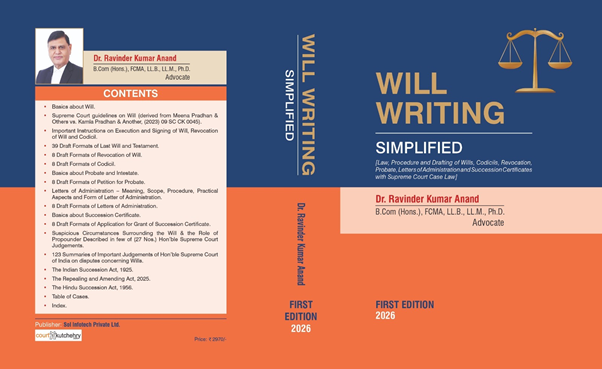
OUR RECOMMENDATION: Check out 123 Key Judgements, as highlighted in the book, WILL WRITING SIMPLIFIED, for the quick research and reference purposes. Click the link here: https://www.courtkutchehry.com/pages/blog/123-supreme-court-judgments-on-wills/
Keywords for SEO & Quick Search
- Seth Beni Chand v. Kamla Kunwar Supreme Court case
- 1976 Indian Supreme Court will dispute judgment
- Testamentary freedom exclusion of son case India
- Justice Y.V. Chandrachud will validity ruling
- Probate granted Supreme Court India
- Civil Appeal No. 2259 of 1972 Supreme Court
- Apex Court suspicious circumstances will ruling India