
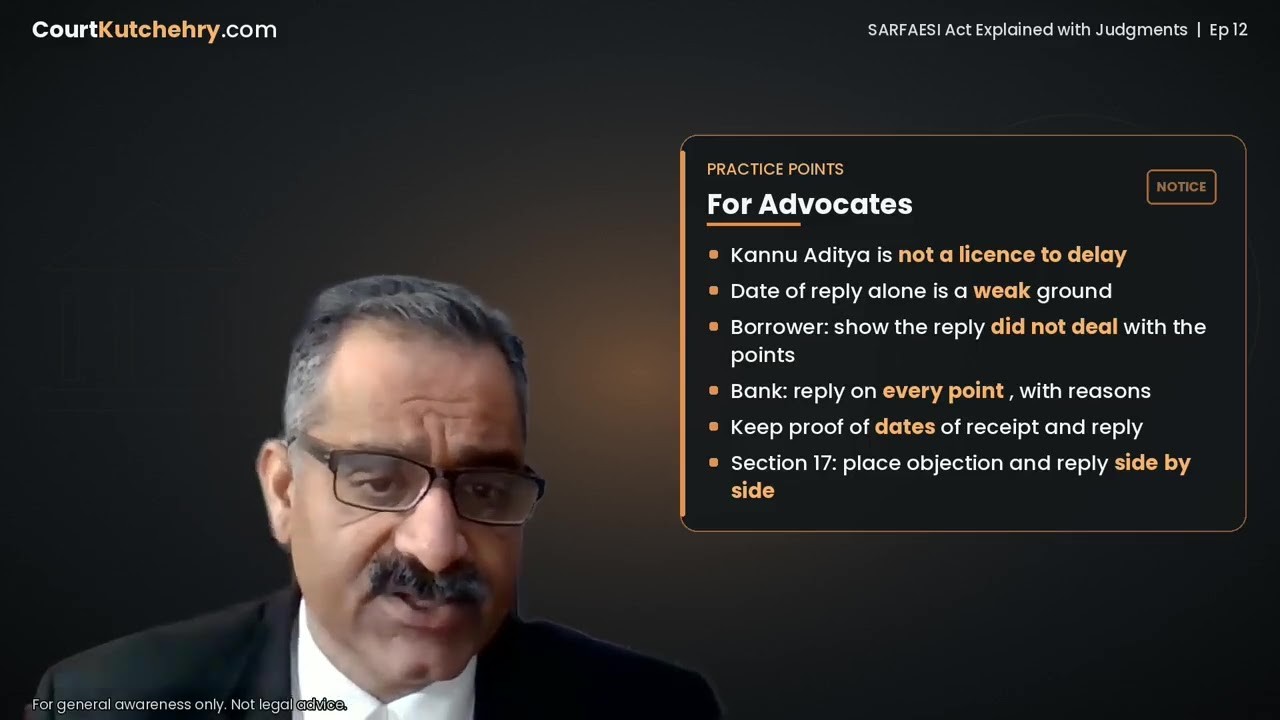
Watch the Video
In this 8-minute video, Vineet Kohli, Advocate, explains what happens when a bank considers the borrower’s objection but replies after the 15 days allowed by Section 13(3A), through a Delhi High Court judgment, in Episode 12 of “SARFAESI Act Explained with Judgments”. This article sets out the same points in writing, with links to the judgments on CourtKutchehry.
The Question: Is a Late Reply Fatal?
Under Section 13(3A) of the Securitisation and Reconstruction of Financial Assets and Enforcement of Security Interest Act, 2002, a bank that rejects a borrower’s objection to a demand notice must communicate its reasons within 15 days. But what if the bank does consider the objection, and simply replies late? Does the whole SARFAESI action fall?
This episode answers that question through a Delhi High Court judgment, and the Supreme Court judgment it relied on.
Two Duties Under Section 13(3A)
Read closely, Section 13(3A) places two separate duties on the secured creditor:
- To consider the borrower’s representation or objection; and
- To communicate the reasons for not accepting it, within 15 days of receipt.
Notice the structure. The duty to consider is stated without any time limit. The 15 days attach only to the second duty, the communication of reasons. So the question becomes: are both duties equally mandatory?
Lawyers call a requirement mandatory when breaking it makes the action invalid, and directory when it is meant to secure action within a reasonable time, so that a delay alone does not invalidate what is done.
ITC Ltd. v. Blue Coast Hotels (Supreme Court, 2018)
In ITC Limited vs Blue Coast Hotels Ltd., (2018) 03 SC CK 0035, the Supreme Court examined the purpose of Section 13(3A): to ensure that the borrower’s objections are considered before measures are taken against the secured asset.
The creditor in that case had not replied in writing to one of the borrower’s representations. But the Court found that the creditor had in fact considered the borrower’s proposals and given it repeated extensions, while the borrower kept seeking time without paying. In those circumstances, the non-compliance could not help the borrower, and relief was refused. The lesson: not every procedural lapse is fatal. The Court looks at whether the borrower was actually heard.
Kannu Aditya India v. State Bank of India (Delhi High Court, 2018)
The facts
In M/s Kannu Aditya India Ltd vs State Bank of India, (2018) 10 DEL CK 0449, the bank issued a notice under Section 13(2) on 30 July 2018. The company submitted a representation on 27 September 2018. The bank rejected it by a letter dated 14 October 2018, which the company said it received on 20 October 2018. The company filed a writ petition arguing that the reply came more than 15 days after its representation, and that this made the SARFAESI proceedings invalid.
The decision
On 26 October 2018, Justice Vibhu Bakhru dismissed the writ petition. Relying on ITC v. Blue Coast Hotels, the Court held that:
- the requirement to consider the borrower’s representation is mandatory; but
- the 15-day period for communicating the decision is directory, not mandatory.
The Court reasoned that Parliament could not have intended a secured creditor to forfeit its right to enforce its security merely because it missed that period. A decision communicated within a reasonable time, measured against the 15-day benchmark, is substantial compliance. A late reply alone, therefore, did not invalidate the proceedings.
The Line to Remember
Remember this line: ignoring the objection is fatal; replying a few days late usually is not.
The courts look at substance over form. Were the borrower’s points actually examined before the bank acted? If yes, a short delay in telling him the result does not take away anything, because he can still raise every point before the DRT once a measure is taken. If no, the measure itself is open to challenge.
Kannu Aditya is not a licence to delay. It protects a reply that is reasoned but late. It does not protect a bank that never replies, or that takes possession before it has considered the objection at all.
Practice Points for Borrowers and Banks
For the borrower
- The strongest ground is usually non-consideration, not delay: a reply that does not deal with the points raised, or no reply at all before measures are taken.
- In the Section 17 application, place the objection and the reply side by side and show which points the bank never answered.
For the bank
- Reply on every point raised, with reasons, even if briefly.
- Reply before taking any measure under Section 13(4). A reasoned reply, even slightly late, protects the action.
For both
Keep proof of the date of receipt of the representation and of the date of the reply. These dates often decide the argument.
A Practical Example: A Reply 10 Days Late
A borrower sends detailed objections to the bank. The bank considers them and replies with reasons, but 10 days after the 15-day period has run out. It then takes possession of the secured asset.
Following Kannu Aditya, the delay alone will not undo the possession, because the objection was considered and answered before the bank acted. The borrower would be better advised to attack the substance: if the reply did not deal with his real objections, that is a stronger ground before the DRT. And if the bank had taken possession without any reply at all, the borrower would have a much stronger case.
Quick Test
- Which duty under Section 13(3A) is mandatory? The duty to consider the representation.
- Is the 15-day time to communicate the decision mandatory? No. As held in Kannu Aditya India v. SBI (2018), it is directory.
- Which Supreme Court judgment did the Delhi High Court rely on? ITC Ltd. v. Blue Coast Hotels.
Key Takeaways
- Section 13(3A) has two duties: to consider the objection, and to communicate reasons for rejecting it within 15 days.
- ITC v. Blue Coast Hotels (SC, 2018): the purpose is that objections are considered before measures are taken; not every procedural lapse is fatal.
- Kannu Aditya India v. SBI (Delhi HC, Justice Vibhu Bakhru, 26 October 2018): considering the objection is mandatory; the 15-day time limit is directory.
- A late but reasoned reply does not by itself invalidate the proceedings; ignoring the objection is a far stronger ground.
- Keep proof of the dates of receipt and reply, and compare the objection with the reply point by point.
Frequently Asked Questions
Does a late reply under Section 13(3A) make the SARFAESI action void?
Not by itself. In Kannu Aditya India v. SBI, the Delhi High Court held that the 15-day period is directory, so a delay alone does not invalidate the proceedings if the objection was genuinely considered.
Which part of Section 13(3A) is mandatory?
The duty to consider the borrower’s representation or objection.
What is the stronger ground for a borrower?
Non-consideration: no reply at all before measures were taken, or a reply that does not deal with the points actually raised.
Should I file a writ petition against a late reply?
Kannu Aditya was itself a writ petition, and it was dismissed. The remedy against SARFAESI measures lies before the DRT under Section 17.
How late is too late?
The judgment does not fix a number of days. The test is whether the decision came within a reasonable time and before the bank acted against the secured asset.
Where can I watch the full explanation?
Watch Vineet Kohli, Advocate, explain it in 8 minutes: https://youtu.be/NZIVRaU41-s.
Conclusion
Section 13(3A) protects the borrower’s right to be heard, not a calendar date. A bank must genuinely consider every objection; if it does so and replies a little late, the action usually survives.
For advocates, the practical message is clear: argue substance, not dates alone. Next, the series moves to what the bank can actually do once the 60 days are over: the measures under Section 13(4).
▶ Watch the video: Bank Replied Late to Your Objection? Kannu Aditya v. SBI, Delhi HC | SARFAESI Explained Ep 12
Research Judgments Like These on CourtKutchehry
Every judgment cited in this article, and lakhs more, can be searched and read on CourtKutchehry. Searching and reading judgments is free. A membership adds unlimited summaries, all related judgments, original court PDF downloads, bookmarks, notes and the CourtKutchehry AI assistant.
| Membership | Price | Works out to | AI credits |
|---|---|---|---|
| Monthly (1 month) | ₹599 | ₹599 / month | 1,000 / month |
| Quarterly (3 months) · Save 16% | ₹1,499 | ₹499.67 / month | 1,100 / month |
| Six-monthly (6 months) · Save 33% | ₹2,399 | ₹399.83 / month | 1,200 / month |
| Yearly (12 months) · Save 44% · Best value | ₹3,999 | ₹333.25 / month | 1,300 / month |
Every plan is a one-off purchase for a fixed period: nothing auto-renews and no card is kept on file. Prices are exclusive of applicable tax, which is added at checkout. Extra AI chat credits can be topped up from ₹99. A free verified account gets 5 summaries and 50 AI trial credits.
Prices are as displayed on courtkutchehry.com on 20 November 2026 and are subject to change without notice. Please check the pricing page for the current plans and offers.
For more judgments, legal opinions and case analysis, visit courtkutchehry.com
Visit CourtKutchehry →