
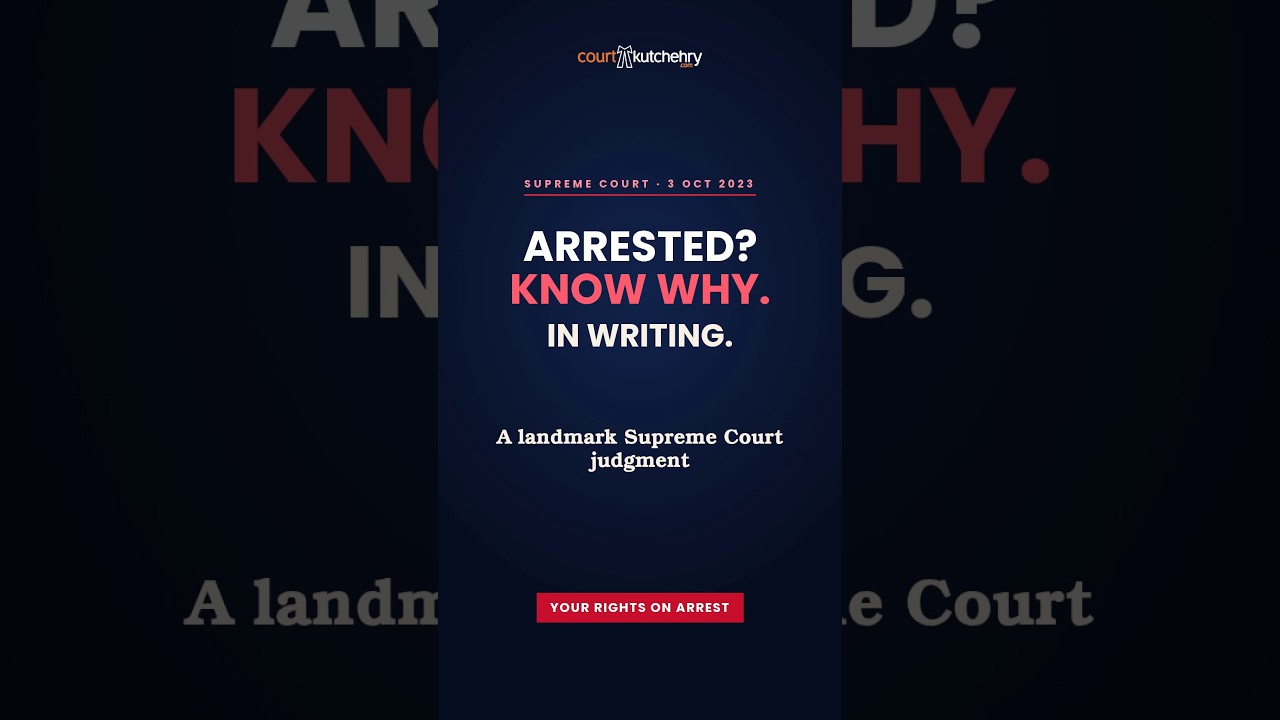
Watch the Video
In this 2-minute video, CourtKutchehry explains Pankaj Bansal v. Union of India, decided by the Supreme Court on 3 October 2023, the landmark judgment holding that a person arrested must be given the grounds of arrest in writing. This article walks through the facts, the three key holdings and what later rulings have said.
The Right to Know Why
Article 22(1) of the Constitution says that no person who is arrested shall be detained without being informed, as soon as may be, of the grounds of the arrest. Under the Prevention of Money Laundering Act, 2002 (PMLA), Section 19 says the same in its own words: the arrested person must be informed of the grounds. The question in this case was simple: is reading the grounds aloud enough?
The Facts
- A businessman and his father got interim protection from the Delhi High Court in one money-laundering case.
- Within days, the Enforcement Directorate (ED) recorded a second case, summoned them, and arrested them under Section 19 of the PMLA.
- The grounds of arrest were only read out to them. No written copy was given.
What the Supreme Court Held
In Pankaj Bansal Vs Union Of India & Ors., (2023) 10 SC CK 0001, a Bench of Justice A.S. Bopanna and Justice Sanjay Kumar held:
- Written grounds, every time. From now on, a written copy of the grounds of arrest must be given to the arrested person, as a matter of course and without exception.
- Why writing matters. A person who has just been arrested cannot be expected to remember pages of grounds read out once. He needs them to consult a lawyer and to seek bail, which is the whole purpose of Article 22(1).
- Not confessing is not non-cooperation. Failing to answer the way the ED wants is not, by itself, a ground for arrest, because of the protection against self-incrimination in Article 20(3).
The Court also said the ED must act with transparency and fair play, and must not be vindictive. The arrests and the remand orders were set aside, and both were ordered to be released.
Remember this line: grounds read out are forgotten; grounds in writing can be shown to a lawyer and a judge.
What Later Rulings Have Said
Later decisions have clarified how the rule applies:
- In Ram Kishor Arora Vs Directorate Of Enforcement, (2023) 12 SC CK 0021, the Court held that the requirement of written grounds operates from the date of the Pankaj Bansal judgment, 3 October 2023, and does not invalidate arrests made earlier.
- In Prabir Purkayastha Vs State (Nct Of Delhi), (2024) 05 SC CK 3145, the Court applied the same reasoning to an arrest under the Unlawful Activities (Prevention) Act, holding that the grounds of arrest must be given in writing.
Why It Matters for Everyone
Although the case arose under the PMLA, its reasoning rests on Article 22(1), which protects every arrested person. Under the BNSS, too, Section 47 requires the police to inform an arrested person of the grounds of arrest. If you or a family member is arrested, ask for the grounds in writing, and give them to your lawyer at once.
Key Takeaways
- In Pankaj Bansal (3 October 2023), the Supreme Court held that grounds of arrest must be given in writing, as a matter of course and without exception.
- Written grounds are needed to consult a lawyer and seek bail under Article 22(1).
- Not confessing is not the same as not cooperating (Article 20(3)).
- The arrests and remand orders were set aside.
- Later rulings clarified that the rule operates from 3 October 2023 and extends beyond the PMLA.
Frequently Asked Questions
What did the Supreme Court decide in Pankaj Bansal?
That the grounds of arrest under Section 19 of the PMLA must be furnished to the arrested person in writing, and that reading them out is not enough.
Why must the grounds be in writing?
So that the arrested person can understand them, consult a lawyer and seek bail, which is the purpose of Article 22(1).
Is refusing to answer questions a ground for arrest?
Not by itself. Failing to answer the way the agency wants is not non-cooperation, given the right against self-incrimination.
Does the rule apply to arrests made before 3 October 2023?
No. In Ram Kishor Arora, the Court held that it operates from the date of the Pankaj Bansal judgment.
Where can I watch the video?
Watch the explainer here: https://youtu.be/NBa78bsiLXA.
Conclusion
Pankaj Bansal turned a constitutional promise into a practical rule: if you are arrested, you get the reasons on paper. That simple step makes it possible to challenge an arrest and to seek bail.
Know the rule, and if an arrest ever touches your family, ask for the grounds in writing.
▶ Watch the video: Arrested? You Have the Right to Know Why — in Writing | Supreme Court | Pankaj Bansal Case
📖 Read more: Pankaj Bansal v. Union of India & Ors. (2023)
Research Judgments Like These on CourtKutchehry
Every judgment cited in this article, and lakhs more, can be searched and read on CourtKutchehry. Searching and reading judgments is free. A membership adds unlimited summaries, all related judgments, original court PDF downloads, bookmarks, notes and the CourtKutchehry AI assistant.
| Membership | Price | Works out to | AI credits |
|---|---|---|---|
| Monthly (1 month) | ₹599 | ₹599 / month | 1,000 / month |
| Quarterly (3 months) · Save 16% | ₹1,499 | ₹499.67 / month | 1,100 / month |
| Six-monthly (6 months) · Save 33% | ₹2,399 | ₹399.83 / month | 1,200 / month |
| Yearly (12 months) · Save 44% · Best value | ₹3,999 | ₹333.25 / month | 1,300 / month |
Every plan is a one-off purchase for a fixed period: nothing auto-renews and no card is kept on file. Prices are exclusive of applicable tax, which is added at checkout. Extra AI chat credits can be topped up from ₹99. A free verified account gets 5 summaries and 50 AI trial credits.
Prices are as displayed on courtkutchehry.com on 20 November 2026 and are subject to change without notice. Please check the pricing page for the current plans and offers.
For more judgments, legal opinions and case analysis, visit courtkutchehry.com
Visit CourtKutchehry →