
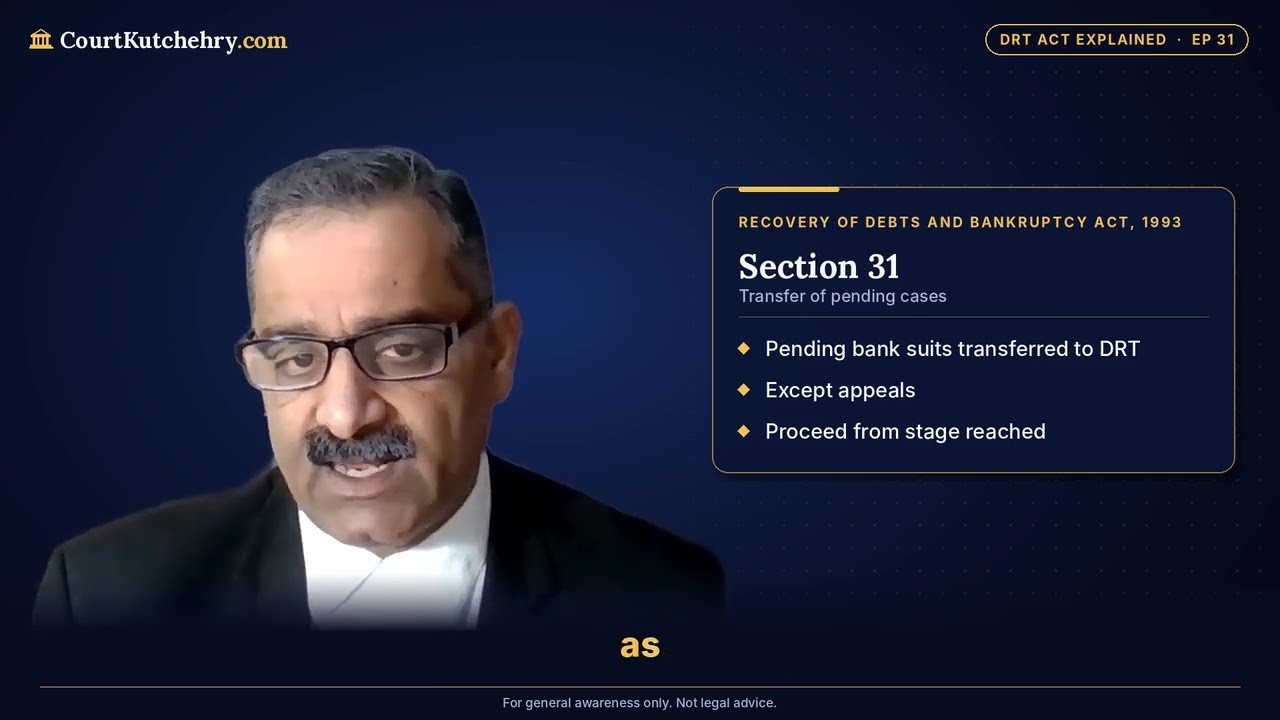
Watch the Video
In this 5-minute video, Vineet Kohli, Advocate, explains Sections 30, 30A and 31 of the Recovery of Debts and Bankruptcy Act, 1993 in Episode 31 of “DRT Act Explained with Judgments”. How do you challenge an order of the Recovery Officer? Who must make a deposit first? And how did old bank suits pending in civil courts reach the DRT? This article answers the same questions, with links to the two Supreme Court judgments on the limits of the transfer.
Why a Remedy Against the Recovery Officer Matters
The Recovery Officer attaches property, fixes auctions, confirms sales and decides objections. Those are powerful steps, and mistakes happen. The Act therefore provides a quick internal remedy, within the Tribunal itself, so that execution can be corrected without a separate suit.
Section 30: Appeal Against the Recovery Officer
Under Section 30:
- any person aggrieved by an order of the Recovery Officer may prefer an appeal;
- the appeal lies to the Tribunal, that is, the DRT, and not to the DRAT;
- it must be filed within 30 days from the date on which a copy of the order is issued to him; and
- after calling for the Recovery Officer’s records and giving the appellant an opportunity of being heard, the DRT may confirm, modify or set aside the order.
So the ladder in execution is: Recovery Officer → DRT (Section 30) → DRAT, with the High Court’s writ jurisdiction remaining as the constitutional safeguard.
Section 30A: Deposit for the Appeal
Section 30A was added in 2016. It provides that an appeal under Section 30 by a person from whom the amount of debt is due shall not be entertained unless he deposits 50% of the amount of debt due as determined by the Tribunal.
The purpose is plain. Before 2016, debtors could stall execution by challenging every step of the Recovery Officer. Section 30A makes the debtor put money down before using the appeal.
Remember this line: Section 30A binds the debtor, not the stranger whose property was wrongly attached.
Who Else Can Appeal Under Section 30?
The words “any person aggrieved” are wide. They include:
- a third party whose property has been attached as the defendant’s, such as a purchaser or a family member claiming ownership;
- an auction purchaser aggrieved by a refusal to confirm the sale.
A third party first raises a claim or objection before the Recovery Officer under the procedure of the Income-tax Schedules applied by Section 29. If the objection is rejected, he appeals to the DRT under Section 30. Because the debt is not due from him, the Section 30A deposit does not apply to his appeal.
Section 31: Transfer of Pending Cases
When DRTs were set up, thousands of bank recovery suits were pending in civil courts. Section 31 moved them across:
- every suit or other proceeding pending before any court immediately before the date on which a Tribunal was established, whose cause of action would have fallen within that Tribunal’s jurisdiction, stood transferred to it;
- appeals pending before any court were not transferred;
- the Tribunal may proceed from the stage the case had reached before transfer, or from any earlier stage, or de novo, as it thinks fit;
- a proviso added in 2013 saves proceedings relating to multi-State co-operative banks pending before the date of that amendment.
Judicial View: The Limits of the Transfer
Section 31 transfers only bank and financial institution recovery claims. It does not sweep in every case that involves a bank.
Indian Bank v. ABS Marine Products (2006)
In Indian Bank vs ABS Marine Products Pvt. Ltd., (2006) 04 SC CK 0062, AIR 2006 SC 1899, decided on 18 April 2006 by R.V. Raveendran and A.R. Lakshmanan, JJ., the bank applied to transfer a borrower’s independent suit against it to the DRT. The Supreme Court held that Section 31 covers only recovery proceedings by banks or financial institutions pending when the Tribunal was established. A borrower’s suit is not such a proceeding, and the bank’s application was not maintainable. A borrower may raise his claim as a counter-claim in the bank’s application, but he is not obliged to; he may sue separately in a competent court.
Nahar Industrial Enterprises v. HSBC (2009)
In Nahar Industrial Enterprises Ltd. vs Hong Kong and Shanghai Banking Corporation, (2009) 07 SC CK 0071, (2009) 8 SCC 646, decided on 29 July 2009 by S.B. Sinha and Asok Kumar Ganguly, JJ., the Supreme Court held that the DRT is not a civil court, and that a borrower’s civil suit cannot be transferred to the DRT without statutory authority. The only transfer provision in the Act is Section 31, and it did not apply.
Practical Illustration: The Brother’s Flat
A Recovery Officer attaches a flat as the defendant’s property. The defendant’s brother objects, producing a registered sale deed of 2015 in his own name. The Recovery Officer rejects the objection without examining the deed.
- Appeal under Section 30. The brother can appeal to the DRT within 30 days of receiving a copy of the order.
- No Section 30A deposit. The debt is not due from him, so the 50% deposit does not apply.
- Outcome. If the DRT finds that the sale to him is genuine and the flat is his, it can set aside the order and lift the attachment.
- Contrast. If the defendant himself appeals against the auction of the flat, he must first deposit 50% of the debt determined by the Tribunal.
Quick Test
- Where does an appeal against a Recovery Officer’s order lie? To the DRT, under Section 30.
- Who must make the 50% deposit under Section 30A? The person from whom the debt is due.
- Did Section 31 transfer a borrower’s own suit against a bank to the DRT? No, as held in ABS Marine and Nahar Industrial.
Key Takeaways
- Section 30: any person aggrieved by a Recovery Officer’s order may appeal to the DRT within 30 days; the DRT may confirm, modify or set aside the order.
- Section 30A (2016): an appeal by the debtor is not entertained without a deposit of 50% of the debt determined by the Tribunal.
- Third parties whose property is attached, and auction purchasers, can also appeal; the deposit does not apply to those from whom no debt is due.
- Section 31 transferred pending bank recovery suits to the DRTs, but not appeals.
- A borrower’s independent suit against a bank was not transferred (Indian Bank v. ABS Marine Products, 2006; Nahar Industrial, 2009).
Frequently Asked Questions
How do I challenge an order of the Recovery Officer?
File an appeal to the DRT under Section 30 within 30 days from the date a copy of the order is issued to you.
Do I have to deposit money to appeal against the Recovery Officer?
Only if you are the person from whom the debt is due. Section 30A then requires a deposit of 50% of the debt as determined by the Tribunal.
My property was attached for someone else’s loan. What can I do?
Object before the Recovery Officer with proof of your ownership. If the objection is rejected, appeal to the DRT under Section 30. The 50% deposit does not apply to you.
Which cases were transferred to the DRT under Section 31?
Suits and proceedings for recovery of bank and financial institution debts pending in courts when the Tribunal was established. Appeals were not transferred.
Can a bank get a borrower’s suit against it moved to the DRT?
No. The Supreme Court held in ABS Marine (2006) and Nahar Industrial (2009) that such a suit is not covered by Section 31 and cannot be transferred to the DRT.
Where can I watch the full explanation?
Watch Vineet Kohli, Advocate explain it in 5 minutes: https://youtu.be/jOvcKvH21xo.
Conclusion
Section 30 gives anyone hurt by a Recovery Officer’s order a quick appeal to the DRT. Section 30A makes sure that the debtor cannot use that appeal as a delaying tactic without first depositing half the debt, while leaving genuine third parties free to defend their property.
Section 31 explains how the DRTs inherited their first caseload, and the Supreme Court has kept it within its limits: bank recovery claims moved, borrowers’ own suits did not.
▶ Watch the video: Appeal Against Recovery Officer's Order & 50% Deposit | Sections 30, 30A & 31 | DRT Act Ep 31
Research Judgments Like These on CourtKutchehry
Every judgment cited in this article, and lakhs more, can be searched and read on CourtKutchehry. Searching and reading judgments is free. A membership adds unlimited summaries, all related judgments, original court PDF downloads, bookmarks, notes and the CourtKutchehry AI assistant.
| Membership | Price | Works out to | AI credits |
|---|---|---|---|
| Monthly (1 month) | ₹599 | ₹599 / month | 1,000 / month |
| Quarterly (3 months) · Save 16% | ₹1,499 | ₹499.67 / month | 1,100 / month |
| Six-monthly (6 months) · Save 33% | ₹2,399 | ₹399.83 / month | 1,200 / month |
| Yearly (12 months) · Save 44% · Best value | ₹3,999 | ₹333.25 / month | 1,300 / month |
Every plan is a one-off purchase for a fixed period: nothing auto-renews and no card is kept on file. Prices are exclusive of applicable tax, which is added at checkout. Extra AI chat credits can be topped up from ₹99. A free verified account gets 5 summaries and 50 AI trial credits.
Prices are as displayed on courtkutchehry.com on 20 November 2026 and are subject to change without notice. Please check the pricing page for the current plans and offers.
For more judgments, legal opinions and case analysis, visit courtkutchehry.com
Visit CourtKutchehry →