

COURTKUTCHEHRY SPECIAL SERIES ON LANDMARKS JUDGEMENTS ON WILLS, CODICIL & PROBATE
K. Laxmanan v. Thekkayil Padmini & Ors.: Supreme Court Upholds Rejection of Suspicious Will and Gift
Failure to Prove Attestation and Capacity Fatal to Documents
Properties Declared Open for Partition Among Heirs
By Vishwas Kumar
New Delhi: March 24, 2026:
In K. Laxmanan v. Thekkayil Padmini & Ors. (Civil Appeal No. 7082 of 2008, decided on 3 December 2008), the Supreme Court of India reaffirmed the strict standards required for proving testamentary and gift documents. The Division Bench comprising Hon’ble Mr. Justice Tarun Chatterjee and Hon’ble Mr. Justice Mukundakam Sharma examined the validity of two documents executed by Chathu in favour of his son—a Gift and a Will—both allegedly made on the same day.
check important Supreme Court rulings on wills of K. Laxmanan Case
The dispute arose when these documents were challenged by other heirs, who argued that they were neither genuine nor legally proved. The courts below found multiple deficiencies: the attesting witnesses were not examined, Chathu’s mental capacity at the time of execution was not established, and discrepancies in signatures raised serious doubts. These factors created a cloud of suspicion that the propounder failed to dispel.
The Supreme Court agreed with the findings of the lower courts, holding that the documents could not be accepted as valid. Since the Will and Gift deed remained unproved, the properties in question were declared available for partition among all heirs. The appeal filed by K. Laxmanan was accordingly dismissed.
This ruling underscores the judiciary’s consistent approach that Wills and gift deeds must be proved with unimpeachable evidence. Suspicious circumstances, unexplained differences in signatures, or failure to establish the testator’s mental capacity can render such documents void. The judgment serves as a reminder that succession disputes demand strict compliance with statutory requirements to protect fairness in inheritance.
For More, Read Here the Summary of the Judgement from the Book: WILL WRITING SIMPLIFIED, read below or open page no 436, Chapter 14.1 in the book. (Online book purchase link available here on: Buy online: Amazon | Flipkart
|
|
Case Summary |
: |
K. Laxmanan v. Thekkayil Padmini & Ors. |
|
|
Court |
: |
Supreme Court of India |
|
|
Citations |
: |
(2008) 12 SC CK 0054: Civil Appeal No. 7082 of 2008. |
|
|
Link |
: |
https://www.courtkutchehry.com/judgements/661158/k-laxmanan-vs-thekkayil-padmini-and-others/
|
|
|
Decided on |
: |
03 December 2008 |
|
|
Coram |
: |
Hon’ble Mr. Justice Tarun Chatterjee and Hon’ble Mr. Justice Mukundakam Sharma. |
|
|
Relevant Paragraphs |
: |
Para Nos. 2-38 |
1. Facts of the Case:
The dispute arose between the heirs of one Chathu who had one son (the appellant) and three daughters (including the respondent–plaintiff). After Chathu’s death (1975), the plaintiff sought partition claiming equal one-fourth shares in properties listed as Items 1–14. The appellant (fifth defendant) resisted, relying on four documents: Ext. B1 and B4 (Assignments), Ext. B2 (Gift Deed 26 Apr 1974), and Ext. B3 (Will of same date). The trial court upheld Exts. B2 and B3, limiting division to Item 9. The first appellate court reversed this for Exts. B2–B3 and the High Court affirmed, holding both instruments surrounded by suspicious circumstances.
2. Law Points Involved:
(i). Section 68 & 69 – Evidence Act 1872: Proof of attested documents, especially Wills and Gift Deeds.
(ii). Order VI Rule 1 – CPC 1908: Definition of pleadings (Plains & Written Statements).
(iii). Principles of Proof of Will & Suspicious Circumstances: Burden on propounder to remove suspicion and prove execution and testamentary capacity.
3. Acts / Provisions / Articles Referred:
(i). Indian Evidence Act 1872 – Sections 68 and 69
(ii). Code of Civil Procedure 1908 – Order VI Rule 1
(iii). Article 136, Constitution of India (For scope of interference)
4. Judgments Referred:
(i). Shashi Kumar Banerjee v. Subodh Kumar Banerjee, (1963) 09 SC CK 0012.
(ii). Pushpavathi v. Chandraraja Kadamba, (1972) 08 SC CK 0044.
(iii). Daulat Ram v. Sodha, (2004) 11 SC CK 0058.
(iv). Rosammal Fernandez v. Joosa Mariyan Fernandez, (2000) 08 SC CK 0068.
5. Obiter Dicta:
Non-filing of replication to written statement does not amount to admission of facts pleaded therein (Order VI Rule 1 CPC explained). Even where execution of a registered document is not specifically denied in pleadings, if the issue is raised and tried on evidence, proviso to Section 68 is inapplicable.
6. Ratio Decidendi:
(i). For a Will, the propounder must prove due execution and remove suspicious circumstances to the Court’s satisfaction; failure to examine attesting witnesses or to prove mental capacity is fatal.
(ii). For a Gift Deed, where execution is specifically denied, Section 68 applies and at least one attesting witness must be examined; the proviso does not apply when validity is in dispute.
(iii). Concurrent findings of suspicious execution cannot be interfered with under Article 136 of the Constitution.
7. Final Ruling:
The Supreme Court found no error in the findings of the lower courts that both the Deed of Will and Deed of Gift were not proved in accordance with law and were surrounded by suspicious circumstances. Appeal dismissed. No order as to costs.
8. Gist / Dispute & Final Decision:
Dispute concerned validity of two documents executed by Chathu in favour of his son—Gift and Will—both on the same day. Failure to examine attesting witnesses, lack of proof of mental capacity, and differences in signatures created serious suspicion. The Courts below rightly held the documents unproved and properties available for partition. Supreme Court affirmed dismissal of the appeal.
Read full Judgement Here:
K. Laxmanan v. Thekkayil Padmini & Ors.
Supreme Court of India
(2008) 12 SC CK 0054: Civil Appeal No. 7082 of 2008.
https://www.courtkutchehry.com/judgements/661158/k-laxmanan-vs-thekkayil-padmini-and-others/
You Can Also Purchase the Book from here on: Buy online: Amazon | Flipkart
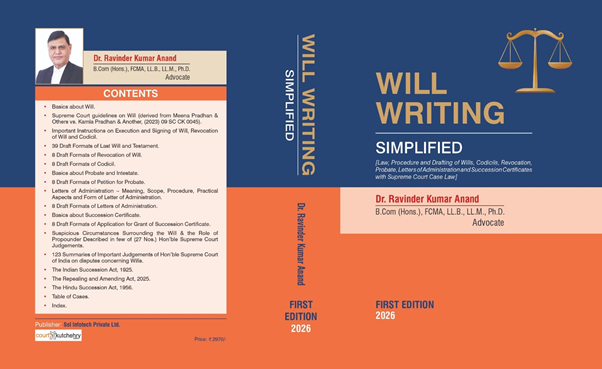
OUR RECOMMENDATION: Check out 123 Key Judgements, as highlighted in the book, WILL WRITING SIMPLIFIED, for the quick research and reference purposes. Click the link here: https://www.courtkutchehry.com/pages/blog/123-supreme-court-judgments-on-wills/
Keywords: K. Laxmanan v. Thekkayil Padmini, Supreme Court of India 2008, Civil Appeal No. 7082 of 2008, Justice Tarun Chatterjee, Justice Mukundakam Sharma, Chathu Will and Gift dispute, attestation requirement, suspicious circumstances in Will, proof of mental capacity, property partition, Indian succession law.