
Watch the Video
In this 6-minute video, Episode 1 of the CourtKutchehry series “AIBE Explained”, the All India Bar Examination is explained in eight simple questions: who conducts it, the paper pattern, the qualifying marks, the open-book rules, the subject-wise weightage, the kinds of questions, the change to the new criminal laws, and how often the exam can be taken. This article is the quick-revision version of that episode: the essentials in five minutes, a one-page table, and the traps candidates fall into.
The Episode in Five Minutes
The video opens with four facts that sum up the whole exam: 100 questions, 3 hours 30 minutes, no negative marking, and a Certificate of Practice at the end of it. Then come seven points to remember:
- The Bar Council of India conducts the exam under the Advocates Act, 1961.
- The paper has 100 MCQs of one mark each, to be done in 210 minutes.
- You pass with 45% (General/OBC) or 40% (SC/ST/PwD).
- You may carry bare acts only, and they must be unannotated.
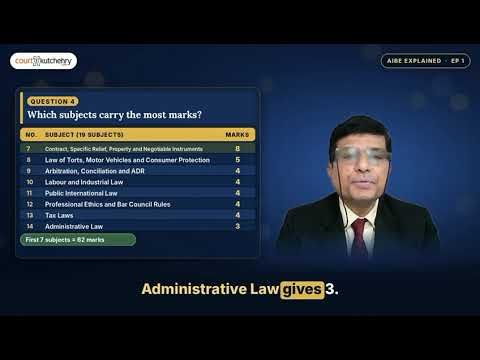
- Constitutional Law, Criminal Procedure (BNSS) and CPC carry the most questions, 10 each.
- Since 1 July 2024, the IPC, CrPC and Evidence Act have been replaced by the BNS, BNSS and BSA.
- There is no limit on attempts, and the video notes that the exam is now held twice a year.
One-Page Revision Table
Here is the whole episode in a single table, arranged by the eight questions the video asks.
| Question | Short answer |
|---|---|
| Q1. Who conducts the AIBE? | The Bar Council of India, under the Advocates Act, 1961 |
| Q2. What is the pattern? | 100 MCQs, 100 marks, 3 hours 30 minutes, no negative marking |
| Q2. What are the qualifying marks? | 45% for General/OBC; 40% for SC/ST/PwD |
| Q3. Is it open-book? | Yes, but only unannotated bare acts; no notes, commentary or printed short notes |
| Q4. Which subjects carry most marks? | Constitutional Law, Criminal Procedure (BNSS) and CPC, 10 questions each |
| Q5. What kind of questions? | Questions on provisions, landmark cases and short fact situations |
| Q6. What changed in criminal law? | IPC → BNS, CrPC → BNSS, Evidence Act → BSA, from 1 July 2024 |
| Q8. How many attempts? | No limit; the exam is now held twice a year |
Why the Bar Council’s Power Is Settled
For years it was argued that the Bar Council of India could not make a law graduate pass an exam before practising. That argument is now closed. In Bar Council of India v. Bonnie Foi Law College, (2023) 02 SC CK 0021, a Constitution Bench of the Supreme Court held on 10 February 2023 that the Bar Council of India can conduct a pre-practice examination such as the AIBE.
Remember three things: Constitution Bench, 2023, power upheld. It is the only judgment in the episode.
Common Exam Traps
Most mistakes in the AIBE are not about the law at all. They come from misreading the rules of the exam or the new numbering. Watch for these:
Trap 1: “Open-book” means anything goes
It does not. Only bare acts are allowed, and they must be free of notes and commentary. A bare act with handwritten notes in the margin, or a printed set of short notes, can be refused at the hall. Check the notification for your sitting.
Trap 2: Leaving questions blank
There is no negative marking. Every one of the 100 questions should be answered before time runs out.
Trap 3: Answering with the old section number
Questions are increasingly framed on the BNS, BNSS and BSA. If the option says “Section 302” and the question asks about the BNS, that is the old IPC number, not the new one (murder is now punished under Section 103 BNS). Learn the new number first and keep the old one alongside it.
Trap 4: Not practising with the bare act
An open-book exam helps only those who know where to look. With roughly two minutes per question, there is no time to read an Act from the beginning. Practise finding sections quickly in the same unannotated bare acts you will carry.
Remember this line: the bare act is a tool, not a textbook; it helps only if you know where to look.
A Short Strategy for the Paper
The episode ends with a strategy to clear the paper. In the same spirit, a simple plan looks like this:
- Start with the 10-question subjects: Constitutional Law, the BNSS and the CPC.
- Make a two-column list of important criminal-law sections: new number on the left, old number on the right.
- Revise landmark cases as one line each: name, year, and the principle.
- Solve full papers under the clock, 100 questions in 210 minutes, before the real exam.
Can You Take the Exam Again?
Yes. As the video explains, there is no limit on the number of attempts, and the exam is now held twice a year. A candidate who does not clear it at one sitting can simply appear again at the next.
Key Takeaways
- The AIBE is conducted by the Bar Council of India under the Advocates Act, 1961; its power was upheld by a Constitution Bench in Bonnie Foi Law College (2023).
- 100 MCQs, 3 hours 30 minutes, no negative marking; pass marks are 45% and 40%.
- Only unannotated bare acts may be carried into the hall.
- Constitutional Law, the BNSS and the CPC carry 10 questions each.
- There is no limit on attempts, and the exam is now held twice a year.
Frequently Asked Questions
How long is the AIBE paper?
Three hours and thirty minutes for 100 multiple-choice questions, which works out to a little over two minutes per question.
Can I carry printed short notes into the exam?
No. The episode is clear that only unannotated bare acts are allowed: no notes, commentary or printed short notes.
Which three subjects carry the most questions?
Constitutional Law, Criminal Procedure (now the BNSS) and the Code of Civil Procedure, with 10 questions each.
Is there a limit on the number of attempts?
No. A candidate can appear as many times as needed, and the video notes that the exam is now held twice a year.
Where can I watch the video?
Watch the 6-minute episode here: https://youtu.be/H7mWM0EDnhs.
Conclusion
Episode 1 is the map for the whole series. Once you know who conducts the AIBE, how the paper is set, what you can carry, where the marks are and how the criminal laws have changed, every later episode fits into place.
Keep this page as your one-page reminder, and get your bare act of the Constitution ready: the next episode begins Constitutional Law with the Fundamental Rights.
▶ Watch the video: AIBE Explained Ep 1: Exam Pattern, Open-Book Rules, Subject-wise Marks & Strategy | AIBE 2026
▶ Also on YouTube: AIBE Exam Pattern 2026: Open-Book Rules, Subject-wise Marks & Strategy | AIBE Explained Ep 1
📖 Read the full article: AIBE Exam Pattern 2026: Open-Book Rules, Qualifying Marks, Subject-wise Marks and Strategy | AIBE Explained Ep 1
Research Judgments Like These on CourtKutchehry
Every judgment cited in this article, and lakhs more, can be searched and read on CourtKutchehry. Searching and reading judgments is free. A membership adds unlimited summaries, all related judgments, original court PDF downloads, bookmarks, notes and the CourtKutchehry AI assistant.
| Membership | Price | Works out to | AI credits |
|---|---|---|---|
| Monthly (1 month) | ₹599 | ₹599 / month | 1,000 / month |
| Quarterly (3 months) · Save 16% | ₹1,499 | ₹499.67 / month | 1,100 / month |
| Six-monthly (6 months) · Save 33% | ₹2,399 | ₹399.83 / month | 1,200 / month |
| Yearly (12 months) · Save 44% · Best value | ₹3,999 | ₹333.25 / month | 1,300 / month |
Every plan is a one-off purchase for a fixed period: nothing auto-renews and no card is kept on file. Prices are exclusive of applicable tax, which is added at checkout. Extra AI chat credits can be topped up from ₹99. A free verified account gets 5 summaries and 50 AI trial credits.
Prices are as displayed on courtkutchehry.com on 20 November 2026 and are subject to change without notice. Please check the pricing page for the current plans and offers.
For more judgments, legal opinions and case analysis, visit courtkutchehry.com
Visit CourtKutchehry →