
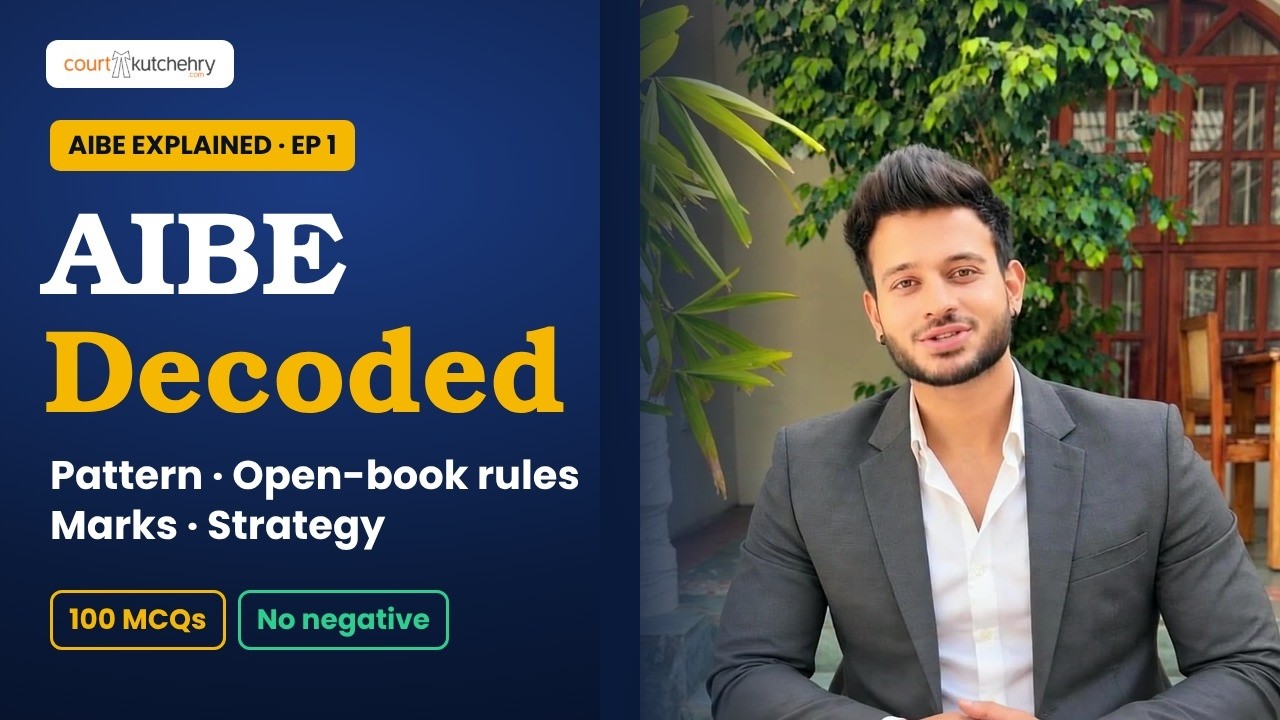
Watch the Video
In this 4-minute video, Episode 1 of the CourtKutchehry series “AIBE Explained”, Advocate Vinayak Pawar explains how the All India Bar Examination works: who conducts it, the paper pattern and qualifying marks, the open-book rules, the subject-wise marks, the kinds of questions, the new criminal laws and how to prepare. This article sets out the same ground in writing.
About the AIBE Explained Series
“AIBE Explained” is a CourtKutchehry series that takes the All India Bar Examination one subject at a time. Episode 1 sets the ground: how the exam works, how the marks are spread, and how to prepare for it. The next episode moves to Constitutional Law, the subject that carries the most marks.
What Is the AIBE, and Who Conducts It?
The All India Bar Examination is conducted by the Bar Council of India. A law graduate who enrols with a State Bar Council must clear it to receive the Certificate of Practice. The Bar Council draws its power to hold the exam from the Advocates Act, 1961 and the rules it has framed under that Act.
That power was challenged for years. In Bar Council of India v. Bonnie Foi Law College, (2023) 02 SC CK 0021, a Constitution Bench of the Supreme Court decided on 10 February 2023 that the Bar Council of India is entitled to conduct the examination. So the AIBE is not just a formality of the Bar Council. It is a lawful condition for practising law, and it is here to stay.
Exam Pattern and Qualifying Marks
The paper pattern, as the video explains it, is simple to remember:
- 100 multiple-choice questions, each carrying one mark, so the paper is of 100 marks.
- 3 hours 30 minutes to attempt the paper.
- No negative marking. A wrong answer costs nothing, so no question should be left blank.
- Qualifying marks: 45 for General and OBC candidates, and 40 for SC, ST and candidates with disabilities.
Put another way: a General category candidate must get 45 questions right out of 100. With three and a half hours for the paper, that is roughly two minutes per question, which is enough time to check a bare act when you need to.
Is It an Open-Book Exam?
Yes, but with a strict condition. Candidates may carry bare acts only, and they must be unannotated. That means:
- no handwritten notes in the margins,
- no commentary, guides or case-law digests, and
- no sticky notes or flags with text written on them.
An open-book exam sounds easy, but it is not. A bare act helps only if you already know where to look. Candidates who have practised finding sections quickly gain the most from it. Always check the Bar Council’s notification for your particular exam, because the detailed rules on what may be carried are issued afresh for each sitting.
Subject-wise Marks: Where the Marks Are
The AIBE syllabus has 19 subjects, but the marks are not spread evenly. Seven subjects together carry 62 of the 100 marks:
| Subject | Marks |
|---|---|
| Constitutional Law | 10 |
| Criminal Procedure (now the BNSS) | 10 |
| Civil Procedure | 10 |
| Penal Code (now the BNS) | 8 |
| Law of Evidence (now the BSA) | 8 |
| Family Law | 8 |
| Contract, Specific Relief and Property Law | 8 |
The remaining 38 marks are shared among the other twelve subjects. The lesson is clear: master the big seven first, and then cover the rest.
Remember this line: 62 marks come from just seven subjects, so start there.
The Kinds of Questions You Will Meet
The video sorts AIBE questions into three types. Whatever labels you use, most questions in past papers ask you to do one of three things:
- Recall a provision. “Which section deals with…?” or “Under which Order and Rule…?” These are where a well-tabbed bare act helps most.
- Know a landmark case. Which judgment laid down a principle, or what a famous case decided.
- Apply the law to facts. A short set of facts is given and you must pick the correct legal result.
Each later episode of the series ends with practice questions of this kind, so you can test yourself after every subject.
The New Criminal Laws: BNS, BNSS and BSA
From 1 July 2024, three new laws replaced the old criminal codes:
- the Indian Penal Code, 1860 was replaced by the Bharatiya Nyaya Sanhita, 2023 (BNS);
- the Code of Criminal Procedure, 1973 was replaced by the Bharatiya Nagarik Suraksha Sanhita, 2023 (BNSS); and
- the Indian Evidence Act, 1872 was replaced by the Bharatiya Sakshya Adhiniyam, 2023 (BSA).
Most principles are the same, but the section numbers have changed. For example, murder was Section 302 IPC and is now punished under Section 103 BNS; the FIR was Section 154 CrPC and is now Section 173 BNSS. Learn the new number first and keep the old number alongside it, because older judgments and many questions still refer to the old codes. The series does exactly that in every criminal-law episode.
Strategy: How to Prepare
The video closes with five tips to clear the exam. In the same spirit, a sensible plan looks like this:
- Prioritise by marks. Spend most of your time on the seven subjects that carry 62 marks.
- Know your bare acts. Practise finding sections quickly in the unannotated bare acts you will carry.
- Learn the BNS, BNSS and BSA numbers, with the old IPC, CrPC and Evidence Act numbers alongside.
- Revise the landmark cases for each subject, in one line each: name, year and principle.
- Attempt every question. There is no negative marking, so a blank answer is a lost chance.
Key Takeaways
- The AIBE is conducted by the Bar Council of India under the Advocates Act, 1961, a power upheld by a Constitution Bench in 2023.
- The paper has 100 MCQs for 100 marks, 3 hours 30 minutes, and no negative marking.
- Qualifying marks are 45 (General/OBC) and 40 (SC/ST/PwD).
- It is open-book, but only unannotated bare acts are allowed.
- Seven subjects carry 62 marks; from 1 July 2024 the IPC, CrPC and Evidence Act have become the BNS, BNSS and BSA.
Frequently Asked Questions
Who conducts the All India Bar Examination?
The Bar Council of India, under the Advocates Act, 1961. The Supreme Court upheld its power to do so in Bar Council of India v. Bonnie Foi Law College (2023).
Is there negative marking in the AIBE?
No. Each of the 100 questions carries one mark and a wrong answer carries no penalty, so attempt every question.
What are the qualifying marks?
45 out of 100 for General and OBC candidates, and 40 out of 100 for SC, ST and candidates with disabilities.
Can I take my own notes into the exam?
No. Only bare acts without notes, commentary or annotations are permitted. Check the Bar Council’s notification for the exact rules for your sitting.
Will questions be asked from the IPC or from the BNS?
The new laws, the BNS, BNSS and BSA, have been in force since 1 July 2024. Prepare the new section numbers, and keep the old IPC, CrPC and Evidence Act numbers alongside them.
Where can I watch the full explanation?
Watch Advocate Vinayak Pawar explain it in 4 minutes: https://youtu.be/kr_4DtAZEX4.
Conclusion
The AIBE rewards preparation more than memory. It is a 100-mark, open-book paper with no negative marking, and nearly two-thirds of the marks sit in seven subjects. A candidate who knows where to look in the bare act, knows the new BNS, BNSS and BSA numbers, and knows the landmark cases is well placed to clear it.
Start with the big subjects, practise with past-style questions, and follow the series episode by episode, beginning with Constitutional Law.
▶ Watch the video: AIBE Exam Pattern 2026: Open-Book Rules, Subject-wise Marks & Strategy | AIBE Explained Ep 1
📖 Read more: BCI Issues Detailed Guidelines for AIBE XXI: Rules Every Candidate Must Know
Research Judgments Like These on CourtKutchehry
Every judgment cited in this article, and lakhs more, can be searched and read on CourtKutchehry. Searching and reading judgments is free. A membership adds unlimited summaries, all related judgments, original court PDF downloads, bookmarks, notes and the CourtKutchehry AI assistant.
| Membership | Price | Works out to | AI credits |
|---|---|---|---|
| Monthly (1 month) | ₹599 | ₹599 / month | 1,000 / month |
| Quarterly (3 months) · Save 16% | ₹1,499 | ₹499.67 / month | 1,100 / month |
| Six-monthly (6 months) · Save 33% | ₹2,399 | ₹399.83 / month | 1,200 / month |
| Yearly (12 months) · Save 44% · Best value | ₹3,999 | ₹333.25 / month | 1,300 / month |
Every plan is a one-off purchase for a fixed period: nothing auto-renews and no card is kept on file. Prices are exclusive of applicable tax, which is added at checkout. Extra AI chat credits can be topped up from ₹99. A free verified account gets 5 summaries and 50 AI trial credits.
Prices are as displayed on courtkutchehry.com on 20 November 2026 and are subject to change without notice. Please check the pricing page for the current plans and offers.
For more judgments, legal opinions and case analysis, visit courtkutchehry.com
Visit CourtKutchehry →