
Watch the Video
In this 15-minute video, Episode 37 of the “AIBE Explained” series, the episode begins a complete 100-question AIBE mock paper set in the same proportion as the real examination. Part 1 solves Questions 1 to 34: ten from Constitutional Law, ten from Criminal Procedure under the BNSS, ten from Civil Procedure and four from the Limitation Act and allied topics. The questions themselves are best taken in the video, under exam conditions. This article explains the law behind the topics that this part tests, and how to approach a question on each.
How to Take This Mock Test
The mock is spread over three episodes: Part 1 (this episode, Questions 1 to 34), Mock Test Part 2 (Questions 35 to 67: the Penal Code, Evidence, Family Law, Contract and Property) and Mock Test Part 3 (Questions 68 to 100, with how to work out your final result). The episode asks you to sit with your bare acts, pause after each question, mark your answer, and only then listen to the explanation. Give yourself 70 minutes for this part, the time the real paper allows for 34 questions.
One habit helps across all three parts: before you look at the options, decide which Act and chapter the question comes from, so you can find the section quickly.
Constitutional Law: Questions 1 to 10
This block covers ten areas. Here is the law behind each.
- The 42nd Amendment and the Preamble: the Constitution (Forty-second Amendment) Act, 1976 added the words “socialist”, “secular” and “integrity”. It is the only amendment to the Preamble.
- Article 17: abolishes untouchability and forbids its practice in any form; enforcing any disability arising from it is an offence punishable in accordance with law.
- Article 254(2): a State law on a Concurrent List subject that is repugnant to an earlier Central law prevails in that State if it was reserved for and received the President’s assent, though Parliament can later override it.
- Article 200: when a Bill is presented, the Governor may assent, withhold assent, return it (if not a Money Bill) for reconsideration, or reserve it for the President.
- Certiorari vs prohibition: both go to inferior courts and tribunals. Prohibition is issued while proceedings are pending, to stop the excess of jurisdiction; certiorari is issued after a decision, to quash it.
- CAG (Article 148): the Comptroller and Auditor-General is appointed by the President and removable only like a Supreme Court Judge.
- Right to education: in Mohini Jain v. State of Karnataka, (1992) 3 SCC 666, the Supreme Court read a right to education into Article 21; in Unni Krishnan v. State of Andhra Pradesh, (1993) 1 SCC 645, it limited the fundamental right to free education to children up to 14 years. That is now Article 21A, inserted by the 86th Amendment in 2002.
- Rajya Sabha age: a member must be at least 30 years old (Article 84); for the Lok Sabha it is 25.
- Attorney General (Article 76): appointed by the President, must be qualified to be a Supreme Court Judge, holds office during the pleasure of the President, and has a right of audience in all courts in India.
- The NJAC case: in Supreme Court Advocates-on-Record Association v. Union of India (2015), reported in (2016) 5 SCC 1, a Constitution Bench struck down the 99th Amendment and the National Judicial Appointments Commission Act, 2014, by a majority of 4:1, and the collegium system continued.
Criminal Procedure (BNSS): Questions 11 to 20
All ten questions are on the Bharatiya Nagarik Suraksha Sanhita, 2023, which replaced the CrPC from 1 July 2024.
- e-FIR: information given by electronic communication is taken on record once the informant signs it within three days (Section 173(1)).
- Arrest of persons above 60 (Section 35(7)): no arrest without the prior permission of an officer not below the rank of Deputy Superintendent of Police, for an offence punishable with less than three years, where the person is infirm or above sixty.
- Charge sheet (Section 193): the police report on completion of investigation (old Section 173). The police must also inform the informant or victim of the progress of the investigation within 90 days.
- Supply of documents: in a police case, the Magistrate must supply the accused the police report and documents without delay and not later than 14 days from his appearance (Section 230).
- Compounding (Section 359): lists the offences compoundable by the victim without permission, and those compoundable with the court’s permission (old Section 320).
- Appeal against acquittal in a complaint case: the complainant may appeal only with the special leave of the High Court (Section 419(4)).
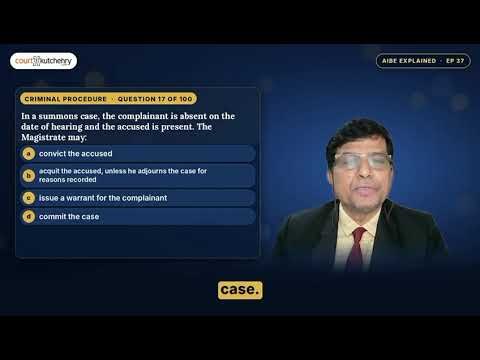
- Absence of complainant (Section 279): in a summons case, if the complainant does not appear, the Magistrate may acquit the accused unless there is a reason to adjourn (old Section 256).
- Undertrial release (Section 479): an undertrial who has served half the maximum sentence for the offence must be released on bail; a first-time offender, after one-third. It does not apply to offences punishable with death or life imprisonment.
- Revision powers: the Sessions Court and the High Court can call for and examine records to check the correctness, legality or propriety of a finding or order, but there is no revision against interlocutory orders.
- Confessions (Section 183): recorded by a Judicial Magistrate (old Section 164), after warning the accused that he is not bound to confess, and the recording may be by audio-video electronic means. A police officer cannot record it.
Civil Procedure (CPC): Questions 21 to 30
- Decree without jurisdiction: in Kiran Singh v. Chaman Paswan, (1954) 04 SC CK 0020, the Supreme Court held that a decree passed by a court without inherent jurisdiction is a nullity and its invalidity can be raised even in execution. Objections to territorial or pecuniary jurisdiction, however, are limited by Section 21.
- Section 25: the Supreme Court can transfer a suit, appeal or proceeding from a court in one State to a court in another.
- Order IX Rules 8 and 9: if only the defendant appears, the suit is dismissed (Rule 8); the plaintiff cannot bring a fresh suit on the same cause, but may apply to restore the suit for sufficient cause (Rule 9).
- Order VI Rule 17: amendment of pleadings is allowed, but after the trial has commenced only if the party could not have raised the matter earlier despite due diligence.
- Order 39 Rule 3A: where an injunction is granted without notice, the court must try to finally decide the application within 30 days.
- Receiver (Order XL): the court can appoint a receiver of property where it appears just and convenient.
- Order XXI Rule 72: a decree-holder cannot bid for or buy property at the execution sale without the court’s permission.
- Order XLIII Rule 1(d): an appeal lies against an order rejecting an application under Order IX Rule 13 to set aside an ex parte decree.
- Abatement: legal representatives of a deceased party must be brought on record within 90 days of death (Article 120, Limitation Act), or the suit abates as against that party.
- Compromise decrees: no appeal lies from a decree passed with the consent of parties (Section 96(3)), and no separate suit lies to set aside a compromise decree on the ground that the compromise was unlawful (Order XXIII Rule 3A); the challenge goes to the court that recorded it.
Remember this line: a decree without inherent jurisdiction is a nullity; a decree by a court lacking only territorial or pecuniary jurisdiction is not.
Limitation and Allied Topics: Questions 31 to 34
- Article 65: a suit for possession of immovable property based on title can be filed within 12 years from when the defendant’s possession becomes adverse to the plaintiff.
- Article 136: a decree (other than one for a mandatory injunction) can be executed within 12 years from when it becomes enforceable; a decree for a perpetual injunction has no limitation.
- The eleven-month lease: under Section 17(1)(d) of the Registration Act, 1908, a lease of immovable property from year to year, or for a term exceeding one year, must be registered. That is why so many residential leases are drafted for eleven months.
- Legal disability (Section 6): if the person entitled to sue is a minor, insane or an idiot when time would begin, he can sue within the same period after the disability ends.
Count Your Score
At the end of the part, note your score out of 34, and write down the subjects where you lost marks. Then carry the score forward: Mock Test Part 2 covers Questions 35 to 67, and Mock Test Part 3 covers Questions 68 to 100 and explains how to work out your final result against the qualifying mark.
Key Takeaways
- The mock test runs across three episodes; this part has 34 questions and should be taken in 70 minutes.
- Constitutional questions test exact articles: 17, 76, 84, 148, 200, 254(2) and 21A.
- BNSS questions focus on new rules: e-FIR signature within three days, Section 35(7) for persons above 60, Section 479 for undertrials.
- CPC questions test the Orders: IX, VI Rule 17, 39 Rule 3A, XXI Rule 72, XLIII Rule 1(d) and XXIII.
- Limitation: 12 years for adverse possession and execution, 90 days to bring legal representatives on record.
Frequently Asked Questions
How many questions are in this part of the mock test?
Thirty-four: ten each from Constitutional Law, the BNSS and the CPC, and four from the Limitation Act and allied topics.
Is a decree passed without jurisdiction always void?
A decree passed without inherent jurisdiction is a nullity (Kiran Singh v. Chaman Paswan). Objections to territorial or pecuniary jurisdiction must be taken at the earliest opportunity, and an appellate court will not set aside a decree on that ground unless there has been a failure of justice (Section 21).
Can a complainant appeal against an acquittal?
In a case instituted on a complaint, yes, but only with the special leave of the High Court under Section 419(4) of the BNSS.
What are the other parts of the mock test?
Mock Test Part 2 (Questions 35 to 67) and Mock Test Part 3 (Questions 68 to 100, with how to work out your result).
Where can I watch the video?
Take Part 1 of the mock test here: https://youtu.be/N9cYSKWOI14.
Conclusion
A mock test is only useful if taken honestly: with the clock running, with the bare acts you will carry, and with your answer marked before you hear the explanation.
Use the law set out above to check your reasoning, note the subjects where you lost marks, and continue with Mock Test Part 2.
▶ Watch the video: AIBE Full Mock Test Part 1: Questions 1 to 34, Constitution, BNSS (Criminal Procedure), CPC Ep 37
Research Judgments Like These on CourtKutchehry
Every judgment cited in this article, and lakhs more, can be searched and read on CourtKutchehry. Searching and reading judgments is free. A membership adds unlimited summaries, all related judgments, original court PDF downloads, bookmarks, notes and the CourtKutchehry AI assistant.
| Membership | Price | Works out to | AI credits |
|---|---|---|---|
| Monthly (1 month) | ₹599 | ₹599 / month | 1,000 / month |
| Quarterly (3 months) · Save 16% | ₹1,499 | ₹499.67 / month | 1,100 / month |
| Six-monthly (6 months) · Save 33% | ₹2,399 | ₹399.83 / month | 1,200 / month |
| Yearly (12 months) · Save 44% · Best value | ₹3,999 | ₹333.25 / month | 1,300 / month |
Every plan is a one-off purchase for a fixed period: nothing auto-renews and no card is kept on file. Prices are exclusive of applicable tax, which is added at checkout. Extra AI chat credits can be topped up from ₹99. A free verified account gets 5 summaries and 50 AI trial credits.
Prices are as displayed on courtkutchehry.com on 20 November 2026 and are subject to change without notice. Please check the pricing page for the current plans and offers.
For more judgments, legal opinions and case analysis, visit courtkutchehry.com
Visit CourtKutchehry →