
Watch the Video
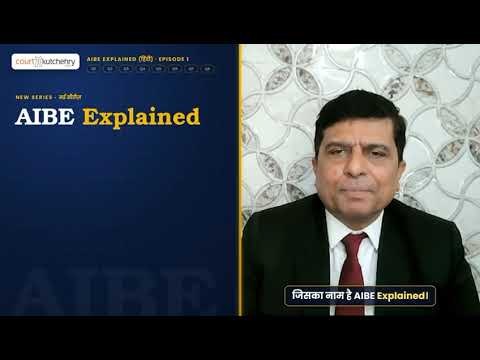
In this 7-minute video in Hindi, Episode 1 of the CourtKutchehry series “AIBE Explained”, Advocate Vinayak Pawar explains how the All India Bar Examination works, answering seven questions in Hindi: who conducts the exam, the paper pattern and passing marks, the open-book rules, the marks for all 19 subjects, the three kinds of questions, the new criminal laws and five tips to clear the paper. This English article, written for Hindi-medium aspirants, turns the episode into revision notes and pairs the Hindi terms with the English words used in bare acts and options.
Q1. What Is the AIBE and Who Conducts It?
The episode begins with the basics. The All India Bar Examination is conducted by the Bar Council of India (बार काउंसिल ऑफ इंडिया) under the Advocates Act, 1961 (एडवोकेट्स एक्ट). An advocate enrolled with a State Bar Council must clear it to receive the Certificate of Practice.
Revision points
- Who conducts: the Bar Council of India.
- Source of power: the Advocates Act, 1961 and the rules framed by the Bar Council.
- Leading case: in Bar Council of India v. Bonnie Foi Law College, (2023) 02 SC CK 0021, a Constitution Bench (संविधान पीठ) of the Supreme Court upheld the Bar Council’s power to conduct the examination, in its judgment of 10 February 2023.
Q2. Paper Pattern and Passing Marks
The episode then sets out the paper itself. These numbers should be learnt exactly:
| Point | As the episode states it |
|---|---|
| Questions | 100 multiple-choice questions (MCQ) |
| Total marks | 100 (one mark each) |
| Time | 3 hours 30 minutes |
| Negative marking | None (कोई नेगेटिव मार्किंग नहीं) |
| Passing marks: General / OBC | 45 |
| Passing marks: SC / ST / persons with disabilities | 40 |
That is about two minutes per question, and since a wrong answer costs nothing, no question should be left blank.
Q3. Is It an Open-Book Exam?
Yes, but the episode is careful to add the condition. Only bare acts without annotations (बिना टिप्पणी वाले बेयर एक्ट) may be carried. The episode lists what is not allowed:
- no notes (नोट्स),
- no commentary (कमेंट्री), and
- no stickers or flags with handwriting on them (लिखावट वाले स्टिकर).
Practise finding sections in the very editions you will carry, and check the Bar Council’s notification for your sitting, which sets out the permitted material.
Remember this line: an open book helps only the candidate who already knows which page to open.
Q4. Subject-wise Marks: All 19 Subjects
The AIBE syllabus has 19 subjects, and the episode walks through the marks for each. The point to carry into the exam hall is the one the episode highlights: seven subjects together carry 62 marks.
| Subject (Hindi, as in the episode) | Subject (English) | Marks |
|---|---|---|
| संवैधानिक कानून | Constitutional Law | 10 |
| आपराधिक प्रक्रिया | Criminal Procedure (now BNSS) | 10 |
| सिविल प्रक्रिया | Civil Procedure | 10 |
| दंड संहिता | Penal Code (now BNS) | 8 |
| साक्ष्य | Law of Evidence (now BSA) | 8 |
| पारिवारिक कानून | Family Law | 8 |
| संविदा / संपत्ति कानून | Contract, Specific Relief and Property Law | 8 |
The other twelve subjects share the remaining 38 marks, so make the big seven strong first.
Q5. The Three Kinds of Questions
The episode sorts AIBE questions into three types. In past-paper terms they look like this:
- Provision questions. “Which section…?” or “Which Order and Rule…?” Here the bare act is your best friend, so long as you can find the right chapter quickly.
- Case-law questions. Which judgment laid down a principle, or what a landmark case held. These need memory, not the bare act, because case names are not printed in the bare act.
- Application questions. A short set of facts, and you must choose the correct legal result. These test understanding of the concept.
Q6. New Criminal Laws: BNS, BNSS and BSA
The episode reminds candidates that from 1 July 2024 the three old criminal statutes have been replaced:
| Old law | New law (in force from 1 July 2024) |
|---|---|
| Indian Penal Code, 1860 (IPC) | Bharatiya Nyaya Sanhita, 2023 (BNS) |
| Code of Criminal Procedure, 1973 (CrPC) | Bharatiya Nagarik Suraksha Sanhita, 2023 (BNSS) |
| Indian Evidence Act, 1872 | Bharatiya Sakshya Adhiniyam, 2023 (BSA) |
The concepts are largely the same; the numbers are not. Murder, once Section 302 IPC, is now punishable under Section 103 BNS; the FIR, once Section 154 CrPC, is now Section 173 BNSS. Learn the new number with the old one beside it.
Q7. Five Tips to Clear the AIBE
The episode ends with five tips. Put into a study plan, they come to this:
- Follow the marks. Give most of your time to the seven subjects that carry 62 marks.
- Practise with your bare acts. Use the same unannotated editions you will carry, and time yourself finding sections.
- Learn both numbers. BNS, BNSS and BSA sections, with the IPC, CrPC and Evidence Act numbers alongside.
- Make a case list. One line per landmark case: name, year, principle.
- Attempt everything. With no negative marking, a guess is always better than a blank.
Key Legal Terms: Hindi ↔ English
These are terms used in the Hindi episode, with the English words you will see in bare acts, judgments and English options.
| Hindi | English |
|---|---|
| परीक्षा पैटर्न | Exam pattern |
| पासिंग मार्क्स (उत्तीर्ण अंक) | Qualifying / passing marks |
| नेगेटिव मार्किंग | Negative marking |
| बेयर एक्ट (बिना टिप्पणी वाला) | Bare act (unannotated) |
| विषयवार अंक | Subject-wise marks |
| संविधान पीठ | Constitution Bench |
| संवैधानिक कानून | Constitutional Law |
| आपराधिक प्रक्रिया | Criminal Procedure |
| सिविल प्रक्रिया | Civil Procedure |
| दंड संहिता | Penal Code |
| साक्ष्य | Evidence |
| संविदा | Contract |
Key Takeaways
- The AIBE is conducted by the Bar Council of India under the Advocates Act, 1961; a Constitution Bench upheld this in Bonnie Foi Law College (2023).
- 100 MCQs, 100 marks, 3 hours 30 minutes, no negative marking; pass marks 45 (General/OBC) and 40 (SC/ST/PwD).
- Open-book means bare acts only: no notes, commentary or handwritten stickers.
- Seven subjects carry 62 marks; prepare them first.
- From 1 July 2024, the BNS, BNSS and BSA replace the IPC, CrPC and Evidence Act; learn both sets of numbers.
Frequently Asked Questions
Is the Hindi episode different from the English Episode 1?
It covers the same exam-pattern topics in Hindi, in seven questions. Watch whichever language you prepare in; this article gives the Hindi and English terms together.
Can a Hindi-medium candidate carry Hindi bare acts?
The rule the episode stresses is that only unannotated bare acts may be carried. The exact permitted material is notified by the Bar Council of India for each sitting, so check that notification before you pack your books.
How many questions must I get right to pass?
45 out of 100 for General and OBC candidates, and 40 out of 100 for SC, ST and candidates with disabilities.
Which subjects should I study first?
Constitutional Law, Criminal Procedure and Civil Procedure (10 marks each), then Penal Code, Evidence, Family Law and Contract/Property (8 each). Together they make 62 marks.
Should I learn IPC or BNS section numbers?
Both. The BNS, BNSS and BSA are the law from 1 July 2024, but older judgments and many options still refer to the IPC, CrPC and Evidence Act.
Where can I watch the full explanation?
Watch the Hindi episode here: https://youtu.be/P8zh9nkmm04.
Conclusion
The first Hindi episode of “AIBE Explained” gives Hindi-medium aspirants the map of the exam: who conducts it, how the 100 marks are spread, what may be carried into the hall, and how the new criminal laws change the numbers you must learn.
Use the term table above to connect the Hindi you think in with the English you will read in the bare act, and follow the series subject by subject, beginning with Constitutional Law.
▶ Watch the video: AIBE परीक्षा पैटर्न 2026: ओपन-बुक नियम, विषयवार अंक और रणनीति | AIBE Explained Ep 1 | Courtkutchehry
▶ Watch in English: AIBE Exam Pattern 2026: Open-Book Rules, Subject-wise Marks & Strategy | AIBE Explained Ep 1
📖 Read the full article: AIBE Exam Pattern 2026: Open-Book Rules, Qualifying Marks, Subject-wise Marks and Strategy | AIBE Explained Ep 1
Research Judgments Like These on CourtKutchehry
Every judgment cited in this article, and lakhs more, can be searched and read on CourtKutchehry. Searching and reading judgments is free. A membership adds unlimited summaries, all related judgments, original court PDF downloads, bookmarks, notes and the CourtKutchehry AI assistant.
| Membership | Price | Works out to | AI credits |
|---|---|---|---|
| Monthly (1 month) | ₹599 | ₹599 / month | 1,000 / month |
| Quarterly (3 months) · Save 16% | ₹1,499 | ₹499.67 / month | 1,100 / month |
| Six-monthly (6 months) · Save 33% | ₹2,399 | ₹399.83 / month | 1,200 / month |
| Yearly (12 months) · Save 44% · Best value | ₹3,999 | ₹333.25 / month | 1,300 / month |
Every plan is a one-off purchase for a fixed period: nothing auto-renews and no card is kept on file. Prices are exclusive of applicable tax, which is added at checkout. Extra AI chat credits can be topped up from ₹99. A free verified account gets 5 summaries and 50 AI trial credits.
Prices are as displayed on courtkutchehry.com on 20 November 2026 and are subject to change without notice. Please check the pricing page for the current plans and offers.
For more judgments, legal opinions and case analysis, visit courtkutchehry.com
Visit CourtKutchehry →