
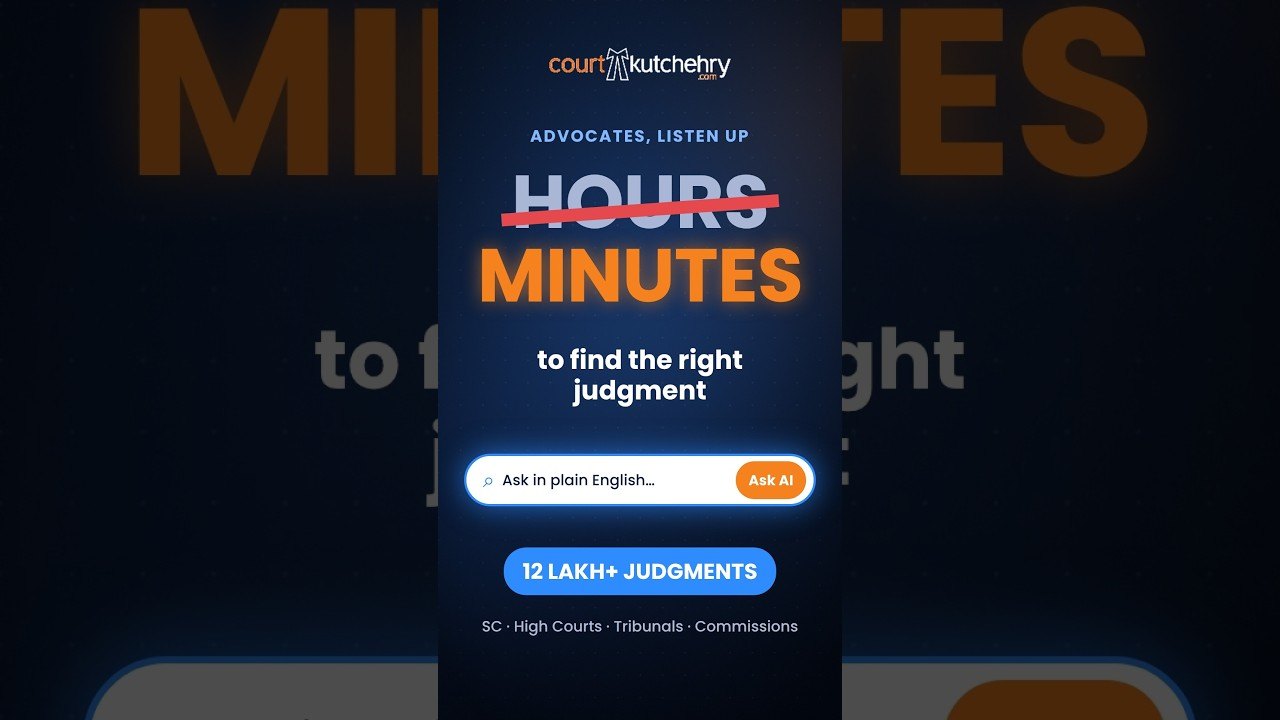
Watch the Video
In this 1-minute Short, Adv. Vinayak Pawar asks advocates a direct question: how many hours did you spend last week searching for just one judgment? The Short’s promise is in its title, from hours to minutes. This article looks at that one point: where research hours go, which steps the features shown are meant to shorten, and which step no tool should shorten.
▶ Watch on YouTube: Advocates: Hours → Minutes to Find the Right Judgment ⚡
▶ Watch the full episode: Advocates, Stop Wasting Hours Searching for Judgments | Courtkutchehry AI
Where the Hours Go
Ask an advocate to break down a long research evening and the pattern is familiar. Very little of the time is spent reading the paragraph that is finally cited. Most of it goes on four things:
- Guessing keywords. Trying one search term after another until a relevant judgment turns up.
- Sorting results. Scrolling through long result lists, most of which are irrelevant.
- Opening to check relevance. Reading the first pages of a long judgment only to discover it is about something else.
- Losing track. Re-finding a judgment you read last week, or retyping notes you made elsewhere.
The Short’s “hours to minutes” is about these four steps, not the reading a brief needs.
Step 1 Shortened: Ask the Question, Not the Keyword
The first feature in the Short is the ability to ask your legal question in plain English. Instead of guessing which keyword a judge might have used, you write the question as you would put it to a senior: for instance, whether a particular procedural safeguard is mandatory, or what the limitation is for a particular remedy.
According to the Short, the answer comes with supporting judgments and a relevance score for each. A relevance score is best treated as a reading order: it tells you which judgment to open first, not which judgment is right.
Steps 2 and 3 Shortened: Decide Relevance Before You Read
The second feature is the structured summary. The Short lists its headings: facts, issues, reasoning, decision, key principles, cases cited and similar judgments. Used well, a structured summary answers the question “should I read this judgment at all?” in a minute, and, if the answer is yes, tells you which part to read.
The Short also mentions search across 12 lakh+ judgments of the Supreme Court, High Courts, Tribunals and Commissions, and filters by court, judge, Act, section or date. Filters are what cut a result list down to the forum and period that matter, so you are not reading a Tribunal order when you need a High Court ruling, or a decision under a repealed section when the new one applies.
Remember this line: let the tool decide what to read first; never let it decide what the law is.
Step 4 Shortened: Keep the Research in One Place
The last group of features in the Short is housekeeping: save, bookmark, add notes and download the PDF. This is the least glamorous step but often the biggest hidden cost. A judgment you bookmarked with a note on the relevant paragraph is one you do not have to find again before the next date of hearing.
The Step No Tool Should Shorten
The Short itself carries the necessary caution: AI summaries are research aids; always verify with the original judgment, and the screens shown are illustrative. For an advocate, that is not a formality. Before a judgment goes into a pleading or is cited in court:
- open the original judgment and read the paragraph you will rely on;
- check the court, bench strength, date and citation;
- check that it has not been overruled, stayed or referred to a larger bench; and
- where the law has changed, as with the IPC, CrPC and Evidence Act becoming the BNS, BNSS and BSA from 1 July 2024, make sure the provision you cite is the one in force.
Key Takeaways
- Most research time is lost in searching, sorting and re-finding, not in reading the paragraph you cite.
- The Short shows plain-English questions with supporting judgments and relevance scores; treat a score as a reading order.
- Structured summaries and filters help you decide quickly what to read and from which court and period.
- Saving, bookmarking, notes and PDF downloads keep a matter’s research in one place.
- Always verify with the original judgment before citing; the monthly plan starts at ₹599 plus tax.
Frequently Asked Questions
What does “hours to minutes” refer to in the Short?
It refers to the time spent finding the right judgment: searching, sorting results and checking relevance. Reading and verifying the judgment remains the advocate’s job.
What is a relevance score?
As shown in the Short, each supporting judgment comes with a score indicating how closely it relates to your question. Use it to decide the order in which to read, not as a conclusion on the law.
Can I cite an AI summary in court?
No. Cite the original judgment and the paragraph you rely on. The Short itself says AI summaries are research aids.
How much does the monthly plan cost?
The Short states it starts at ₹599 plus applicable tax; see the table below and the pricing page for current plans.
Where can I watch the video?
Watch the Short here: https://youtu.be/F2lgY59wiH0.
Conclusion
The Short makes one promise: less time finding the right judgment. That promise is about the searching, sorting and re-finding that take up most research evenings, and the features it shows are aimed at exactly those steps.
The reading and verifying stay with the advocate. Spend the time saved on the original judgment, and the research is both faster and safer.
▶ Watch the video: Advocates: Hours → Minutes to Find the Right Judgment ⚡
▶ Watch the full episode: Advocates, Stop Wasting Hours Searching for Judgments | Courtkutchehry AI
📖 Read the full article: Advocates, Stop Wasting Hours Searching for Judgments: How to Research Case Law Efficiently with Courtkutchehry AI
Research the Law on CourtKutchehry
CourtKutchehry gives you lakhs of Indian judgments, searchable for free. A membership adds unlimited summaries, all related judgments, original court PDF downloads, bookmarks, notes and the CourtKutchehry AI assistant.
| Membership | Price | Works out to | AI credits |
|---|---|---|---|
| Monthly (1 month) | ₹599 | ₹599 / month | 1,000 / month |
| Quarterly (3 months) · Save 16% | ₹1,499 | ₹499.67 / month | 1,100 / month |
| Six-monthly (6 months) · Save 33% | ₹2,399 | ₹399.83 / month | 1,200 / month |
| Yearly (12 months) · Save 44% · Best value | ₹3,999 | ₹333.25 / month | 1,300 / month |
Every plan is a one-off purchase for a fixed period: nothing auto-renews and no card is kept on file. Prices are exclusive of applicable tax, which is added at checkout. Extra AI chat credits can be topped up from ₹99. A free verified account gets 5 summaries and 50 AI trial credits.
Prices are as displayed on courtkutchehry.com on 20 November 2026 and are subject to change without notice. Please check the pricing page for the current plans and offers.
For more judgments, legal opinions and case analysis, visit courtkutchehry.com
Visit CourtKutchehry →