
Case at a Glance
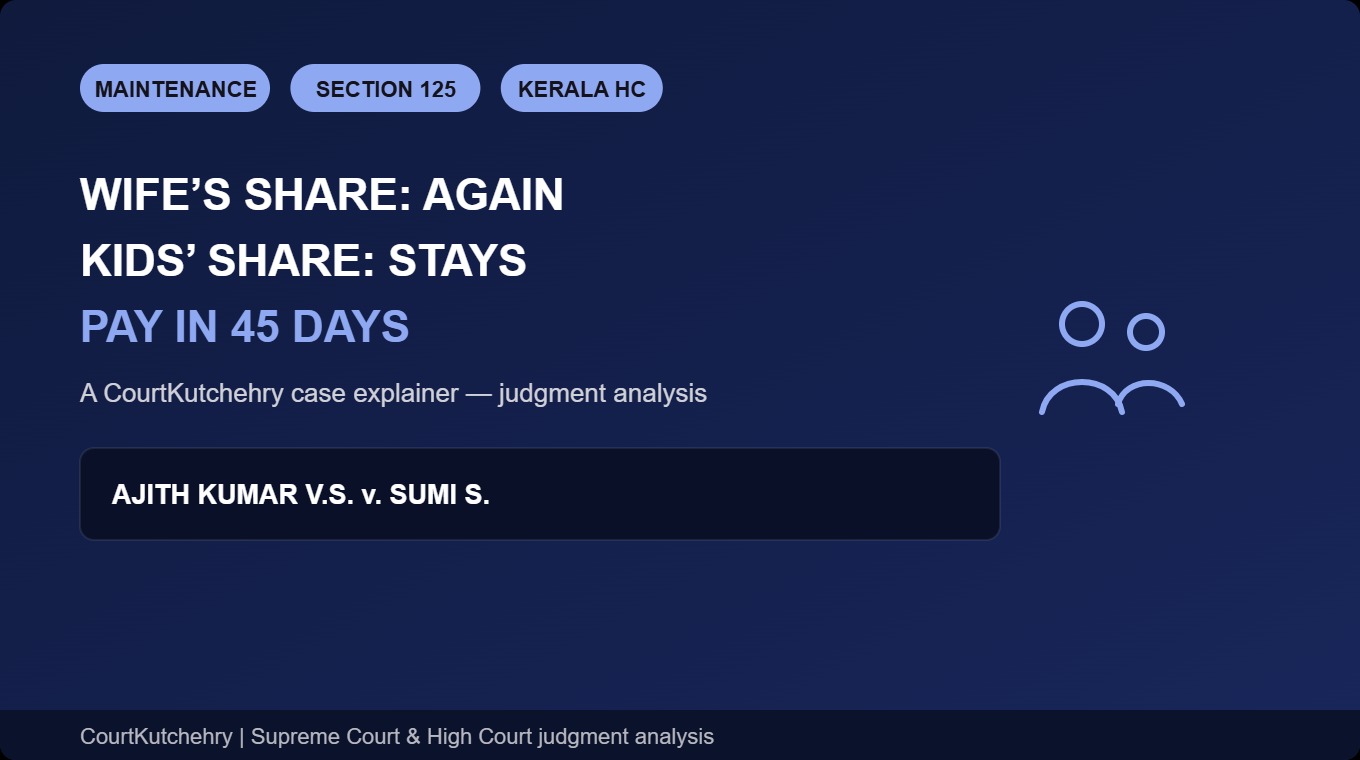
The Family Court, Neyyattinkara, awarded a wife ₹5,000 a month and each of her two children ₹10,000 a month under Section 125 CrPC. The husband challenged it, saying the wife had refused to live with him without reason and that she was employed. Justice C. Jayachandran found that the Family Court had not dealt with his objection and that the wife had admitted a job without disclosing her income, so he remitted the wife’s claim for fresh consideration with directions for evidence on both sides’ incomes. The children’s maintenance was confirmed, and the remand was made conditional on the husband paying the children’s arrears within 45 days.
The wife and the couple’s two children filed M.C. No. 389 of 2023 under Section 125 CrPC before the Family Court, Neyyattinkara. By order dated 9 June 2026 the Family Court awarded ₹5,000 a month to the wife and ₹10,000 a month to each child. The husband had filed objections on 21 November 2025 contending that the wife was refusing to live with him without valid reason.
In revision before the High Court, the husband argued that the objection had not been considered and that the wife was employed. The wife admitted that she has a job in a company but did not disclose her income. The children’s claimed educational expenses were about ₹6,000 each a month, and counsel for the respondents submitted that arrears of ₹9,80,000 were due.
The Key Question Before the Court
Can a maintenance order in favour of a wife stand when the Family Court has not considered the husband’s plea that she refused to live with him without reason, and the wife has admitted employment without disclosing her income?
Separating the Wife’s Claim From the Children’s
The Court found that the Family Court’s order did not address the husband’s objection that the wife had refused to live with him without valid reason. Under Section 125(4), a wife who refuses to live with her husband without sufficient reason is not entitled to maintenance. The husband had not yet led evidence on the point, and the Court held he should get that opportunity. It also took note of the wife’s undisclosed income, since Section 125 contemplates maintenance for a wife who is “unable to maintain herself.” The wife’s claim was therefore remitted for fresh consideration, with the husband to file an affidavit of his income, assets and liabilities, and the wife to adduce evidence of her income for the relevant period.
The children stood on a different footing. Given their documented educational needs, the Court saw no reason to interfere with ₹10,000 a month for each child and confirmed it. To prevent the remand from becoming a means of delay, the Court made it conditional: the husband must pay the full arrears due to the children within 45 days, in which case interest is reduced to 6% per annum; if he fails, he loses the benefit of the remand and the Family Court’s order stands confirmed in full.
What the Court Actually Held
- A maintenance order for the wife cannot stand where the husband’s objection under Section 125(4) was not considered; the claim was remitted.
- The wife’s admitted employment and undisclosed income must be examined; both parties must place their income on record.
- Maintenance of ₹10,000 a month for each child was confirmed.
- The husband must pay the children’s arrears within 45 days (interest then reduced to 6%), failing which the remand lapses and the Family Court order stands.
Why This Judgment Matters
- Disputes over a working wife’s entitlement to maintenance are among the most common in family courts.
- It shows that a flaw in the wife’s award does not unsettle the children’s maintenance.
- The conditional remand discourages using revision to avoid paying arrears.
What Should Advocates Take Away From the Judgment?
For Wives and Children
- Disclose your income honestly; non-disclosure can lead to the wife’s claim being reopened.
- Children’s maintenance is assessed on their own needs, such as education, and may be upheld independently.
- Courts can make relief to the husband conditional on payment of arrears.
For Counsel
- If a Section 125(4) objection is raised, ensure the Family Court records a finding on it.
- Insist on income, assets and liabilities affidavits from both sides.
- In revision, expect the High Court to separate the wife’s claim from the children’s and to condition any remand on payment.
Key Takeaways
- Wife’s maintenance remitted because the husband’s objection was not considered.
- A wife’s undisclosed income is relevant under Section 125 CrPC.
- Children’s ₹10,000 a month each confirmed.
- Pay arrears in 45 days or lose the remand.
Frequently Asked Questions
Did the High Court say an earning wife can never get maintenance?
No. It remitted the claim so that the Family Court can examine the wife’s income and the husband’s objection afresh on evidence.
What happens if the husband does not pay the arrears in 45 days?
He loses the benefit of the remand, and the Family Court’s order, including the wife’s ₹5,000 a month, stands confirmed.
What is Section 125(4) CrPC?
It provides that a wife is not entitled to maintenance if, among other things, she refuses to live with her husband without sufficient reason.
Conclusion
The ruling is a careful division of a maintenance dispute: the children’s needs are secured at once, while the wife’s claim is sent back for a proper inquiry into the husband’s objection and her own income. Making the remand depend on payment of arrears keeps the children from bearing the cost of the parents’ dispute.
Practical takeaway: In Section 125 CrPC cases, both spouses should file full income disclosures early — and a husband seeking a remand should be ready to clear the children’s arrears first.
For more judgments, legal opinions and case analysis, visit courtkutchehry.com