
COURTKUTCHEHRY EXCLUSIVE: EXTRACTS FROM BEST SELLING BOOK: WILL WRITING SIMPLIFIED
Witnesses in Indian Will Law: Why Independent Attestation Safeguards Testamentary Intent
Witnesses Confirm Voluntary Execution and Mental Capacity of the Testator
Courts Rely on Witness Testimony to Resolve Disputes Over Wills
By Vishwas Kumar
New Delhi: March 31, 2026:
In India, inheritance disputes often hinge on one crucial question: Was the Will executed properly? At the center of this question stand the witnesses—the impartial observers who confirm that the Testator signed the Will voluntarily, with sound understanding, and without undue influence. Their role is not ceremonial; it is a legal safeguard that ensures the Will reflects the true intention of the deceased.
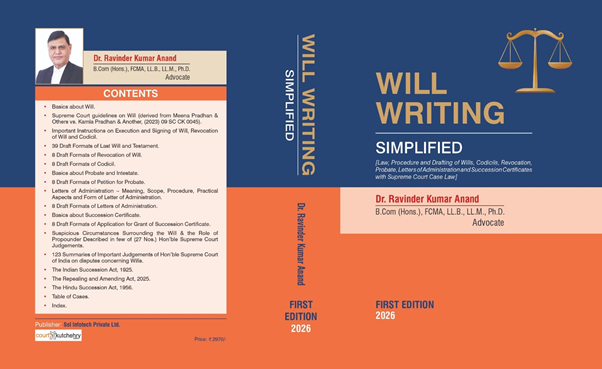
The extract from Will Writing Simplified by Dr. Ravinder Kumar Anand [📘 Buy Will Writing Simplified online: Amazon 🔹 Flipkart] explains the importance of witnesses in Will-making. This article expands on that extract, explaining in plain language what witnesses do, why independence matters, and how courts interpret their testimony.
Detailed Explanation of the Extract
The extract provides a clear definition:
- “Witness is a person who observes the Testator sign the Will or receives an acknowledgement of the Testator’s signature and thereafter signs the documents himself/herself.”
→ Meaning: A witness either sees the Testator sign or hears the Testator acknowledge the signature and then signs the Will themselves. - “Witnesses act as impartial observers who confirm that the Testator executed the Will voluntarily, with sound understanding, and without undue influence.”
→ Meaning: Witnesses ensure the Testator was not coerced, intoxicated, or mentally incapable. - “Ideally, witnesses should be independent and not beneficiaries.”
→ Meaning: Beneficiaries should not act as witnesses, as it raises suspicion about undue influence. - “In case of challenge, they may be summoned to court to prove execution and the Testator’s mental capacity.”
→ Meaning: Witnesses may testify in probate proceedings to confirm validity.
Legal Context
Indian Succession Act, 1925
- Section 63: Requires that a Will be attested by at least two witnesses.
- Witnesses must sign in the presence of the Testator.
- At least one witness must testify in court if the Will is contested.
Hindu Succession Act, 1956
- Applies when there is no Will. Property devolves by intestate succession.
- A validly attested Will overrides these default rules.
Judicial Principles
Courts emphasize:
- Witnesses must be credible and independent.
- Suspicious circumstances—such as beneficiaries acting as witnesses—must be explained.
- Witness testimony is crucial in proving execution and mental capacity.
Examples and Case Studies
- Hypothetical Example:
A father signs a Will leaving property to his son. The son and his wife act as witnesses. Later, the daughter challenges the Will. Courts may view the witnesses as biased, raising suspicion. - Hypothetical Example:
A Will is signed in front of two neighbours who have no interest in the estate. Their testimony later confirms the Testator’s sound mind. The Will is upheld. - Hypothetical Example:
A Will is signed without witnesses. Even if genuine, it is invalid under law.
LEGAL RESEARCH RESOURCES: Check out 123 Key Judgements, as highlighted in the book, WILL WRITING SIMPLIFIED, for the quick research and reference purposes. Click the link here: https://www.courtkutchehry.com/pages/blog/123-supreme-court-judgments-on-wills/
Historical and Comparative Context
- Colonial Legacy: The Indian Succession Act, 1925, consolidated testamentary law and introduced strict attestation requirements.
- UK Law: Wills Act 1837 requires two witnesses, similar to India.
- US Law: Requirements vary by state, but witness attestation is universally required.
- Evolution in India: Courts emphasize impartiality and independence of witnesses to prevent fraud.
Implications for Society, Families, and Courts
- Families: Independent witnesses prevent disputes and preserve harmony.
- Courts: Witness testimony is often decisive in probate cases.
- Society: Proper attestation ensures trust in testamentary documents and protects vulnerable heirs.
FAQ Section
1. Who can be a witness to a Will?
Any adult of sound mind, ideally independent and not a beneficiary.
2. How many witnesses are required?
At least two, under the Indian Succession Act.
3. Can a beneficiary act as a witness?
Legally possible but raises suspicion and may weaken the Will’s credibility.
4. What if a Will has no witnesses?
It is invalid, even if genuine.
5. Can witnesses be called to court?
Yes, to prove execution and the Testator’s mental capacity.
6. Do witnesses administer the estate?
No. That is the executor’s role.
7. Why must witnesses be independent?
To avoid suspicion of undue influence or fraud.
Conclusion
The extract from Will Writing Simplified highlights a fundamental truth: witnesses are the guardians of testamentary intent. Their role is not symbolic but legal, ensuring that the Testator’s wishes are respected and disputes minimized. Independent witnesses provide credibility, while biased witnesses invite suspicion.
For families, proper attestation prevents quarrels. For courts, it provides reliable evidence. For society, it strengthens trust in the law. The lesson is simple: choose independent witnesses and follow legal formalities to safeguard the Will.
Book Reference
📘 Buy Will Writing Simplified online: Amazon 🔹 Flipkart
Sentences Used from Extract
- “Witness is a person who observes the Testator sign the Will or receives an acknowledgement of the Testator’s signature and thereafter signs the documents himself/herself.”
- “Witnesses act as impartial observers who confirm that the Testator executed the Will voluntarily, with sound understanding, and without undue influence.”
- “Ideally, witnesses should be independent and not beneficiaries.”
- “In case of challenge, they may be summoned to court to prove execution and the Testator’s mental capacity.”
Suggested Keywords
- Witness in Indian Will law
- Indian Succession Act witness rules
- Attestation requirements for Will India
- Beneficiary as witness Will India
- Probate disputes witness testimony
- Testamentary capacity proof India
- Independent witness Will India