
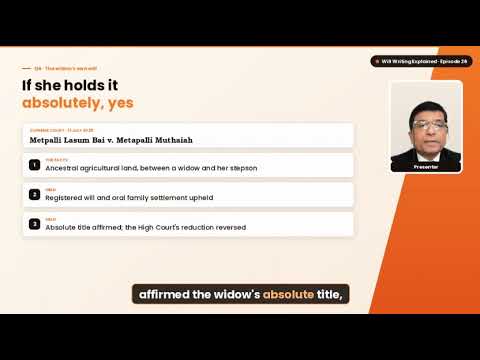
Watch the Video
In this 11-minute video, CourtKutchehry presents Episode 26 of “Will Writing Explained”: wills by women, and wills for women. A woman has the same full power to make a will as a man, yet a woman who dies without one often loses the most. The episode explains a woman’s right to will her property (Section 14 of the Hindu Succession Act, 1956), the surprises of Section 15, a widow’s life interest, how a husband or father should protect his wife and daughters in his will, and how Supreme Court cases on mothers’ wills turned out. This article explains the same law in writing.
▶ Watch on YouTube: Wills by Women, Wills for Women: Rights and Protection | Will Writing Ep 26
A Woman’s Full Power to Make a Will: Section 14
Before 1956, a Hindu woman often held inherited property only as a “limited owner”: she could enjoy it during her life, but could not freely sell it or leave it by will. Section 14(1) of the Hindu Succession Act changed that. Any property possessed by a female Hindu, whether acquired before or after the Act, is held by her as full owner and not as a limited owner.
Read with Section 30, which allows any Hindu to dispose of property by will, this means a woman can leave her property to anyone she chooses, in exactly the same way as a man. Her will must be signed and attested under Section 63 of the Indian Succession Act, 1925, and it is proved in the same way.
The property covered includes what she inherited, what she bought, her stridhan, gifts from her parents or husband, property received at a partition and property given to her in lieu of maintenance.
The Surprises of Section 15
If a Hindu woman dies without a will, Section 15 decides who inherits. Many families are surprised by the result.
The general order: Section 15(1)
- sons, daughters (including children of a predeceased son or daughter) and the husband;
- the heirs of the husband;
- the mother and father;
- the heirs of the father; and
- the heirs of the mother.
So if a married woman has no children and her husband has died, her husband’s heirs come before her own parents.
The exceptions: Section 15(2)
- Property she inherited from her father or mother goes, if she has no son or daughter, to the heirs of her father.
- Property she inherited from her husband or father-in-law goes, if she has no son or daughter, to the heirs of her husband.
The exceptions apply only to inherited property. In Omprakash v. Radhacharan, (2009) 05 SC CK 0164, a young widow, turned out of her matrimonial home soon after her husband’s death, built up her own savings and property while living with her parents. She died intestate. The Supreme Court held that because her property was self-acquired, Section 15(1) applied and it went to her husband’s heirs, not to her mother’s side, however hard that seemed.
Remember this line: a woman who wants her own family to inherit must say so in a will.
A Widow’s Life Interest
Husbands often leave property to the wife “for her life”, with the remainder to the children after her. Is that restriction valid, or does Section 14(1) turn her life interest into full ownership?
The answer lies in Section 14(2). It says Section 14(1) does not apply to property acquired by way of gift, or under a will or other instrument, or a decree or award, where the terms prescribe a restricted estate. In V. Tulasamma v. Sesha Reddy, (1977) 3 SCC 99, the Supreme Court explained the line:
- where property is given to a woman in recognition of a pre-existing right, such as her right to maintenance, the restriction falls away and she becomes full owner under Section 14(1); but
- where she receives property under a will as a fresh grant, with no pre-existing right behind it, Section 14(2) applies and the life interest stays a life interest.
Whether a particular will gives a fresh grant or recognises maintenance depends on its words and the facts, which is why the drafting matters.
How a Husband or Father Should Protect His Wife and Daughters
A man making a will can protect the women in his family in practical ways:
- Do not leave the wife out silently. If she is to receive less, say why. In Episode 17 of the series, an unexplained silence about a living wife cost a nephew his inheritance.
- Choose between full ownership and a life interest deliberately. A life interest protects the children’s eventual share; full ownership gives the wife independence. Say clearly which is intended.
- Secure a roof. Give the wife a clear right of residence in the family home for life, even if ownership passes to the children.
- Remember the daughters’ own rights. Since the 2005 amendment to Section 6 of the Hindu Succession Act, daughters are coparceners by birth in Mitakshara joint family property. A father can will only his own interest, not his daughter’s share.
- Align nominations and joint accounts with the will, and name a trusted executor who will actually carry out the wishes.
How the Supreme Court Treated Mothers’ Wills
Several Supreme Court cases on wills made by mothers show the same rules applied to women testators.
- Upheld: In Ramabai Padmakar Patil v. Rukminibai Vishnu Vekhande, (2003) 08 SC CK 0086, a mother of seven daughters left her property to the widowed daughter who had cared for her for over twenty years. The Court found the disposition natural and accepted the will, though she could give only the share she actually held.
- Upheld: In Swarnalatha v. Kalavathy, (2022) 03 SC CK 0096, wills made by a father and a mother were upheld despite a daughter’s exclusion, because the reasons were stated and the evidence was sound.
- Refused: In Kavita Kanwar v. Pamela Mehta, (2020) 05 SC CK 0022, probate of a mother’s will favouring her younger daughter, who was also the executor and played a prominent part in its execution, was refused because the suspicious circumstances were not explained.
- Failed: In Dhani Ram v. Shiv Singh, (2023) 10 SC CK 0011, a woman’s registered will failed because the attesting witnesses did not prove attestation. Her property then passed under Section 15 of the Hindu Succession Act.
The common thread: a mother’s will, like a father’s, survives when it is properly executed, explains its choices and is kept free of the beneficiary’s control.
Practical Checklist for a Woman Making a Will
- List all property, including stridhan, jewellery, deposits and inherited property.
- Decide whether you want your own parents or siblings to benefit; without a will, Section 15 may send your property elsewhere.
- Use two independent attesting witnesses, and consider registration.
- Keep beneficiaries away from the drafting and signing.
- Give reasons for unequal shares.
- Name an executor and tell someone where the original is kept.
Key Takeaways
- A Hindu woman is the full owner of her property (Section 14(1)) and can will it freely (Section 30).
- Without a will, Section 15 can send a married woman’s property to her husband’s heirs before her own parents (Omprakash, 2009).
- A life interest given by will as a fresh grant stays restricted under Section 14(2); one recognising maintenance can become absolute (Tulasamma, 1977).
- A husband or father should name and provide for his wife and remember daughters’ coparcenary rights.
- Mothers’ wills are tested by the same rules as any other will.
Frequently Asked Questions
Can a Hindu woman make a will of her property?
Yes. She holds it as full owner under Section 14(1) and can dispose of it by will under Section 30 of the Hindu Succession Act.
Who inherits a married woman’s property if she dies without a will and has no children?
Her husband, or if he is dead, his heirs, before her own parents, except for property she inherited from her parents, which goes to her father’s heirs.
Is a life interest given to a widow in a will valid?
Generally yes, under Section 14(2), where it is a fresh grant. If it is given in recognition of her right of maintenance, it may become absolute.
Can a father leave his daughter’s coparcenary share to his son?
No. Since 2005 a daughter is a coparcener by birth; the father can will only his own interest.
Do courts treat a mother’s will differently?
No. The same rules on execution, attestation and suspicious circumstances apply.
Where can I watch the full explanation?
Watch the video explain wills by and for women in 11 minutes: https://youtu.be/xjsCScPacu8.
Conclusion
The law gives women full ownership and full power to make a will. What it does not do, without a will, is send a woman’s property where she might expect. Section 15 can surprise families, and the only reliable answer is a clear, well-executed will.
For men, the lesson is the reverse: a will that silently ignores a wife or forgets a daughter’s own rights invites both injustice and litigation. Name the women in the family, provide for them, and explain the choices.
▶ Watch the video: Wills by Women, Wills for Women: Rights and Protection | Will Writing Ep 26
Research Judgments Like These on CourtKutchehry
Every judgment cited in this article, and lakhs more, can be searched and read on CourtKutchehry. Searching and reading judgments is free. A membership adds unlimited summaries, all related judgments, original court PDF downloads, bookmarks, notes and the CourtKutchehry AI assistant.
| Membership | Price | Works out to | AI credits |
|---|---|---|---|
| Monthly (1 month) | ₹599 | ₹599 / month | 1,000 / month |
| Quarterly (3 months) · Save 16% | ₹1,499 | ₹499.67 / month | 1,100 / month |
| Six-monthly (6 months) · Save 33% | ₹2,399 | ₹399.83 / month | 1,200 / month |
| Yearly (12 months) · Save 44% · Best value | ₹3,999 | ₹333.25 / month | 1,300 / month |
Every plan is a one-off purchase for a fixed period: nothing auto-renews and no card is kept on file. Prices are exclusive of applicable tax, which is added at checkout. Extra AI chat credits can be topped up from ₹99. A free verified account gets 5 summaries and 50 AI trial credits.
Prices are as displayed on courtkutchehry.com on 20 November 2026 and are subject to change without notice. Please check the pricing page for the current plans and offers.
For more judgments, legal opinions and case analysis, visit courtkutchehry.com
Visit CourtKutchehry →