

COURTKUTCHEHRY EXCLUSIVE: EXTRACTS FROM BEST SELLING BOOK: WILL WRITING SIMPLIFIED
How to Execute, Sign, and Authenticate a Will in India: Key Instructions for Testators
Handwritten or typed Wills are valid, but clarity and proper execution are essential.
Signatures, witnesses, and optional registration strengthen authenticity and reduce disputes.
By Vishwas Kumar
New Delhi: April 01, 2026:
In India, writing a Will is one of the most important legal acts a person can undertake. It determines how property and assets will be distributed after death, ensuring that the testator’s wishes are respected. Yet, many disputes arise because Wills are not executed properly. Questions of authenticity, identity, and validity often reach the courts, leading to delays and family conflicts.
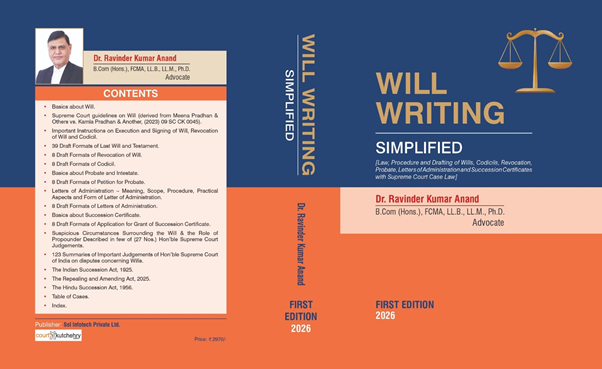
The extract from Will Writing Simplified by Dr. Ravinder Kumar Anand [📘 Buy Will Writing Simplified online: Amazon 🔹 Flipkart] provides practical instructions on how to execute and sign a Will, how to revoke it, and how to use codicils for amendments. These guidelines highlight the importance of proper drafting, identification, signatures, witnesses, and optional registration. This article explains these instructions in plain language, situates them within Indian succession law, and explores their implications for families and society.
Find all key will cases decided by Supreme Court here. Click the link here: https://www.courtkutchehry.com/pages/blog/123-supreme-court-judgments-on-wills/
Detailed Explanation of the Extract in Plain Language
1. Handwritten vs Typed Wills
The extract states: “As a First Option, the Will should be handwritten by the Testator, and if it is not possible…then as a Second Option, the Will should be typed on a Plain Paper.”
- A handwritten Will (holograph Will) is strong evidence because handwriting can be verified.
- If handwriting is not feasible, a neatly typed Will on plain paper is equally valid.
- Stamp paper is not required. What matters is clarity and proper execution.
2. Heading: “Last Will and Testament”
The extract advises: “The Will must on the Top State ‘Last Will and Testament’.”
This heading removes doubt and ensures courts recognize the document as a Will.
3. Identification Details
The extract notes: “The Aadhaar No./ PAN No./ Passport No.___ of the Testator must be mentioned in the Will.”
This prevents confusion between individuals with similar names and helps in probate proceedings.
4. Photograph of the Testator
The extract says: “A recent photograph of the Testator should be affixed to the Will. (This is optional but recommended.)”
A photograph prevents impersonation and supports authenticity.
5. Signatures or Thumb Impressions
The extract emphasizes: “The Testator must sign or affix his/her Thumb Impression on each page of the Will.”
This prevents tampering and confirms approval of all contents.
6. Signature Across Photograph
The extract adds: “The Testator's signature or Thumb Impression should extend halfway on the photograph and halfway on the paper to ensure authenticity.”
This ensures the photograph was affixed at the time of signing.
7. Witnesses
The extract requires: “The Will must be witnessed by at least two individuals…Two witnesses are mandatory under Section 63 of the Indian Succession Act, 1925.”
- Witnesses should preferably be younger, ensuring availability in future.
- A doctor as a witness supports mental fitness.
- A Chartered Accountant or Auditor adds credibility.
- Witnesses must provide identification details.
8. Legal Authentication Options
The extract outlines three preferences:
- Registration (optional): Adds evidentiary strength and public record.
- Notarisation (optional): Confirms identity and voluntary execution.
- Unregistered Will: Still valid if properly signed and witnessed.
Legal Context
- Indian Succession Act, 1925: Section 63 requires signature and attestation by two witnesses.
- Evidence Act, 1872: Witnesses may be examined to prove execution.
- Hindu Succession Act, 1956: Governs intestate succession, underscoring the importance of valid Wills.
Examples and Case Studies (Hypothetical)
- Example 1: Handwritten Will
An elderly man writes a holograph Will in his own handwriting. His handwriting is later verified, reducing disputes. - Example 2: Typed Will with photograph
A woman types her Will, affixes her photograph, and signs across it. This prevents impersonation. - Example 3: Witness credibility
A doctor and auditor witness a Will. Their testimony later confirms mental fitness and authenticity. - Example 4: Unregistered Will
A Will is signed and witnessed but not registered. It is still valid in court.
Historical and Comparative Context
- India: Traditionally, handwritten Wills were preferred. Modern practice accepts typed Wills, emphasizing clarity and execution.
- England: Similar rules apply; handwritten Wills are strong evidence but typed Wills are valid.
- United States: Witness requirements vary by state, but signatures and clarity remain essential.
Globally, the focus is on authenticity and preventing fraud.
Implications for Society, Families, and Courts
- For families: Proper execution prevents disputes and ensures smooth succession.
- For society: Reinforces trust in testamentary freedom.
- For courts: Reduces litigation by ensuring Wills are clear, authentic, and properly attested.
FAQ Section
1. Is a handwritten Will better than a typed one?
Yes, because handwriting can be verified. But typed Wills are equally valid.
2. Must a Will be written on stamp paper?
No. Plain paper is sufficient.
3. Is registration compulsory?
No. Registration is optional but adds authenticity.
4. How many witnesses are required?
At least two witnesses under Section 63 of the Indian Succession Act.
5. Should a photograph be affixed?
Optional but recommended to prevent impersonation.
6. Must the testator sign every page?
Yes, to prevent tampering.
7. Can an unregistered Will be valid?
Yes, if properly signed and witnessed.
Conclusion
Executing a Will is not just about writing down wishes—it is about ensuring those wishes are respected after death. The instructions from Will Writing Simplified highlight the importance of clarity, identification, signatures, witnesses, and optional registration. Families must follow these guidelines to avoid disputes, and courts must enforce them to protect testamentary freedom. A properly executed Will is the best safeguard against conflict and ensures peace of mind for the testator and their loved ones.
Book Reference
Exact Sentences Used from the Extract
- “As a First Option, the Will should be handwritten by the Testator, and if it is not possible for the Testator to prepare a Handwritten Will due to age, health, or convenience then as a Second Option, the Will should be typed on a Plain Paper.”
- “A handwritten Will, also known as a holograph Will, reduces the chances of disputes regarding authenticity because the handwriting of the Testator can be verified.”
- “Where handwriting is not feasible due to age, health, or convenience, a neatly typed Will on plain paper (not necessarily stamp paper) is equally valid under Indian law.”
- “The Will must on the Top State ‘Last Will and Testament’.”
- “The Aadhaar No./ PAN No./ Passport No.___ of the Testator must be mentioned in the Will.”
- “A recent photograph of the Testator should be affixed to the Will. (This is optional but recommended.)”
- “The Testator must sign or affix his/her Thumb Impression on each page of the Will.”
- “The Testator's signature or Thumb Impression should extend halfway on the photograph and halfway on the paper to ensure authenticity.”
- “The Will must be witnessed by at least two individuals…Two witnesses are mandatory under Section 63 of the Indian Succession Act, 1925.”
- “Choosing witnesses of younger age ensures their likely availability for verification in the future, especially during probate. A doctor as a witness supports the Testator’s mental fitness at the time of signing, and a Chartered Accountant or Auditor provides credibility due to their professional association and familiarity with the Testator’s affairs.”
- “Registration gives the Will an additional layer of evidentiary strength. Although optional, it provides a public record of the Will and its date of execution, reduces chances of suppression, and can simplify probate in some cases.”
- “Notarisation confirms the identity of the Testator and the witnesses and records the fact of voluntary execution. It does not substitute the two-witness requirement, but supplements further credibility.”
- “The Will may remain unregistered, as an unregistered Will is legally valid under Indian law.”
[📘 Buy Will Writing Simplified online: Amazon 🔹 Flipkart]
Suggested Keywords for SEO
- Execution of Will India
- Signing of Will Indian Succession Act
- Witness requirement in Wills India
- Registration of Wills India
- Codicil and revocation of Will India
- Will Writing Simplified Dr Ravinder Kumar Anand