
Watch the Video
In this 9-minute video, Vineet Kohli, Advocate opens the series “SARFAESI Act Explained with Judgments” with Episode 1. Before reading a single section, he goes back to the late 1990s to explain the bad-loan problem that the Securitisation and Reconstruction of Financial Assets and Enforcement of Security Interest Act, 2002 was designed to solve: the NPA crisis, the committees that studied it, the Ordinance of June 2002, and the three pillars on which the Act stands. This article covers the same background in writing, with the practice points for advocates.
The Problem of Bad Loans
Picture a bank in the late 1990s. It has lent crores of rupees against factories, flats and machinery. Many borrowers stop paying. The bank goes to the civil court, or after 1993 to the Debts Recovery Tribunal. The case takes years, and all the while the property secured to the bank loses value while the borrower stays in possession.
Across the banking system, these non-performing assets, or NPAs, had grown into a very large problem. Money that came from ordinary depositors was locked up in loans that were not being repaid, and banks could not lend it again.
Why the DRT alone was not enough
Parliament had already tried one answer. In 1993 it enacted the Recovery of Debts Due to Banks and Financial Institutions Act, now called the Recovery of Debts and Bankruptcy Act, 1993, and set up Debts Recovery Tribunals so that bank cases would not wait in the queue of ordinary civil courts.
That was progress, but a Tribunal still had to hear and decide the case before the bank could recover. Borrowers filed replies, applications and appeals, and meanwhile a closed factory lost its machinery and a disputed flat lost its buyers. The lesson was that the delay lay not only in the forum, but in the very need to go to a forum before the security could be touched.
The Committees That Pointed the Way
Narasimham Committee II (1998)
The second Narasimham Committee on Banking Sector Reforms, reporting in 1998, recommended that banks should be able to enforce their security without the intervention of courts, and that asset reconstruction companies should be set up to take over bad loans from banks.
Andhyarujina Committee (1999)
The Andhyarujina Committee, set up in 1999, examined the legal changes needed. It recommended a new law on securitisation, and a power for secured creditors to take possession of the security and sell it themselves.
The Supreme Court later referred to the reports of both committees when it examined the validity of the Act in Mardia Chemicals Ltd. v. Union of India, (2004) 04 SC CK 0076, the subject of the next episode.
From Ordinance to Act
In June 2002, the President promulgated the Securitisation and Reconstruction of Financial Assets and Enforcement of Security Interest Ordinance, 2002. After a second Ordinance, Parliament passed the Act, which is Act No. 54 of 2002. Under Section 1, it is deemed to have come into force on 21 June 2002, the date of the first Ordinance.
The full name is long, so everyone uses the initials: the SARFAESI Act.
Remember this line: Ordinance in June 2002, Act No. 54 of 2002, deemed in force from 21 June 2002.
The Three Pillars of the Act
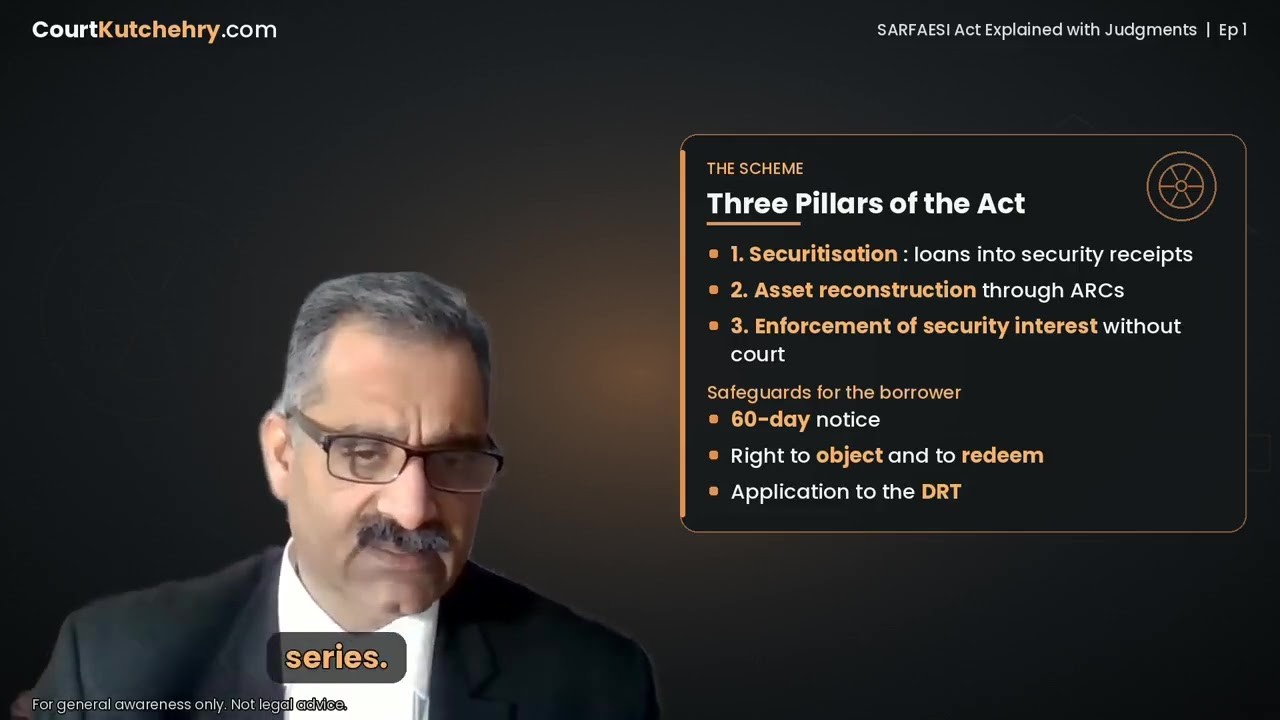
The Act rests on three pillars:
- Securitisation: regulating the conversion of loans into security receipts that can be issued to investors.
- Reconstruction of financial assets: through asset reconstruction companies, which acquire bad loans from banks and work to recover or restructure them.
- Enforcement of security interest without the intervention of a court or tribunal: the secured creditor itself can take measures against the secured asset. In practice, this is the pillar that matters most.
Enforcement without a court is not enforcement without rules
The Act builds in safeguards for the borrower:
- a 60-day demand notice under Section 13(2) before any measure is taken;
- the borrower’s right to make representations or objections, which the bank must consider and answer;
- the right to redeem the secured asset by paying the dues within the time the Act allows; and
- an application to the Debts Recovery Tribunal under Section 17 against the measures taken.
Each of these safeguards gets its own episode in the series.
Practice Points for Advocates
- Find out what stage the bank has reached. When a client walks in with a SARFAESI notice, the first question is not “how much is due?” but “what stage is the bank at?”: demand notice, possession notice, physical possession, or sale. The remedies differ at each stage.
- The Act applies to secured creditors only. If the loan was unsecured, the bank must go to the DRT or the civil court; SARFAESI is not available.
- Keep the amendments in mind. The Act has been significantly amended, notably in 2004, 2012 and 2016. Many disputes turn on which version of a section applied on the date of the bank’s action, so always check the text in force at the relevant time.
A Practical Illustration: The ₹1 Crore Factory Loan
A bank lends ₹1 crore to a company against a mortgage of its factory. The company defaults.
- Before 2002: the bank had to file a case, wait for a decree or recovery certificate, and only then execute it against the factory.
- After the SARFAESI Act: the bank classifies the account as an NPA, issues a 60-day notice, and if the dues are not paid, it can take possession of the factory and sell it.
The borrower is not left without a remedy: he can approach the Debts Recovery Tribunal. That shift, from court-led recovery to creditor-led enforcement, is the heart of this Act.
Questions Clients Often Ask
Can the bank take my property without a court order?
If the loan is secured, the account is an NPA, and the bank follows Section 13 and the Security Interest (Enforcement) Rules, yes, it can take measures without a decree. For physical possession, banks often seek the help of the Chief Metropolitan Magistrate or District Magistrate under Section 14.
Does the Act apply to every loan?
No. Section 31 excludes certain cases, for example security created on agricultural land, and cases where the amount due is less than 20% of the principal amount and interest.
Am I left without a forum?
No. Under Section 17, any person aggrieved by the measures taken under Section 13(4) can apply to the Debts Recovery Tribunal within 45 days.
Quick Test
- Which committee, set up in 1999, recommended the new law? The Andhyarujina Committee.
- From which date is the SARFAESI Act deemed to be in force? 21 June 2002.
- Can a secured creditor enforce its security under the Act without going to court? Yes, subject to the safeguards in the Act.
Key Takeaways
- The SARFAESI Act was a response to the NPA crisis of the late 1990s, when recovery cases dragged on and security lost value.
- The Narasimham Committee II (1998) and the Andhyarujina Committee (1999) recommended enforcement without court intervention and asset reconstruction.
- The June 2002 Ordinance became Act No. 54 of 2002, deemed in force from 21 June 2002.
- Three pillars: securitisation, asset reconstruction, and enforcement of security interest without a court, with built-in safeguards for borrowers.
- For advocates: identify the bank’s stage, remember the Act covers secured creditors only, and check which amended version applied.
Frequently Asked Questions
What does SARFAESI stand for?
The Securitisation and Reconstruction of Financial Assets and Enforcement of Security Interest Act, 2002.
Why was the SARFAESI Act needed when DRTs already existed?
Because even before a DRT the bank had to win the case before it could touch the security, which took years. SARFAESI lets secured creditors enforce security directly, subject to safeguards.
When did the SARFAESI Act come into force?
It is deemed to have come into force on 21 June 2002, the date of the first Ordinance.
Can a bank use SARFAESI for an unsecured personal loan?
No. The Act is a remedy for secured creditors enforcing a security interest. For unsecured debts, the bank must go to the DRT or a civil court.
What can a borrower do against SARFAESI action?
Respond to the demand notice with objections, redeem the asset by paying the dues within the permitted time, or apply to the DRT under Section 17 within 45 days of the measures taken.
Where can I watch the full explanation?
Watch Vineet Kohli, Advocate explain it here: https://youtu.be/YjeIerVdKZ0.
Conclusion
The SARFAESI Act was born out of a simple problem: banks were winning cases slowly while their security was melting away. Following the Narasimham and Andhyarujina Committees, Parliament gave secured creditors a direct route to enforce their security, from 21 June 2002, while building in a notice period, objections, redemption and a DRT remedy for borrowers.
Every judgment in this series fits somewhere on that map. In the next episode, Vineet Kohli takes up how the Act survived its constitutional challenge in Mardia Chemicals, and how Parliament has amended it since.
▶ Watch the video: Why Was the SARFAESI Act Needed? Bad Loans, NPAs and the 2002 Law | SARFAESI Act Explained Ep 1
Research Judgments Like These on CourtKutchehry
Every judgment cited in this article, and lakhs more, can be searched and read on CourtKutchehry. Searching and reading judgments is free. A membership adds unlimited summaries, all related judgments, original court PDF downloads, bookmarks, notes and the CourtKutchehry AI assistant.
| Membership | Price | Works out to | AI credits |
|---|---|---|---|
| Monthly (1 month) | ₹599 | ₹599 / month | 1,000 / month |
| Quarterly (3 months) · Save 16% | ₹1,499 | ₹499.67 / month | 1,100 / month |
| Six-monthly (6 months) · Save 33% | ₹2,399 | ₹399.83 / month | 1,200 / month |
| Yearly (12 months) · Save 44% · Best value | ₹3,999 | ₹333.25 / month | 1,300 / month |
Every plan is a one-off purchase for a fixed period: nothing auto-renews and no card is kept on file. Prices are exclusive of applicable tax, which is added at checkout. Extra AI chat credits can be topped up from ₹99. A free verified account gets 5 summaries and 50 AI trial credits.
Prices are as displayed on courtkutchehry.com on 20 November 2026 and are subject to change without notice. Please check the pricing page for the current plans and offers.
For more judgments, legal opinions and case analysis, visit courtkutchehry.com
Visit CourtKutchehry →