
Watch the Video
In this 6-minute video, Adv. Dr. Vineet Kohli opens Episode 1 of the series “DRT Act Explained with Judgments” on the Recovery of Debts and Bankruptcy Act, 1993. Before reading a single section, he asks a simple question: why did India need a separate law, and a separate tribunal, for bank recovery at all? This article walks through the same story in writing, for advocates, law students, bankers and borrowers.
The Problem Before 1993
Until 1993, a bank that wanted to recover an unpaid loan had essentially one road: file a money suit, or a mortgage suit, in the ordinary civil court. That road was slow. A recovery suit had to travel through pleadings, issues, oral evidence, arguments, a decree, and then a separate execution proceeding, with appeals possible at several stages. It was common for such cases to take many years.
Delay in a bank case is not just an inconvenience. It hurts in three ways:
- The security loses value. Hypothecated machinery rusts, stock disappears, and mortgaged buildings age while the suit is pending.
- Public money is locked up. Most of the money that banks lend belongs to depositors. When thousands of crores are stuck in pending suits, that money cannot be lent again.
- Defaulters gain from delay. When a borrower knows the case will take years, there is little pressure to settle.
The civil courts were not at fault. They were handling every kind of dispute at once, and bank recovery suits simply joined the queue.
The Committees That Recommended Special Tribunals
The idea of a special forum for bank recovery came from expert committees. The video highlights two of them.
- The Tiwari Committee (1981) examined the legal and other difficulties faced by banks in recovering their dues, and suggested setting up special tribunals for this purpose.
- The Narasimham Committee on the Financial System (1991), part of the wider reform of India’s banking sector, again recommended special tribunals so that banks could recover their dues quickly and clean up their books.
Both committees reached the same conclusion: recovery of bank debts needed a specialised forum with a simpler procedure, rather than the general civil court.
From Ordinance to Act
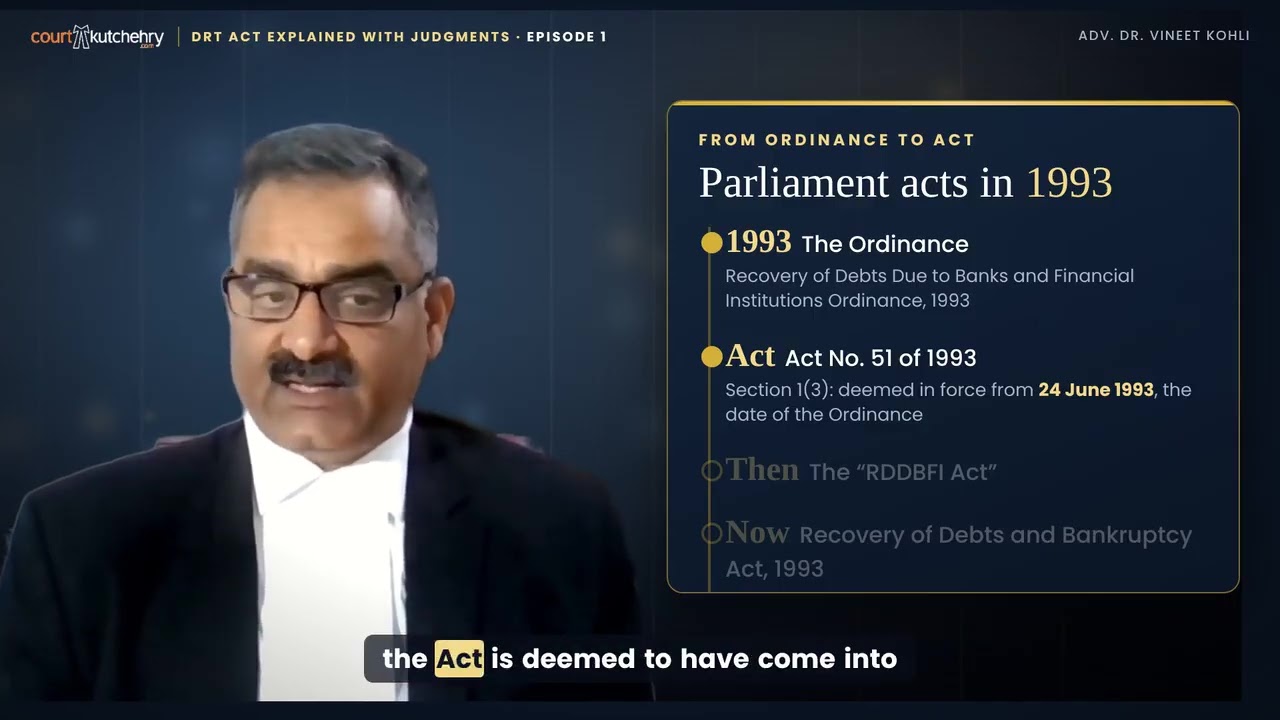
Parliament acted on these recommendations in 1993. The law first came as an Ordinance, and was then replaced by an Act of Parliament, Act No. 51 of 1993. Under Section 1(3), the Act is deemed to have come into force on 24 June 1993, the date of the Ordinance. That is why the Act operates from a date earlier than the day it was actually passed.
The name has also changed over the years. The Act was originally called the Recovery of Debts Due to Banks and Financial Institutions Act, 1993, often shortened to the “RDDBFI Act”. After the Insolvency and Bankruptcy Code, 2016 amended it, the Act is now called the Recovery of Debts and Bankruptcy Act, 1993. Older judgments use the old name; newer ones use the new name. Both refer to the same statute.
Remember this line: the Act is deemed to be in force from 24 June 1993, the date of the Ordinance.
What the Act Set Out to Do
The Act was built around three ideas.
1. A specialised forum
It created the Debts Recovery Tribunal (DRT) to decide bank and financial-institution claims, and the Debts Recovery Appellate Tribunal (DRAT) to hear appeals. Once a claim falls within the Act, the civil court no longer has jurisdiction over it.
2. A summary procedure
The Tribunal is not bound by the detailed procedure of the Code of Civil Procedure. It follows the principles of natural justice and its own rules, and evidence can be taken on affidavit. The Act also directs the Tribunal to make an endeavour to dispose of an application within 180 days.
3. A dedicated recovery machinery
A decree is only paper until it is executed. So the Act gave the DRT its own Recovery Officer, who executes the Tribunal’s recovery certificate by attachment and sale of property, appointment of a receiver and other modes. Execution does not go back to the civil court.
Example: Years Versus Months
The video illustrates the difference with a simple comparison. Imagine a bank whose borrower has defaulted on a large business loan secured by machinery and a factory building.
- In the civil court before 1993: the bank files a suit. Written statements, issues, evidence and adjournments follow. Years pass, as the episode’s title puts it, eight years in the civil court. By the time a decree comes and execution begins, the machinery is scrap and the borrower’s other assets have been moved.
- In the DRT: the bank files an original application. The Tribunal works on a summary procedure, with a statutory target of 180 days. Once it decides the claim, it issues a recovery certificate, and its own Recovery Officer starts recovery.
Real cases in DRTs do not always finish within 180 days, and pendency remains a concern. But the design of the law is clear: a focused forum, a quicker procedure and recovery without a second round of litigation.
Quick Test
The episode closes with a short test. Try answering before you read the answers.
- From which date is the Act deemed to be in force? From 24 June 1993, under Section 1(3).
- Name the two committees discussed in the video. The Tiwari Committee (1981) and the Narasimham Committee on the Financial System (1991).
- What is the Act called today? The Recovery of Debts and Bankruptcy Act, 1993.
The next episode looks at how the Act survived a constitutional challenge and how Parliament has amended it over three decades.
Key Takeaways
- Before 1993, bank recovery suits in civil courts took years, while securities lost value and public money stayed locked up.
- The Tiwari Committee (1981) and the Narasimham Committee (1991) recommended special tribunals for bank recovery.
- The Act, No. 51 of 1993, is deemed in force from 24 June 1993 under Section 1(3).
- Once the “RDDBFI Act”, it is now the Recovery of Debts and Bankruptcy Act, 1993.
- Its three pillars are a specialised forum, a summary procedure and a dedicated recovery machinery.
Frequently Asked Questions
Why was the DRT Act enacted?
Because bank recovery suits in civil courts were taking years. Parliament wanted a specialised tribunal with a summary procedure and its own recovery machinery, so that public money lent by banks could be recovered quickly.
Which committees recommended Debts Recovery Tribunals?
The Tiwari Committee in 1981 and the Narasimham Committee on the Financial System in 1991.
When did the DRT Act come into force?
It is deemed to have come into force on 24 June 1993, the date of the Ordinance, under Section 1(3) of the Act.
Is the RDDBFI Act the same as the Recovery of Debts and Bankruptcy Act?
Yes. The Act was renamed after the Insolvency and Bankruptcy Code, 2016 amended it. Older judgments use the old name.
Does the DRT follow the Code of Civil Procedure?
Not strictly. The Tribunal follows the principles of natural justice and its own procedure, which is meant to be summary, though it has certain civil-court powers under the Act.
Where can I watch the full explanation?
Watch Adv. Dr. Vineet Kohli explain it in 6 minutes: https://youtu.be/E-XLFQLiAEE.
Conclusion
The DRT Act was born out of a practical problem: bank money stuck in slow civil suits. Two expert committees pointed to the answer, and Parliament gave it shape in 1993 with a specialised forum, a summary procedure and a recovery officer of its own.
Every section that follows in this series makes more sense once you remember that purpose. When a provision seems strict, ask what problem it was meant to solve.
▶ Watch the video: Why Was the DRT Act Needed? 8 Years in Civil Court vs 180 Days in DRT | DRT Act Explained Ep 1
Research Judgments Like These on CourtKutchehry
Every judgment cited in this article, and lakhs more, can be searched and read on CourtKutchehry. Searching and reading judgments is free. A membership adds unlimited summaries, all related judgments, original court PDF downloads, bookmarks, notes and the CourtKutchehry AI assistant.
| Membership | Price | Works out to | AI credits |
|---|---|---|---|
| Monthly (1 month) | ₹599 | ₹599 / month | 1,000 / month |
| Quarterly (3 months) · Save 16% | ₹1,499 | ₹499.67 / month | 1,100 / month |
| Six-monthly (6 months) · Save 33% | ₹2,399 | ₹399.83 / month | 1,200 / month |
| Yearly (12 months) · Save 44% · Best value | ₹3,999 | ₹333.25 / month | 1,300 / month |
Every plan is a one-off purchase for a fixed period: nothing auto-renews and no card is kept on file. Prices are exclusive of applicable tax, which is added at checkout. Extra AI chat credits can be topped up from ₹99. A free verified account gets 5 summaries and 50 AI trial credits.
Prices are as displayed on courtkutchehry.com on 20 November 2026 and are subject to change without notice. Please check the pricing page for the current plans and offers.
For more judgments, legal opinions and case analysis, visit courtkutchehry.com
Visit CourtKutchehry →