
Watch the Video
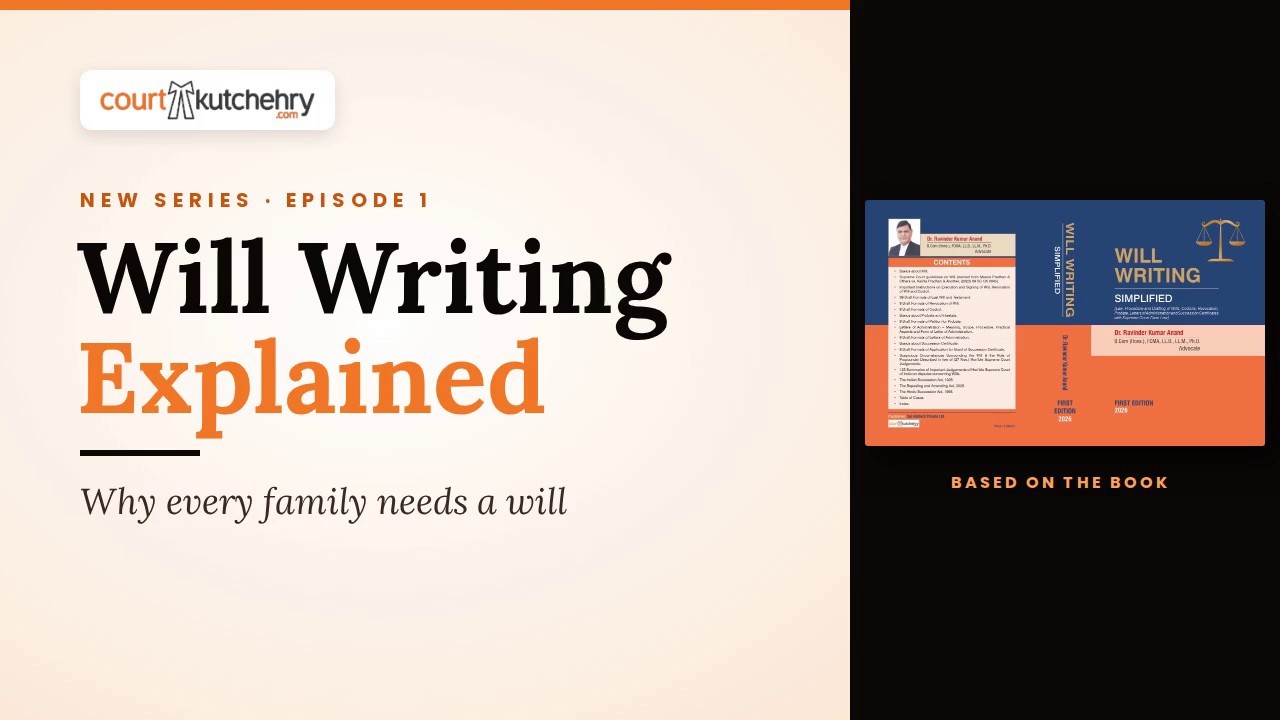
In this 9-minute video, CourtKutchehry opens the CourtKutchehry series “Will Writing Explained” with Episode 1, built on the book “Will Writing Simplified” by Dr. Ravinder Kumar Anand, Advocate. He answers seven questions every family should ask: what a will is, what happens if you die without one, why a nominee is not the owner, which law governs wills in India, who’s who in a will, and which popular beliefs are simply myths. This article sets out the same law in writing, with the Supreme Court judgments behind it.
Forty Years of Work, One Missing Document
A man works for forty years, builds a house and saves in the bank. Then he dies, and everything he built becomes a court case between his own children, because nobody knows for certain what he wanted.
The one document that could have prevented it is simple, cheap and private: a will. This episode is about why every family, not just wealthy ones, needs one.
Q1. What Exactly Is a Will?
Section 2(h) of the Indian Succession Act, 1925 defines a will as the legal declaration of the intention of a testator with respect to his property which he desires to be carried into effect after his death. Three ideas sit inside that definition:
- A legal declaration. Not a wish list or a letter: it must meet the formalities of Section 63 (signature and two attesting witnesses).
- About property. A house, a bank balance, shares, jewellery, even digital assets.
- Effective only after death. Until then, it gives nobody any right. You can change it or revoke it as many times as you like while you are alive and of sound mind (Section 62).
The person who makes the will is the testator.
Q2. What Happens If I Die Without a Will?
Dying without a will is called dying intestate. Your property does not go to the State and it does not automatically go to the eldest son. It goes to your legal heirs under your personal succession law:
- For Hindus, Buddhists, Sikhs and Jains, the Hindu Succession Act, 1956 decides. For a Hindu man, for example, the Class I heirs (including the widow, sons, daughters and mother) take together under Section 8.
- For Christians and Parsis, the intestacy chapters of the Indian Succession Act, 1925 apply.
- For Muslims, Muslim personal law applies.
The trouble is that the law’s formula may not match your family. A son who looked after you for twenty years and a child who never visited take the same share. A house ends up owned jointly by five siblings who cannot agree on anything. Banks and housing societies then ask for succession certificates or no-objection papers, and every missing signature becomes a delay.
Q3. Is a Nomination as Good as a Will?
This is the most expensive misunderstanding in Indian families. A nominee is the person a bank, insurer or company pays after your death. A nominee is not, by that fact alone, the person who owns the money. The Supreme Court has said this again and again:
- In Smt. Sarbati Devi and Another v. Smt. Usha Devi, (1983) 12 SC CK 0020, the Court held that a nominee under Section 39 of the Insurance Act, 1938 is only the person authorised to receive the policy money and give the insurer a valid discharge; the heirs can claim it under the law of succession.
- In Ram Chander Talwar v. Devender Kumar Talwar, (2010) 10 SC CK 0083, the same rule was applied to a bank deposit under Section 45ZA of the Banking Regulation Act, 1949: the nominee can collect, but the money forms part of the deceased’s estate.
- In Shakti Yezdani v. Jayanand Jayant Salgaonkar, (2023) 12 SC CK 0033, the Court held that a nominee for shares under the Companies Act and the depository bye-laws does not become the absolute owner. Nomination is not a third mode of succession that overrides a will or the succession law.
One caution for life insurance: Section 39 of the Insurance Act was amended in 2015 and now contains a special category of “beneficial nominee” for certain close family members, so the position for a particular policy should be checked. But the safe rule for families stays the same: nomination decides who collects; a will (or the succession law) decides who keeps.
Remember this line: the nominee is the postman, the heir is the owner.
Q4. Do I Really Need a Will?
If you own anything at all, the honest answer is yes. A will is most useful where:
- you want a different division from the one the succession law would make, for example more to a child who cares for you, or a share to a grandchild;
- you have minor children and want to name a guardian and someone to manage their property;
- your assets are spread out and you want one person (an executor) to gather and distribute them;
- you simply want to spare your family the time, cost and bitterness of proving heirship.
A will cannot give away what is not yours, but within your own property it lets you decide.
Q5. Which Law Governs Wills in India?
There is no single “wills law” for everyone. The main rules are:
- Indian Succession Act, 1925, Part VI (testamentary succession). It applies fully to Christians and Parsis. Through Section 57 and Schedule III, most of its provisions on making, revoking and interpreting wills also apply to wills of Hindus, Buddhists, Sikhs and Jains.
- Hindu Succession Act, 1956, Section 30. It confirms that a Hindu may dispose of his or her property, including an undivided coparcenary interest, by will.
- Muslim personal law. The will provisions of the Indian Succession Act do not apply to Muslims. Under Muslim law a bequest is generally limited to one-third of the estate (after funeral expenses and debts), and a bequest to an heir needs the consent of the other heirs.
- Supporting laws. The Registration Act, 1908 and the Bharatiya Sakshya Adhiniyam, 2023 (which replaced the Indian Evidence Act, 1872).
Q6. The Cast of Characters in a Will
Every will has the same small cast:
- Testator – the person making the will.
- Beneficiary or legatee – the person who receives under it.
- Executor – the person the testator appoints to carry out the will (Section 2(c)).
- Attesting witnesses – at least two people who see the testator sign and sign themselves (Section 63).
- Guardian – the person named to look after minor children.
When a will is disputed, two more people appear: the propounder, who must prove the will, and the caveator, who opposes it.
Q7. Myth Busters: True or False?
Here are five popular beliefs about wills, and what the law actually says:
- “A will must be on stamp paper.” False. No stamp duty is payable on a will; plain paper is enough.
- “A will must be registered.” False. Registration of a will is optional under Section 18 of the Registration Act, 1908, though it is often a good idea.
- “Once made, a will cannot be changed.” False. A will can be revoked or altered at any time while the testator is competent (Section 62), by a fresh will or a codicil.
- “The nominee becomes the owner.” False, as the three judgments above show.
- “Only rich people need a will.” False. Even a single flat or bank account can lead to years of paperwork, or litigation, without one.
A Quick Self-Test
Try these three: Does a will take effect on the day it is signed? (No, only on death.) Can a nominee in a bank account keep the money against the heirs? (Generally no; he collects for the estate.) Is a will on plain paper, signed and properly witnessed, valid without registration? (Yes.) The next episode asks who can make a will at all.
Key Takeaways
- A will is the legal declaration of your intention about your property, effective only after death (Section 2(h), Indian Succession Act, 1925), and can be changed at any time.
- Without a will, property goes to heirs under your personal succession law, which may not match what you want.
- A nominee collects but does not own: Sarbati Devi (insurance), Ram Chander Talwar (bank deposits) and Shakti Yezdani (shares).
- Wills of Hindus, Buddhists, Sikhs and Jains follow most of Part VI of the 1925 Act through Section 57 and Schedule III, read with Section 30 of the Hindu Succession Act; Muslims follow their personal law.
- Stamp paper and registration are not compulsory; a signature and two attesting witnesses are.
Frequently Asked Questions
Is a nominee the legal owner of a bank deposit or shares?
Generally no. The Supreme Court held in Ram Chander Talwar (bank deposits) and Shakti Yezdani (shares) that a nominee receives the asset for the estate, and the heirs or legatees take it under the will or succession law.
What happens to my property if I die without a will?
It passes to your legal heirs under your personal law, such as the Hindu Succession Act, 1956 for Hindus, the Indian Succession Act, 1925 for Christians and Parsis, and Muslim personal law for Muslims.
Does a will need stamp paper or registration to be valid?
No. A will needs no stamp duty and registration is optional. What it does need is the testator’s signature (or mark) and attestation by at least two witnesses under Section 63.
Can I change my will later?
Yes. A will can be revoked or altered at any time while you are of sound mind, by making a new will or a codicil executed with the same formalities.
Can a Muslim leave all property by will?
Generally no. Under Muslim personal law a bequest is limited to one-third of the estate after debts and funeral expenses, and a bequest to an heir needs the other heirs’ consent.
Where can I watch the full explanation?
Watch the full explanation in 9 minutes: https://youtu.be/IcymsssTi0k.
Conclusion
A will is a short document that answers one question for your family: who gets what, and who will see to it. Without it, the law answers that question with a fixed formula, and the paperwork falls on the people you leave behind.
Nomination is not a substitute. It tells a bank or insurer whom to pay, not who owns. Write a proper will, keep it safe, and review it as life changes. The rest of this series shows you how.
▶ Watch the video: Why Every Family Needs a Will | Will Writing Explained Ep 1 | Nominee vs Heir, Myths & Law
📖 Read more: Nominee Is Only a Trustee: Supreme Court Orders Father-in-Law to Pay Half of Son’s Life Insurance to Widow
Research Judgments Like These on CourtKutchehry
Every judgment cited in this article, and lakhs more, can be searched and read on CourtKutchehry. Searching and reading judgments is free. A membership adds unlimited summaries, all related judgments, original court PDF downloads, bookmarks, notes and the CourtKutchehry AI assistant.
| Membership | Price | Works out to | AI credits |
|---|---|---|---|
| Monthly (1 month) | ₹599 | ₹599 / month | 1,000 / month |
| Quarterly (3 months) · Save 16% | ₹1,499 | ₹499.67 / month | 1,100 / month |
| Six-monthly (6 months) · Save 33% | ₹2,399 | ₹399.83 / month | 1,200 / month |
| Yearly (12 months) · Save 44% · Best value | ₹3,999 | ₹333.25 / month | 1,300 / month |
Every plan is a one-off purchase for a fixed period: nothing auto-renews and no card is kept on file. Prices are exclusive of applicable tax, which is added at checkout. Extra AI chat credits can be topped up from ₹99. A free verified account gets 5 summaries and 50 AI trial credits.
Prices are as displayed on courtkutchehry.com on 20 November 2026 and are subject to change without notice. Please check the pricing page for the current plans and offers.
For more judgments, legal opinions and case analysis, visit courtkutchehry.com
Visit CourtKutchehry →