
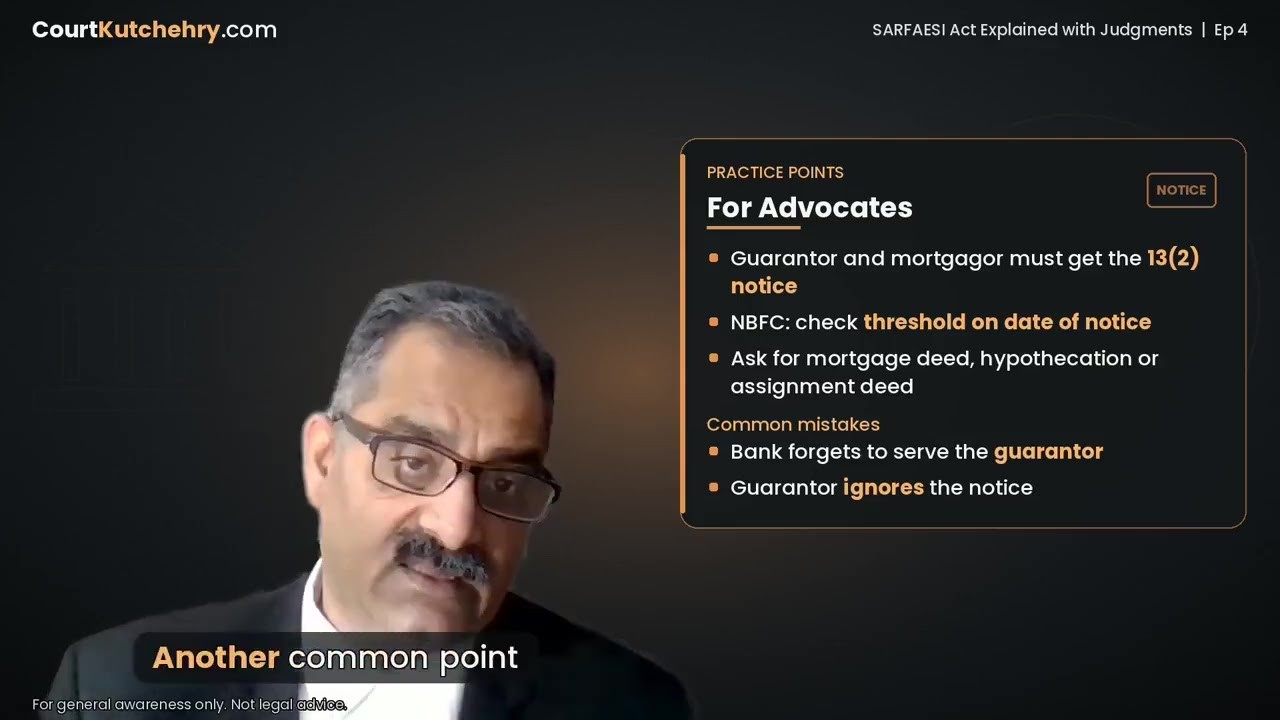
Watch the Video
In this 9-minute video, Vineet Kohli, Advocate, presents Episode 4 of “SARFAESI Act Explained with Judgments”. He explains the key definitions in Section 2 that identify the parties in every SARFAESI case: borrower, bank, financial institution and secured creditor, and the Constitution Bench ruling on co-operative banks. This article sets out the same definitions in writing, with practical checks for both sides.
Who Can Act, and Against Whom?
Every SARFAESI case has two sides: a lender who enforces the security, and a person whose property is taken. Section 2 of the Act decides who falls on each side. Get these definitions wrong, and the whole action can fail at the first step. This episode looks at four of them: borrower, bank, financial institution and secured creditor.
Borrower: Section 2(1)(f)
A “borrower” is any person who has been granted financial assistance by a bank or financial institution, or who has given a guarantee, or created a mortgage or pledge as security for that assistance. It also covers a person who becomes a borrower of an asset reconstruction company when the loan is transferred to it.
Notice what the definition does not ask. It does not ask who took the money. It asks who stands behind the loan. So:
- a guarantor is a borrower for this Act; and
- a third party who mortgages his own property for someone else’s loan is also a borrower.
Both can receive the demand notice, raise objections under Section 13(3A), redeem under Section 13(8), and challenge the measures before the DRT.
Remember this line: under SARFAESI, a guarantor and a mortgagor are borrowers too.
Bank: Section 2(1)(c)
Section 2(1)(c) lists the entities that are “banks” for the Act. They include banking companies, the corresponding new banks (the nationalised banks), the State Bank of India and its former subsidiaries, multi-State co-operative banks (added expressly from 2013), and any other bank that the Central Government specifies by notification. Co-operative banks were specified by a notification of 28 January 2003.
Financial Institution: Section 2(1)(m)
Section 2(1)(m) defines “financial institution”. It covers public financial institutions and other institutions notified by the Central Government. Non-banking financial companies (NBFCs) come in only through notification.
Under the Central Government’s 2021 notification, an NBFC with assets of ₹100 crore or more is a financial institution for the purpose of enforcing security for loans of ₹20 lakh or more. Two points follow:
- An NBFC does not become a financial institution under SARFAESI merely because it is registered with the RBI. It must be covered by the notification.
- The two conditions, asset size and loan size, are separate. Both must be met.
Secured Creditor: Section 2(1)(zd)
A “secured creditor” includes a bank or financial institution, a consortium or group of banks or financial institutions, a debenture trustee, an asset reconstruction company and certain other notified entities, in whose favour a security interest has been created for the due repayment of financial assistance.
Read it as a two-part test:
- Is the lender the right kind of entity?
- Has a security interest actually been created in its favour?
Both must be satisfied. Only a secured creditor can act under Section 13. An unsecured creditor, however large its claim, must use the ordinary remedies, such as a recovery application before the DRT or a civil suit.
Co-operative Banks: Pandurang Ganpati Chaugule (2020)
Borrowers of co-operative banks long argued that SARFAESI did not apply to them. The Constitution Bench of the Supreme Court rejected that argument in Pandurang Ganpati Chaugule v. Vishwasrao Patil Murgud Sahakari Bank Ltd., (2020) 05 SC CK 0002, decided on 5 May 2020.
The Court held that co-operative banks registered under State laws, and multi-State co-operative banks, are “banks” under Section 2(1)(c), and can recover through Section 13. Their banking activity falls under Entry 45 of List I (banking), so Parliament had the power to provide this procedure, and the 2003 notification was upheld. For co-operative bank borrowers, the question is closed.
Practice Points for Advocates
- Serve every borrower properly. A guarantor or third-party mortgagor should be served with the Section 13(2) notice before measures are taken against his property. Banks often serve the company and forget the mortgagor.
- Check the NBFC threshold on the date of the notice. If the NBFC is below ₹100 crore in assets, or the loan is below ₹20 lakh, the SARFAESI action may be without jurisdiction, though the debt itself remains recoverable through other remedies.
- Ask for the security documents. Confirm that the lender really is a secured creditor: the mortgage deed, the hypothecation agreement, or the assignment deed if an asset reconstruction company is involved.
Practical Illustration
A father mortgages his flat to secure a loan taken by his son’s company. The company defaults and the account becomes a non-performing asset.
- The bank issues the Section 13(2) notice to the company and to the father.
- As a mortgagor, the father is a “borrower” under Section 2(1)(f). He can object under Section 13(3A).
- If the bank takes possession of the flat, he can file an application before the DRT under Section 17.
- Under Section 13(11), the bank can proceed against guarantors, or sell the pledged assets, without first taking measures against the other secured assets.
Now the lender’s side. An NBFC with ₹80 crore of assets lends ₹30 lakh against a shop: the asset-size condition fails. Another NBFC with ₹500 crore of assets lends ₹15 lakh: the loan-size condition fails. In both cases, the borrower can argue before the DRT that SARFAESI was not available to that lender.
Quick Test
- Is a guarantor a borrower under Section 2(1)(f)? Yes.
- Can an unsecured creditor take action under Section 13? No. Only a secured creditor can.
- Can an NBFC use the SARFAESI Act? Yes, if it is covered by the notification and meets both thresholds.
The next episode covers the remaining key definitions: non-performing asset, security interest and secured asset.
Key Takeaways
- A borrower under Section 2(1)(f) includes a guarantor and a third-party mortgagor.
- Banks under Section 2(1)(c) include banking companies, nationalised banks, SBI, multi-State co-operative banks and notified banks, including co-operative banks.
- NBFCs are financial institutions under Section 2(1)(m) only through notification: currently ₹100 crore assets and ₹20 lakh loan, both required.
- Only a secured creditor (Section 2(1)(zd)) can act under Section 13: the right entity, with a security interest in its favour.
- Co-operative banks are covered (Pandurang Ganpati Chaugule, Constitution Bench, 2020).
Frequently Asked Questions
I only signed as a guarantor. Can the bank send me a SARFAESI notice?
Yes. A guarantor is a “borrower” under Section 2(1)(f), and can also use the borrower’s remedies.
Can the bank proceed against me as guarantor before selling the company’s factory?
Yes. Section 13(11) allows the secured creditor to proceed against guarantors without first taking measures against the secured assets.
My lender is a small NBFC. Can it use SARFAESI?
Only if it is covered by the Central Government’s notification: under the 2021 notification, assets of ₹100 crore or more, and only for loans of ₹20 lakh or more.
Is a co-operative bank a “bank” under SARFAESI?
Yes. The Constitution Bench held so in Pandurang Ganpati Chaugule v. Vishwasrao Patil Murgud Sahakari Bank (2020).
Can an unsecured creditor use Section 13?
No. Only a secured creditor, in whose favour a security interest has been created, can enforce under Section 13.
Where can I watch the full explanation?
Watch Vineet Kohli, Advocate, explain it in 9 minutes: https://youtu.be/WqkszSTKz84.
Conclusion
The definitions in Section 2 decide the cast of every SARFAESI case. The borrower is not only the person who took the loan, but also anyone who guaranteed it or mortgaged property for it. The lender must be a bank, a notified financial institution or another secured creditor, holding a real security interest.
For advocates on either side, these definitions are the first checklist: is the right person being served, and is the right lender acting?
▶ Watch the video: Who Is a Borrower and Secured Creditor? Section 2 Definitions Including Guarantors and NBFCs | Ep 4
Research Judgments Like These on CourtKutchehry
Every judgment cited in this article, and lakhs more, can be searched and read on CourtKutchehry. Searching and reading judgments is free. A membership adds unlimited summaries, all related judgments, original court PDF downloads, bookmarks, notes and the CourtKutchehry AI assistant.
| Membership | Price | Works out to | AI credits |
|---|---|---|---|
| Monthly (1 month) | ₹599 | ₹599 / month | 1,000 / month |
| Quarterly (3 months) · Save 16% | ₹1,499 | ₹499.67 / month | 1,100 / month |
| Six-monthly (6 months) · Save 33% | ₹2,399 | ₹399.83 / month | 1,200 / month |
| Yearly (12 months) · Save 44% · Best value | ₹3,999 | ₹333.25 / month | 1,300 / month |
Every plan is a one-off purchase for a fixed period: nothing auto-renews and no card is kept on file. Prices are exclusive of applicable tax, which is added at checkout. Extra AI chat credits can be topped up from ₹99. A free verified account gets 5 summaries and 50 AI trial credits.
Prices are as displayed on courtkutchehry.com on 20 November 2026 and are subject to change without notice. Please check the pricing page for the current plans and offers.
For more judgments, legal opinions and case analysis, visit courtkutchehry.com
Visit CourtKutchehry →