
Watch the Video
In this 11-minute video, CourtKutchehry opens Episode 16 of the series “Will Writing Explained” and turns the series from making wills to how wills are attacked and defended in court. The episode is based on Chapter 13 of the book “Will Writing Simplified” by Dr. Ravinder Kumar Anand, Advocate, which analyses 27 Supreme Court judgments on suspicious circumstances. This article walks through the same foundation cases in writing: what makes a will “suspicious”, what does not, and who must prove what.
Why a Will Is Proved Differently
Every contract has two sides, and both can come to court and tell their story. A will has only one author, and by the time it is in court, that person is dead. The testator cannot be asked whether the signature is his, whether he understood the document, or whether someone pressured him.
In 1958 the Supreme Court said this one fact changes how a will must be proved. A will is proved like any other document, under the ordinary rules of evidence. But because the only person who really knows the truth cannot speak, the court looks at the surrounding circumstances with special care.
The formal rules are familiar. Section 63 of the Indian Succession Act, 1925 requires a will to be signed by the testator and attested by two witnesses. Section 68 of the Indian Evidence Act, 1872 (now Section 67 of the Bharatiya Sakshya Adhiniyam, 2023) says a document required by law to be attested cannot be used as evidence until at least one attesting witness has been called to prove its execution, if one is alive and available.
Q1: What Did Venkatachala Iyengar (1958) Decide?
The starting point for every Indian will case is H. Venkatachala Iyengar v. B.N. Thimmajamma, (1958) 11 SC CK 0008, a three-judge decision written by Justice P.B. Gajendragadkar. The Court laid down what the person relying on the will (the propounder) must prove:
- that the testator signed the will;
- that he was of sound and disposing mind when he signed it;
- that he understood the nature and effect of what he was signing; and
- that he put his signature of his own free will.
The standard is the ordinary civil one: what a prudent mind would accept. But where there are suspicious circumstances, for example where the propounder himself took a prominent part in getting the will made and receives a substantial benefit under it, the propounder must remove those suspicions with clear and satisfactory evidence. Only then is the court’s conscience satisfied. In Venkatachala Iyengar itself, the suspicions were not removed and the will was not accepted.
Remember this line: the propounder must satisfy the conscience of the court, not just tick the formal boxes.
Q2: What Counts as a Suspicious Circumstance?
Over the years, the Supreme Court has treated the following as classic suspicious circumstances:
- a shaky or doubtful signature;
- a feeble or seriously ill testator;
- an unnatural, improbable or unfair disposition;
- an active role in the making of the will by the person who benefits most;
- secrecy about the will;
- attesting witnesses who contradict each other;
- unexplained non-registration in circumstances where registration would be expected; and
- real doubt about the testator’s mental condition.
The important point, as the video stresses, is that each of these raises a question. None of them, by itself, invalidates a will. The question is whether the propounder can answer it.
Q3: Does Registration Cure Suspicion?
Many families believe that once a will is registered, nobody can challenge it. The Supreme Court rejected that idea in Rani Purnima Devi v. Kumar Khagendra Narayan Dev, (1961) 08 SC CK 0021. Registration is evidence that can support genuineness, but bare registration does not by itself dispel suspicious circumstances. The Court looked at what actually happened before the Sub-Registrar and found it too thin to show that the testator knew he was admitting execution of a will. The suspicion stood.
So registration helps, but it is never a substitute for proof. Registration of a will is optional under the Registration Act, 1908, and an unregistered will is perfectly valid if properly executed and proved.
Q4: The Expert and the False Document (1963 and 1964)
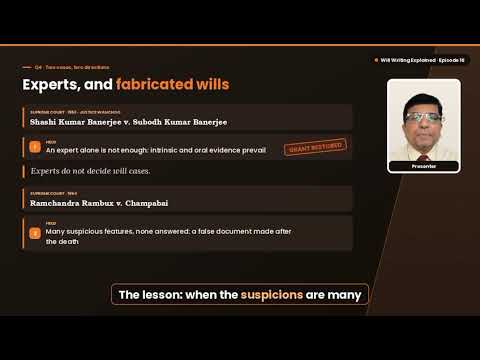
Handwriting experts do not decide will cases
In Shashi Kumar Banerjee v. Subodh Kumar Banerjee, (1963) 09 SC CK 0012, a Constitution Bench held that the opinion of a handwriting expert is only opinion evidence. It rarely substitutes for substantive proof, and it could not override credible testimony of the attesting witnesses where no suspicious circumstances existed. The Court restored the grant of probate.
When suspicions are many and unanswered, the will falls
In Ramchandra Rambux v. Champabai, (1964) 02 SC CK 0018, the propounder had taken an active part in procuring a will that substantially benefited him. He could not remove the suspicions surrounding its execution, and the Supreme Court upheld the rejection of the will. The lesson is the mirror image of Shashi Kumar Banerjee: good attesting evidence can carry a will past an expert, but a cluster of unexplained doubts can sink it.
Q5: Jaswant Kaur v. Amrit Kaur – The Checklist of Suspicion
Smt. Jaswant Kaur v. Smt. Amrit Kaur, (1976) 10 SC CK 0028 is often used as a checklist. A three-judge bench led by Justice Y.V. Chandrachud found a will surrounded by circumstances such as:
- delay in bringing the will forward;
- no credible attesting witness;
- the executors not examined as witnesses;
- an unnatural exclusion of the wife; and
- implausible explanations offered for all of this.
The Court restated the rule that where the propounder takes a prominent part in the execution and receives a substantial benefit, he must give a cogent and convincing explanation and remove all legitimate suspicion before the will can be accepted. Because that was not done, the Supreme Court restored the trial court’s decree in the wife’s favour.
Q6: What Is NOT Suspicious?
The courts are equally clear that suspicion must have a real basis. Several judgments show what does not make a will suspicious:
- Minor omissions, friendly witnesses, no drafts kept. In Indu Bala Bose v. Manindra Chandra Bose, (1981) 11 SC CK 0017, the points raised against the will were either normal or adequately explained, and the Supreme Court upheld the grant of probate.
- Age, no doctor, Sub-Registrar visiting the home. In Madhukar D. Shende v. Tarabai Aba Shedage, (2002) 01 SC CK 0024, the Court set aside concurrent findings that had rejected a registered, attested will on suspicion and conjecture rather than evidence.
- A tangible foundation is needed. In P.P.K. Gopalan Nambiar v. P.P.K. Balakrishnan Nambiar, (1995) 03 SC CK 0039, the Court held that suspicion must rest on real factual grounds, not imagination.
- Facts, not ethics. In V. Prabhakara v. Basavaraj K., (2021) 10 SC CK 0031, the Court said that “a testamentary court is not a court of suspicion but that of conscience”, that it must consider the relevant material instead of adopting an ethical reasoning, and that the mere exclusion of a sibling does not create suspicion unless other circumstances support the inference. The video sums this up as: suspicion must arise from facts, not from ethics.
Q7: Who Must Prove What?
The burden is divided, and it helps to keep the two halves apart.
The propounder must prove
- due execution and attestation under Section 63 of the Indian Succession Act;
- sound and disposing mind and understanding; and
- free will, and must dispel any suspicious circumstances that exist.
The challenger must prove
- fraud, coercion or undue influence, if he alleges it.
In Meena Pradhan v. Kamla Pradhan, (2023) 09 SC CK 0045, the Supreme Court said that one who alleges fraud, fabrication or undue influence has to prove it, while the propounder still has to dispel genuine suspicious circumstances with a cogent explanation. The will in that case was upheld on the testimony of an attesting witness. In the end, the court decides as a prudent mind would, on the whole of the evidence.
Quick Test
The episode ends with a quick test. Here is a short self-test on the same points:
- A will is registered. Can it still be refused? Yes. Registration is evidence, not proof (Rani Purnima Devi).
- A handwriting expert says the signature is forged, but both attesting witnesses are credible. Who wins? Usually the witnesses (Shashi Kumar Banerjee).
- The main beneficiary arranged the lawyer, the witnesses and the Sub-Registrar. What follows? A suspicion the propounder must explain (Venkatachala Iyengar, Jaswant Kaur).
- A brother is left out. Is the will suspicious for that reason alone? No (V. Prabhakara).
Key Takeaways
- A will is proved like any other document, but because the testator cannot speak, the propounder must prove signature, sound mind, understanding and free will (Venkatachala Iyengar, 1958).
- Suspicious circumstances raise questions; none of them alone invalidates a will. The propounder must answer them.
- Registration is evidence, never a substitute for proof, and handwriting experts do not decide will cases.
- Suspicion must have a tangible, factual foundation; the testamentary court is a court of conscience, not of suspicion.
- The propounder dispels suspicion; the challenger proves fraud, coercion or undue influence (Meena Pradhan, 2023).
Frequently Asked Questions
What is a suspicious circumstance in a will case?
Any feature that makes the court doubt whether the will reflects the testator’s free and informed wish, such as a shaky signature, a very ill testator, an unnatural disposition or the beneficiary’s active role in making it.
Does a registered will need to be proved?
Yes. Registration supports genuineness, but the will must still be proved through an attesting witness, and suspicious circumstances must still be explained.
Is leaving out a child automatically suspicious?
No. Exclusion of a natural heir is one circumstance to be weighed with others. By itself it does not make a will suspicious.
Who must prove undue influence?
The person alleging it. The propounder proves due execution and dispels suspicion; the challenger proves fraud, coercion or undue influence.
Can a handwriting expert’s report defeat a will?
Rarely on its own. Expert evidence is opinion evidence and usually cannot override credible attesting witnesses.
Where can I watch the full explanation?
Watch the video explain these foundation cases in 11 minutes: https://youtu.be/Fz2KLeg1Q40.
Conclusion
The foundation cases give one consistent message. A will is a serious document made by a person who cannot defend it later, so the person who relies on it must prove it properly and answer every real doubt. At the same time, courts will not invent doubts: suspicion must come from facts on the record.
For anyone making a will, the practical lesson is simple: keep the process open, use independent witnesses, and let the beneficiaries stay in the background. For anyone fighting a will case, know which side carries which burden.
▶ Watch the video: When Is a Will "Suspicious"? Supreme Court's Foundation Cases (Part I) Will Writing Explained Ep 16
📖 Read more: Courts Reinforce Testamentary Freedom Amid Suspicion
Research Judgments Like These on CourtKutchehry
Every judgment cited in this article, and lakhs more, can be searched and read on CourtKutchehry. Searching and reading judgments is free. A membership adds unlimited summaries, all related judgments, original court PDF downloads, bookmarks, notes and the CourtKutchehry AI assistant.
| Membership | Price | Works out to | AI credits |
|---|---|---|---|
| Monthly (1 month) | ₹599 | ₹599 / month | 1,000 / month |
| Quarterly (3 months) · Save 16% | ₹1,499 | ₹499.67 / month | 1,100 / month |
| Six-monthly (6 months) · Save 33% | ₹2,399 | ₹399.83 / month | 1,200 / month |
| Yearly (12 months) · Save 44% · Best value | ₹3,999 | ₹333.25 / month | 1,300 / month |
Every plan is a one-off purchase for a fixed period: nothing auto-renews and no card is kept on file. Prices are exclusive of applicable tax, which is added at checkout. Extra AI chat credits can be topped up from ₹99. A free verified account gets 5 summaries and 50 AI trial credits.
Prices are as displayed on courtkutchehry.com on 20 November 2026 and are subject to change without notice. Please check the pricing page for the current plans and offers.
For more judgments, legal opinions and case analysis, visit courtkutchehry.com
Visit CourtKutchehry →