
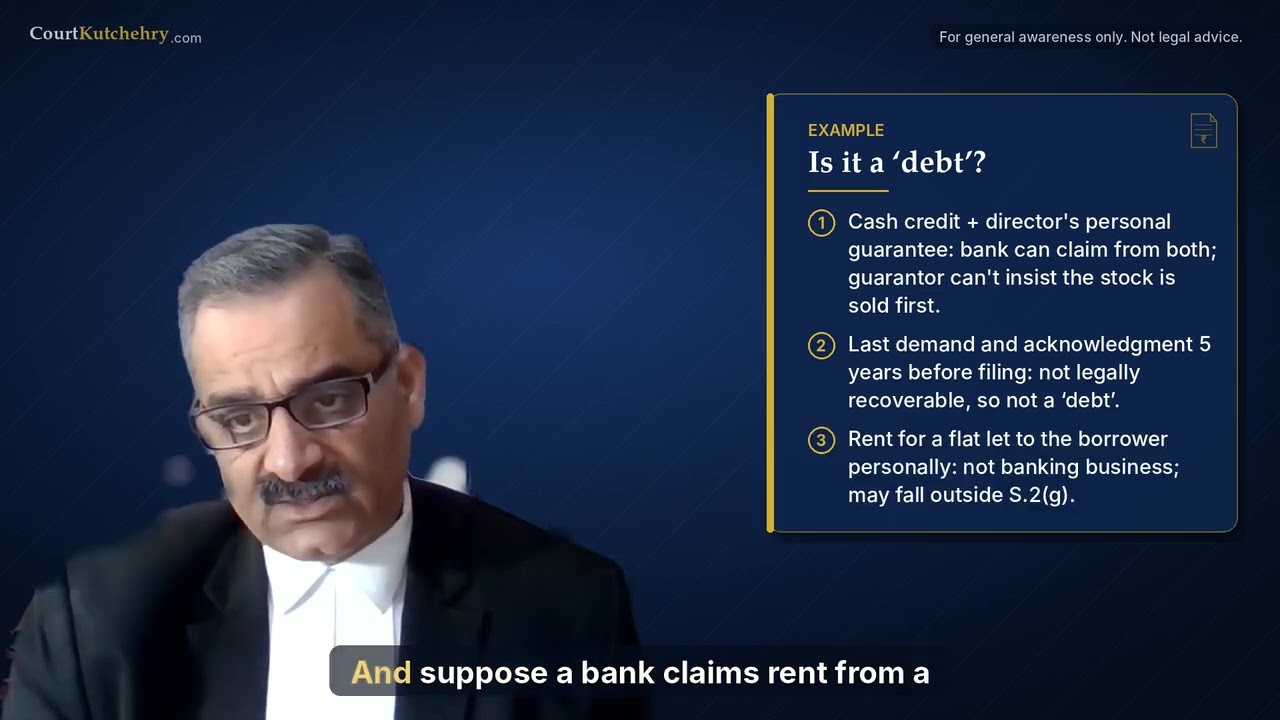
Watch the Video
In this 5-minute video, Vineet Kohli, Advocate explains the single most important word in the Recovery of Debts and Bankruptcy Act, 1993: “debt”. In Episode 6 of “DRT Act Explained with Judgments”, he reads Section 2(g), its later additions, and the Supreme Court’s rulings on the liability of guarantors. This article explains the definition clause by clause, with links to both judgments on CourtKutchehry and the three worked examples from the episode.
One Word Decides the Case
The DRT can only decide an application for recovery of a debt. If the claim is not a “debt” as defined in Section 2(g), the Tribunal has no jurisdiction, however large the amount and however clear the default. That is why the definition is the first thing a borrower’s advocate examines, and the first thing a bank’s advocate must satisfy.
Section 2(g): The Core Definition
The present definition was substituted in 2000. In simple words, a debt is:
- any liability, including interest,
- which is claimed as due from any person
- by a bank, a financial institution, or a consortium of them
- arising in the course of any business activity undertaken by the bank or institution under any law for the time being in force.
Three points stand out. First, interest is part of the debt, which is why the ₹20 lakh limit is calculated with interest. Second, the liability can be claimed from “any person”, so guarantors and mortgagors are covered, not just the main borrower. Third, the liability must arise from the bank’s business activity.
What the Definition Includes
The definition goes on to say that the liability may be:
- in cash or otherwise;
- secured or unsecured;
- assigned or not (which ties in with the assignment of debts discussed in Episode 5);
- payable under a decree or order of a civil court, an arbitration award, a mortgage, or otherwise.
And it must be subsisting and legally recoverable on the date of the application. A claim that is already time-barred under the law of limitation on the date of filing is not a “debt”.
Remember this line: a debt must be subsisting and legally recoverable on the day the bank files.
Debt Securities and Pooled Investment Vehicles
Two later additions widened the definition:
- Since 2016, a debt includes liability towards debt securities that remains unpaid after a notice of 90 days, as the video explains with reference to Section 2(ga).
- Since 2021, it also covers liability claimed from pooled investment vehicles, such as infrastructure investment trusts and real estate investment trusts, that have borrowed.
The Guarantor’s Liability
Bank of Bihar v. Damodar Prasad (1968)
The foundation is Bank of Bihar Ltd. vs Dr. Damodar Prasad & Anr, (1968) 08 SC CK 0017, AIR 1969 SC 297, decided by a three-Judge Bench of the Supreme Court on 8 August 1968 (reported in 1969). The trial court had decreed the bank’s suit against both the borrower and the surety, but directed that the bank could proceed against the surety only after exhausting its remedies against the borrower.
The Supreme Court set that direction aside. Under Section 128 of the Indian Contract Act, 1872, the liability of the surety is co-extensive with that of the principal debtor, unless the contract says otherwise. Once demand is made and not met, the surety is immediately liable. His liability is not deferred until the creditor has exhausted its remedies against the principal debtor.
Industrial Investment Bank of India v. Biswanath Jhunjhunwala (2009)
The same principle was applied directly to DRT proceedings in Industrial Investment Bank of India Ltd. vs Biswanath Jhunjhunwala, (2009) 08 SC CK 0092, (2009) 9 SCC 478, decided on 18 August 2009. A director had personally guaranteed loans to his company. When the bank filed against him before the DRT, he argued that his liability would not arise until the bank’s claim against the company was decided, and the High Court stayed the DRT proceedings.
The Supreme Court allowed the bank’s appeal. Relying on Bank of Bihar, it held that the liability of the guarantor and the principal debtor is co-extensive and not in the alternative, and that the bank may choose its remedy. The High Court should not have stayed the DRT proceedings.
Practical Points for Banks and Borrowers
For banks
- File within limitation, because a time-barred claim is not a debt. Keep acknowledgments and fresh documents on record.
- Join the borrower and the guarantors together; there is no need to wait for the case against the borrower.
For borrowers and guarantors
The video identifies three defences that go to the root of the definition:
- the claim is time-barred on the date of the application;
- the claim does not arise from banking business; or
- the guarantor has been discharged, for example under the provisions of the Contract Act on variance of the contract or release of the principal debtor.
Practical Illustration: Three Examples
- Example 1. A bank files to recover a term loan, with interest, within limitation. It is a debt, and the DRT can decide it.
- Example 2. A bank files for a loan whose limitation expired years ago, with no acknowledgment or part-payment in between. On the date of the application, the claim is not legally recoverable, so it is not a debt.
- Example 3. A bank files against the guarantor alone, while the borrower company is still running. The guarantor says, “Go after the company first.” Following Bank of Bihar and Biswanath Jhunjhunwala, that objection fails.
Key Takeaways
- A debt under Section 2(g) is any liability, including interest, claimed by a bank or financial institution in the course of its business.
- It may be secured or unsecured, assigned or not, and payable under a decree, award or mortgage.
- It must be subsisting and legally recoverable on the date of the application; a time-barred claim is not a debt.
- The definition now covers debt securities (2016) and pooled investment vehicles (2021).
- A guarantor’s liability is co-extensive with the borrower’s, and the bank need not proceed against the borrower first.
Frequently Asked Questions
What is a debt under the DRT Act?
Under Section 2(g), any liability, including interest, claimed as due from any person by a bank, financial institution or consortium in the course of its business, which is subsisting and legally recoverable on the date of the application.
Is a time-barred loan a debt under the DRT Act?
No. The definition requires the liability to be legally recoverable on the date of the application.
Can a bank proceed against a guarantor before the borrower?
Yes. Under Section 128 of the Contract Act the guarantor’s liability is co-extensive with the borrower’s, as held in Bank of Bihar v. Damodar Prasad and IIBI v. Biswanath Jhunjhunwala.
Does a debt include an arbitration award?
Yes. The definition expressly includes a liability payable under an arbitration award, as well as under a decree or a mortgage.
What defences can a guarantor raise?
That the claim is time-barred, that it does not arise from banking business, or that the guarantor has been discharged under the law of guarantee.
Where can I watch the full explanation?
Watch Vineet Kohli, Advocate explain it in 5 minutes: https://youtu.be/hAPxD3JF_To.
Conclusion
Every DRT case stands or falls on the definition of debt. The definition is wide, covering secured and unsecured, assigned and unassigned liabilities, decrees, awards and mortgages, but it has one firm limit: the liability must be legally recoverable on the date of filing.
And once there is a debt, the guarantor stands beside the borrower, not behind him. The bank can proceed against either, or both.
▶ Watch the video: What Is a “Debt” under the DRT Act? Section 2(g) | Bank of Bihar v. Damodar Prasad Ep 6
📖 Read more: Allahabad High Court Rules: Banks Can Directly Recover Loans from Guarantors
Research Judgments Like These on CourtKutchehry
Every judgment cited in this article, and lakhs more, can be searched and read on CourtKutchehry. Searching and reading judgments is free. A membership adds unlimited summaries, all related judgments, original court PDF downloads, bookmarks, notes and the CourtKutchehry AI assistant.
| Membership | Price | Works out to | AI credits |
|---|---|---|---|
| Monthly (1 month) | ₹599 | ₹599 / month | 1,000 / month |
| Quarterly (3 months) · Save 16% | ₹1,499 | ₹499.67 / month | 1,100 / month |
| Six-monthly (6 months) · Save 33% | ₹2,399 | ₹399.83 / month | 1,200 / month |
| Yearly (12 months) · Save 44% · Best value | ₹3,999 | ₹333.25 / month | 1,300 / month |
Every plan is a one-off purchase for a fixed period: nothing auto-renews and no card is kept on file. Prices are exclusive of applicable tax, which is added at checkout. Extra AI chat credits can be topped up from ₹99. A free verified account gets 5 summaries and 50 AI trial credits.
Prices are as displayed on courtkutchehry.com on 20 November 2026 and are subject to change without notice. Please check the pricing page for the current plans and offers.
For more judgments, legal opinions and case analysis, visit courtkutchehry.com
Visit CourtKutchehry →