
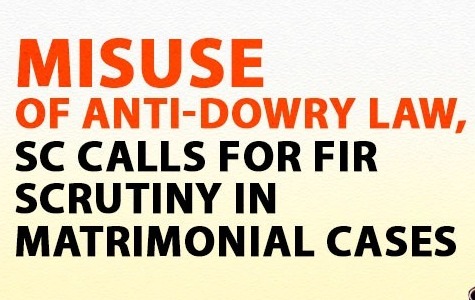
Weaponizing the Penal Code: How Indian Matrimonial Disputes Are Escalating into Grave Sexual Offense Allegations
The Shift from Cruelty to Rape: Anatomy of an Emerging Litigation Strategy Designed to Bypass Judicial Safeguards Against Arbitrary Arrests
Balancing the Scale of Justice: Protecting Genuine Survivors of Domestic Violence While Shielding Innocent Families from Malicious Prosecution
By Legal Editor
New Delhi: July 20, 2026:
The landscape of matrimonial litigation in India is undergoing a profound and deeply troubling structural shift. For decades, legal discourses surrounding marital breakdown were dominated by provisions relating to dowry harassment, cruelty, and domestic violence. However, a significant legal mutation has begun to manifest within the corridors of the higher judiciary. The , in a remarkably candid judicial pronouncement, explicitly flagged what it termed an "emerging trend" wherein complainants are increasingly embedding severe sexual offense allegations—ranging from rape and molestation to unnatural sex and protection of children from sexual offenses (POCSO) violations—into traditional matrimonial disputes.
This analytical investigation explores the legal mechanics driving this phenomenon, examining how legislative amendments designed to protect women are being systematically deployed as tactical levers. By unpacking recent jurisprudence, statutory frameworks, and the unintended systemic consequences of landmark rulings, we can discern how a well-intentioned push toward curbing procedural police abuse has inadvertently incentivized an escalation in criminal charges.
The recent intervention by Justice Girish Kathpalia of the Delhi High Court stayed trial court proceedings against two brothers who had been accused by their sister-in-law of an array of heinous crimes, including cruelty, criminal breach of trust, rape, sexual harassment, and criminal intimidation. The critical pivot in this specific case was a classic indicator of the trend: the initial matrimonial divorce petition was filed in late 2023, followed by a criminal First Information Report (FIR) in April 2024 that completely omitted any mention of sexual assault. It was only months later, during the recording of statutory statements, that an allegation surfaced claiming that one of the brothers-in-law had raped the complainant nearly seven years prior. The absence of a plausible explanation for this protracted delay led the High Court to halt the trial, warning that such extreme allegations are frequently leveraged to coerce extended in-laws into paying exorbitant financial settlements.
The Shadow of Arnesh Kumar: An Unintended Legal Catalyst
To comprehend why matrimonial litigation has escalated from charges of emotional and physical cruelty to allegations of capital sexual offenses, one must look back to the transformative jurisprudence established over a decade ago. In the landmark case of , the Supreme Court of India addressed the widespread structural misuse of Section 498A of the Indian Penal Code (IPC), which penalizes cruelty by a husband or his relatives against a married woman.
+-----------------------------------------------------------------------------+
| THE ARNESH KUMAR ARREST THRESHOLD |
| |
| Offenses Punishable by <= 7 Years Offenses Punishable by > 7 Years|
| --------------------------------- --------------------------------|
| * No automatic arrest permitted * Direct arrest authorized |
| * Mandatory Section 41A CrPC Notice * Statutory protection bypassed |
| * Police must document specific reasons * Immediate systemic pressure |
| * Safeguards apply (e.g., Sec 498A) * Applied via Sec 376 / POCSO |
Prior to this 2014 ruling, an accusation under Section 498A routinely resulted in the immediate, non-bailable arrest of the husband, his elderly parents, siblings, and occasionally extended maternal or paternal relatives, frequently before any preliminary investigation had occurred. Recognizing that this mechanism was being used as a tool of psychological and logistical leverage rather than a shield against real violence, the Supreme Court mandated that for all offenses where the maximum prescribed punishment is up to seven years of imprisonment, automatic arrest is strictly prohibited.
Instead, law enforcement agencies were ordered to rigorously comply with Section 41A of the Code of Criminal Procedure (CrPC), which requires the issuance of a notice of appearance to the accused before any custodial action can be taken. If an arrest is deemed absolutely necessary, the investigating officer must provide explicit written justifications to a magistrate, who must independently review the merits before authorizing detention.
While the Arnesh Kumar guidelines successfully curbed arbitrary arrests under Section 498A, they inadvertently created a procedural roadblock for litigious strategists seeking immediate leverage. Because Section 498A carries a maximum sentence of three years, it falls squarely within the protective ambit of the Arnesh Kumar doctrine. Consequently, a husband or an in-law facing a standard dowry harassment complaint could no longer be summarily thrown into prison to force a rapid financial or custodial concession.
To circumvent this statutory protection, a tactical shift began to emerge. By superimposing graver offenses that carry punishments far exceeding the seven-year threshold—such as Section 376 (rape) against brothers-in-law or fathers-in-law, Section 377 (unnatural sex) against the husband, or provisions of the Protection of Children from Sexual Offences (POCSO) Act involving the couple’s minor children—the restrictive guidelines of Arnesh Kumar are entirely bypassed. Because these severe sexual offenses carry maximum penalties extending to life imprisonment or even death, the police retain the absolute statutory authority to execute immediate arrests without prior notice under Section 41A.
Judicial Repercussions and Expanding Case Law
The concerns articulated by the Delhi High Court do not represent an isolated judicial viewpoint; rather, they align with a broader, increasingly vocal consensus across multiple High Courts and the Supreme Court of India. Senior legal practitioners observe that the traditional "bouquet of litigation"—which historically comprised a divorce petition, a maintenance claim under Section 125 CrPC, and a domestic violence complaint—has evolved into a far more destructive legal assembly.
For instance, in the major ruling of Ishwar Chand Sharma v. State of Uttar Pradesh (2025), the Supreme Court quashed a highly elaborate criminal proceeding directed at a husband and his wider family network. In that instance, the apex court bench, which included Justices B.V. Nagarathna and Ujjal Bhuyan, explicitly noted a growing, aggressive tendency to weaponize catch-all criminal provisions to resolve deeply personal marital disputes. The complainant in that matter had not only levelled allegations of cruelty but had also introduced charges of penetrative sexual assault under the stringent POCSO Act against family members, claiming her minor child had been targeted. The Supreme Court warned that if vague, overbroad, and uncorroborated allegations are not rigorously scrutinized at the introductory stage, the criminal justice process risks transforming into a mechanism of institutional abuse.
Similarly, in Sunny Kant v. State, the Delhi High Court dismantled a criminal prosecution where a wife’s allegations were fundamentally self-contradictory. The complainant had initiated proceedings asserting that her marriage was never consummated due to her husband's absolute impotence, while simultaneously lodging a separate criminal accusation alleging that he had repeatedly subjected her to non-consensual, aggressive oral sex. The court ruled that criminal charges cannot be framed on highly ambiguous and contradictory assertions that fail to establish the foundational elements of the offense.
Furthermore, the Madhya Pradesh High Court invoked the principles laid down in the classic precedent of State of Haryana v. Bhajan Lal to quash a highly sensationalized FIR involving rape, unnatural sex, and cruelty. The court determined that the prosecution was manifestly driven by an ulterior motive and personal vendetta, especially after evidence surfaced indicating that the criminal complaint was preceded by multi-crore financial demands.
The Legislative Vacuum and the Cost of False Stigma
The rapid expansion of this trend highlights a significant legislative gap in the wake of sweeping criminal justice reforms. Following the historic 2013 amendments enacted after the Nirbhaya incident, the Parliament of India dramatically expanded the definitions of sexual offenses and enhanced penal conditions to maximize protection for female survivors of sexual violence. These changes were critically necessary to dismantle the archaic systemic biases that survivors encountered within the police and judicial systems. However, as criminal law practitioners point out, there has been no parallel legislative effort to introduce structural safeguards against patently mala fide or retaliatory prosecutions that are initiated long after a matrimonial breakdown has entered the civil courts.
The systemic fallout of this legislative omission extends far beyond the immediate financial duress of an extended legal battle. In the context of Indian society, the mere accusation of a grave sexual offense carries a profound, irreversible social stigma that can instantly devastate an individual’s professional career, social relationships, and psychological well-being. Unlike standard property or matrimonial disputes, an allegation of rape or child abuse permanently damages an individual's reputation long before a trial court can properly evaluate the evidence.
+-------------------------------------------------------+
| THE Vicious Cycle OF LITIGATION ESCALATION |
+-------------------------------------------------------+
|
v
+-----------------------------------+
| Matrimonial Dispute / Divorce |
+-----------------------------------+
|
v
+-----------------------------------+
| Section 498A Filed (Cruelty) |
| * No Automatic Arrest Allowed * |
+-----------------------------------+
|
v
+-----------------------------------+
| Tactical Escalation: Add Sec 376 |
| (Rape) or Sec 377 (Unnatural Sex) |
+-----------------------------------+
|
v
+-----------------------------------+
| * Immediate Arrest Triggered * |
| Maximum Leverage for Settlement |
+-----------------------------------+
Furthermore, this trend poses a direct threat to the integrity of the legal protections themselves. Every demonstrably false or heavily manipulated accusation of sexual assault utilized as an administrative bargaining chip chips away at the institutional credibility of these laws. This creates an environment of skepticism that directly harms genuine survivors of sexual violence, whose authentic complaints may be viewed with unwarranted suspicion by skeptical law enforcement officials and judges.
Conclusion: Crafting a Balanced Path Forward
The judicial warnings issued by the Delhi High Court and the Supreme Court emphasize the urgent need for comprehensive, empirical institutional research. Rather than relying on anecdotal impressions, an independent expert committee—ideally convened under the guidance of retired jurists and socio-legal scholars—must systematically audit criminal filings in matrimonial contexts to separate genuine grievances from tactical assertions.
The ultimate objective of the legal system must remain unyielding: to ensure that real survivors of domestic and sexual abuse receive immediate, uncompromised protection and access to justice, while simultaneously ensuring that the majestic powers of criminal law are never reduced to a commodified tool for extortion or strategic leverage.
Legal Searchable Index & Comprehensive FAQ
This index serves as a quick-reference legal repository analyzing the statutory provisions, procedural rules, and landmark judicial directives discussed above.
Searchable Index
FAQ 1: Statutory Overview of Section 498A IPC & Evolving Equivalents
FAQ 2: The Operational Mechanics of the Arnesh Kumar Guidelines
FAQ 3: The Procedural Role of Section 41A CrPC / Section 35 BNSS
FAQ 4: Why Severe Sexual Offenses Bypassed Arrest Restrictions
FAQ 5: Understanding the Legal Impact of Ishwar Chand Sharma (2025)
FAQ 6: Statutory Remedies Available Against Vague or Malicious FIRs
FAQ 7: The Evidentiary Weight of Delayed Allegations in Matrimonial Disputes
Detailed FAQ Responses
FAQ 1: What is the primary purpose of Section 498A IPC, and what are its modern statutory equivalents?
Section 498A was introduced into the Indian Penal Code to penalize cruelty inflicted upon a married woman by her husband or his relatives. Cruelty is defined broadly to encompass both physical violence and psychological harassment, particularly when associated with unlawful demands for property or dowry. Under the modernized criminal framework, these provisions have been integrated into contemporary statutory codes, maintaining the core objective of shielding vulnerable spouses from domestic exploitation while carrying a maximum sentence of three years of imprisonment.
FAQ 2: What did the Supreme Court explicitly rule in the landmark Arnesh Kumar judgment?
In Arnesh Kumar vs State of Bihar (2014), the Supreme Court sought to eradicate the practice of automatic, unverified arrests in matrimonial disputes. The Court mandated that for any criminal offense carrying a maximum prison term of seven years or less, the police cannot summarily arrest the accused upon the mere filing of an FIR. Instead, law enforcement must issue a formal notice of appearance. Arrests are permitted only if specific conditions are satisfied—such as preventing the accused from tampering with evidence or committing further offenses—and these reasons must be explicitly documented in writing and approved by a Judicial Magistrate.
FAQ 3: How does Section 41A of the CrPC (now Section 35 of the BNSS) function in daily practice?
Section 41A CrPC acts as a statutory check against arbitrary detention. When a complaint is filed involving an offense penalized by less than seven years, the police are legally required to issue a "Notice of Appearance" to the accused. As long as the accused complies with the terms of the notice, attends the designated investigative sessions, and cooperates transparently with the inquiry, the police are statutorily prohibited from executing an arrest unless they obtain a specific, reason-based authorization from the jurisdictional court.
FAQ 4: Why are charges under Sections 376 and 377 added to matrimonial complaints?
Because Section 498A is protected by the Arnesh Kumar ruling, an ordinary cruelty complaint no longer allows for immediate custodial pressure. By introducing grave charges such as Section 376 (rape) against extended family members or Section 377 (unnatural sex) against the husband, litigious strategists can effectively bypass these protections. Because these sexual offenses carry punishments that significantly exceed the seven-year limitation, the restrictive mandate for a prior Section 41A notice is removed. This grants law enforcement the direct authority to conduct immediate, highly disruptive arrests, maximizing systemic pressure on the accused family.
FAQ 5: What significant legal principle did the Supreme Court reinforce in the Ishwar Chand Sharma (2025) case?
In Ishwar Chand Sharma v. State of Uttar Pradesh (2025), a division bench composed of Justices B.V. Nagarathna and Ujjal Bhuyan directly addressed the troubling escalation of matrimonial complaints into complex, omni-bus criminal prosecutions. The Supreme Court observed a pervasive tendency among some litigants to introduce severe, catch-all allegations—including provisions under the POCSO Act—solely to settle intensely personal marital grievances. The Court emphasized that general, non-specific, and omnibus allegations directed at an entire family network must be rigorously scrutinized at the earliest stages to prevent the judicial apparatus from becoming an instrument of harassment.
FAQ 6: What immediate legal remedies are available to an individual facing a demonstrably false or malicious matrimonial FIR?
An individual subjected to a fabricated or retaliatory FIR can approach the relevant High Court by filing a petition under Section 482 of the CrPC (or its modern equivalent under the Bharatiya Nagarik Suraksha Sanhita) seeking a complete quashing of the criminal proceedings. Relying on established precedents like State of Haryana v. Bhajan Lal, the petitioner can argue that the allegations are inherently implausible, fundamentally contradictory, or transparently driven by mala fide intentions and ulterior financial motives. Additionally, the accused can apply for anticipatory bail to secure comprehensive protection against sudden custodial arrest.
FAQ 7: How do Indian courts evaluate significant delays in reporting sexual offenses within matrimonial litigation?
While Indian jurisprudence is deeply empathetic to the fact that survivors of trauma may require time to report sexual violence, the higher judiciary applies a rigorous standard of scrutiny when serious sexual allegations surface only after civil matrimonial litigation or divorce proceedings have commenced. As demonstrated by the Delhi High Court's intervention, if a complainant asserts that a severe offense like rape occurred years prior, but completely omits this narrative from the initial divorce filings and early police complaints, the court will view the sudden escalation with skepticism. In the absence of a logical, highly compelling explanation for the delay, courts will frequently stay or quash the trial to prevent an abuse of process.