
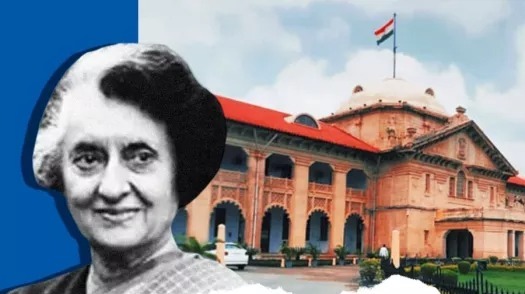
Allahabad High Court Verdict That Unseated Indira Gandhi: The Legal Spark Behind India’s Emergency
Justice Jagmohan Lal Sinha’s ruling found corrupt practices in Gandhi’s 1971 election.
Verdict led to constitutional amendments, Supreme Court battles, and the proclamation of Emergency.
By Vishwas Kumar
New Delhi: June 12, 2026:
The Case That Shook Indian Democracy
In 1971, Indira Gandhi, then Prime Minister of India, contested the Lok Sabha elections from Rae Bareli in Uttar Pradesh. Her opponent was Raj Narain, a socialist leader known for his fiery speeches and grassroots activism. Gandhi won the election by a massive margin, consolidating her political dominance after the Bangladesh Liberation War and her image as a strong leader. Yet, beneath the surface of this victory lay allegations of electoral malpractice that would eventually unravel into one of the most dramatic episodes in Indian political history.
Raj Narain filed an election petition under the Representation of the People Act, 1951 (RPA), challenging Gandhi’s victory. The RPA is the cornerstone of India’s electoral law, laying down rules for conduct of elections, qualifications of candidates, and definitions of corrupt practices. Narain alleged that Gandhi had misused government officials and state machinery during her campaign, and that her campaign expenditure exceeded the statutory limits prescribed under the Act.
Allegations of Misuse of State Machinery
One of the central charges was that Gandhi’s aide, Yashpal Kapoor, who was still a government servant at the time, acted as her election agent before formally resigning from service. This, Narain argued, amounted to a violation of Section 123(7) of the RPA, which defines corrupt practices as the use of government servants for election work.
Additionally, Narain claimed that Gandhi had used state resources—such as government vehicles, electricity, and logistical support—for her campaign. This blurred the line between her role as Prime Minister and as a candidate, raising questions about fairness in elections.
Campaign Expenditure Limits
Another major allegation concerned campaign expenditure. Under Section 77 of the RPA, candidates are required to maintain accounts of election expenses and cannot exceed prescribed limits. Narain argued that Gandhi’s campaign had far exceeded these limits, pointing to rallies, publicity material, and logistical arrangements that could not have been financed within the legal ceiling.
This charge was particularly significant because it touched upon the principle of a level playing field in elections. If incumbents could use unlimited resources, opposition candidates would be at a structural disadvantage, undermining the democratic process.
The Verdict of June 12, 1975
On June 12, 1975, Justice Jagmohan Lal Sinha of the Allahabad High Court delivered his historic judgment. After examining the evidence, he dismissed 12 of the 14 charges against Gandhi but upheld two:
Improper use of government officials (Yashpal Kapoor’s role).
Exceeding campaign expenditure limits.
On these grounds, Justice Sinha declared Gandhi’s election void. He further disqualified her from holding any elected office for six years. The verdict was unprecedented—it was the first time a sitting Prime Minister of India had been unseated by a court of law.
Political Shockwaves
The judgment sent shockwaves across the nation. Gandhi, who had built her image as the “Iron Lady” of India, suddenly faced the prospect of losing her office. The opposition, already mobilized by leaders like Jayaprakash Narayan, seized upon the verdict as proof of Gandhi’s authoritarian tendencies and misuse of power.
The ruling also exposed the fragility of India’s democratic institutions. Could the Prime Minister continue in office after being disqualified? What would happen to the government’s legitimacy? These questions dominated public discourse in the days following the verdict.
Supreme Court Intervention
On June 24, 1975, Gandhi approached the Supreme Court for relief. Justice V.R. Krishna Iyer, sitting as vacation judge, granted a conditional stay. He allowed Gandhi to remain Prime Minister but stripped her of voting rights in Parliament. This partial reprieve did little to ease the political crisis.
The very next day, on June 25, 1975, Gandhi advised President Fakhruddin Ali Ahmed to declare a national Emergency under Article 352 of the Constitution, citing internal disturbance. The Emergency suspended fundamental rights, imposed press censorship, and led to mass arrests of opposition leaders.
Constitutional Fallout
The verdict and its aftermath triggered sweeping constitutional changes. The 39th Amendment (1975) placed the election of the Prime Minister, President, and Speaker beyond judicial review, effectively nullifying the Allahabad High Court’s ruling. However, in 1977, after the Emergency ended, the Supreme Court reaffirmed the principle of judicial review as part of the basic structure doctrine, ensuring that Parliament could not amend the Constitution to shield elections from scrutiny.
Later, the 44th Amendment (1978) curtailed Emergency powers, requiring stricter conditions for proclamation and safeguarding fundamental rights. These reforms were direct responses to the misuse of constitutional provisions during the Emergency.
Legacy of the Verdict
The Allahabad High Court’s judgment remains a landmark in Indian legal and political history. It demonstrated that even the highest office in the land is not above the law. It also underscored the importance of judicial independence in checking executive power.
For Gandhi, the verdict was both a personal and political blow. Though she returned to power in 1980, the shadow of the Emergency and the court’s ruling continued to haunt her legacy. For Indian democracy, the episode was a turning point, reinforcing the need for vigilance against authoritarianism and misuse of state machinery in elections.
Conclusion
The case of Raj Narain versus Indira Gandhi was more than a legal battle; it was a test of India’s democratic resilience. By invalidating Gandhi’s election, Justice Sinha upheld the principle that electoral integrity is non-negotiable. The subsequent declaration of Emergency revealed how fragile democracy can be when constitutional safeguards are undermined. Yet, the eventual reforms and reaffirmation of judicial review ensured that the lessons of 1975 were not forgotten.
The verdict stands today as a reminder that democracy thrives not just on elections, but on the rule of law, accountability, and the courage of institutions to hold even the most powerful to account.
1. Background
Case: Raj Narain, defeated in Rae Bareli in 1971, filed an election petition under the Representation of the People Act, 1951 (RPA).
Allegations: Use of government officials and state machinery, exceeding campaign expenditure limits.
Verdict: On June 12, 1975, Justice Jagmohan Lal Sinha invalidated Gandhi’s election, disqualifying her for six years.
- Key Legal Provisions
- The Representation of the People Act, 1951 (RPA) is the central statute governing the conduct of elections in India. It lays down the framework for qualifications and disqualifications of candidates, procedures for election petitions, and definitions of corrupt practices. In the case against Indira Gandhi, two provisions of the RPA were particularly significant: Section 123(7) and Section 77.
- Section 123(7): Use of Government Servants in Elections
- Section 123 of the RPA defines what constitutes “corrupt practices” in elections. Sub-section (7) specifically prohibits candidates from using government servants for election work. The rationale is clear: government officials are expected to remain neutral and impartial, and their involvement in campaigns would tilt the playing field unfairly in favor of incumbents.
- In the Rae Bareli election of 1971, Gandhi’s aide Yashpal Kapoor was alleged to have acted as her election agent while still serving as a government employee. Although Kapoor resigned later, the fact that he had already performed campaign duties before his resignation was deemed a violation of Section 123(7). This finding was crucial because it directly linked Gandhi’s campaign to misuse of state machinery, undermining the fairness of the electoral process.
- Section 77: Limits on Election Expenditure
- Section 77 requires every candidate to maintain a true and correct account of election expenses and prohibits expenditure beyond prescribed limits. At the time, the ceiling was modest, intended to ensure that elections remained accessible to candidates without vast financial resources.
- Raj Narain argued that Gandhi’s campaign had far exceeded these limits, pointing to large rallies, publicity material, and logistical arrangements that could not have been financed within the statutory ceiling. The High Court accepted this argument, holding that Gandhi’s campaign expenditure violated Section 77.
- Combined Effect
- Together, these violations painted a picture of electoral malpractice. The use of a government servant as an election agent compromised neutrality, while excessive expenditure undermined the principle of equal opportunity. Justice Jagmohan Lal Sinha’s verdict on June 12, 1975, therefore rested on these two provisions, declaring Gandhi’s election void and disqualifying her for six years.
- This interpretation of the RPA underscored the judiciary’s role in safeguarding electoral integrity. It also demonstrated how seemingly technical provisions—like expenditure limits or restrictions on government servants—carry profound implications for democratic fairness.
4. Constitutional Framework
Article 329(b): Bars judicial interference in elections except via election petitions.
Article 352: Basis for declaring Emergency, citing internal disturbance.
39th Amendment (1975): Placed Prime Minister’s election beyond judicial review.
Basic Structure Doctrine: Supreme Court later held judicial review part of basic structure, limiting Parliament’s amendment powers.
3. Judicial Reasoning
Justice Sinha dismissed 12 of 14 charges but upheld two key findings:
Improper use of government officials.
Exceeding campaign expenditure.
His 238-page judgment declared Gandhi’s election void and barred her from holding office.
4. Immediate Consequences
Supreme Court Stay: On June 24, Justice V.R. Krishna Iyer granted conditional stay, allowing Gandhi to remain PM but without voting rights.
Emergency Declaration: On June 25–26, President Fakhruddin Ali Ahmed proclaimed Emergency under Article 352, citing internal security threats.
5. Broader Context
Political Climate: Economic crisis, student protests, and opposition movements intensified pressure.
Emergency Measures: Suspension of fundamental rights, censorship, arrests of opposition leaders.
44th Amendment (1978): Later curtailed Emergency powers, requiring stricter conditions for proclamation.
6. Implications
Judicial Independence: The verdict showed courts could hold even the Prime Minister accountable.
Electoral Integrity: Reinforced importance of fair elections and limits on state resources.
Constitutional Safeguards: Led to reforms ensuring Emergency powers cannot be misused easily.
7. Conclusion
The Allahabad High Court verdict against Indira Gandhi was a turning point in Indian democracy. It exposed misuse of state machinery in elections, triggered constitutional crises, and led to the Emergency. Its legacy continues to shape debates on judicial independence, electoral integrity, and constitutional limits on executive power.
FAQ Section
Q1: What was the Allahabad High Court verdict of 1975?
Answer: Justice Jagmohan Lal Sinha invalidated Indira Gandhi’s 1971 election from Rae Bareli, citing corrupt practices under the RPA, 1951.
Q2: Who filed the petition?
Answer: Raj Narain, a socialist leader defeated by Gandhi in the 1971 election.
Q3: Which laws were violated?
Answer:
Section 123(7), RPA 1951: Use of government officials.
Section 77, RPA 1951: Exceeding campaign expenditure limits.
Q4: What penalty was imposed?
Answer: Gandhi’s election was declared void, and she was disqualified from holding elected office for six years.
Q5: How did the Supreme Court respond?
Answer: Justice V.R. Krishna Iyer granted conditional stay, allowing Gandhi to remain PM but without voting rights.
Q6: How did this lead to the Emergency?
Answer: Facing disqualification, Gandhi advised President Fakhruddin Ali Ahmed to declare Emergency under Article 352 on June 25, 1975.
Q7: What constitutional changes followed?
Answer:
39th Amendment (1975): Exempted PM’s election from judicial review.
44th Amendment (1978): Restricted Emergency powers.
Q8: What is the basic structure doctrine?
Answer: A Supreme Court principle that Parliament cannot amend the Constitution to alter its fundamental framework, including judicial review.
Q9: Why is this verdict significant?
Answer: It demonstrated judicial independence, upheld electoral integrity, and triggered reforms safeguarding democracy.
Q10: What lessons does it hold today?
Answer: That misuse of state machinery in elections undermines democracy, and judicial oversight remains essential to constitutional balance.