
The Foundation of Article 15: A Constitutional Overview
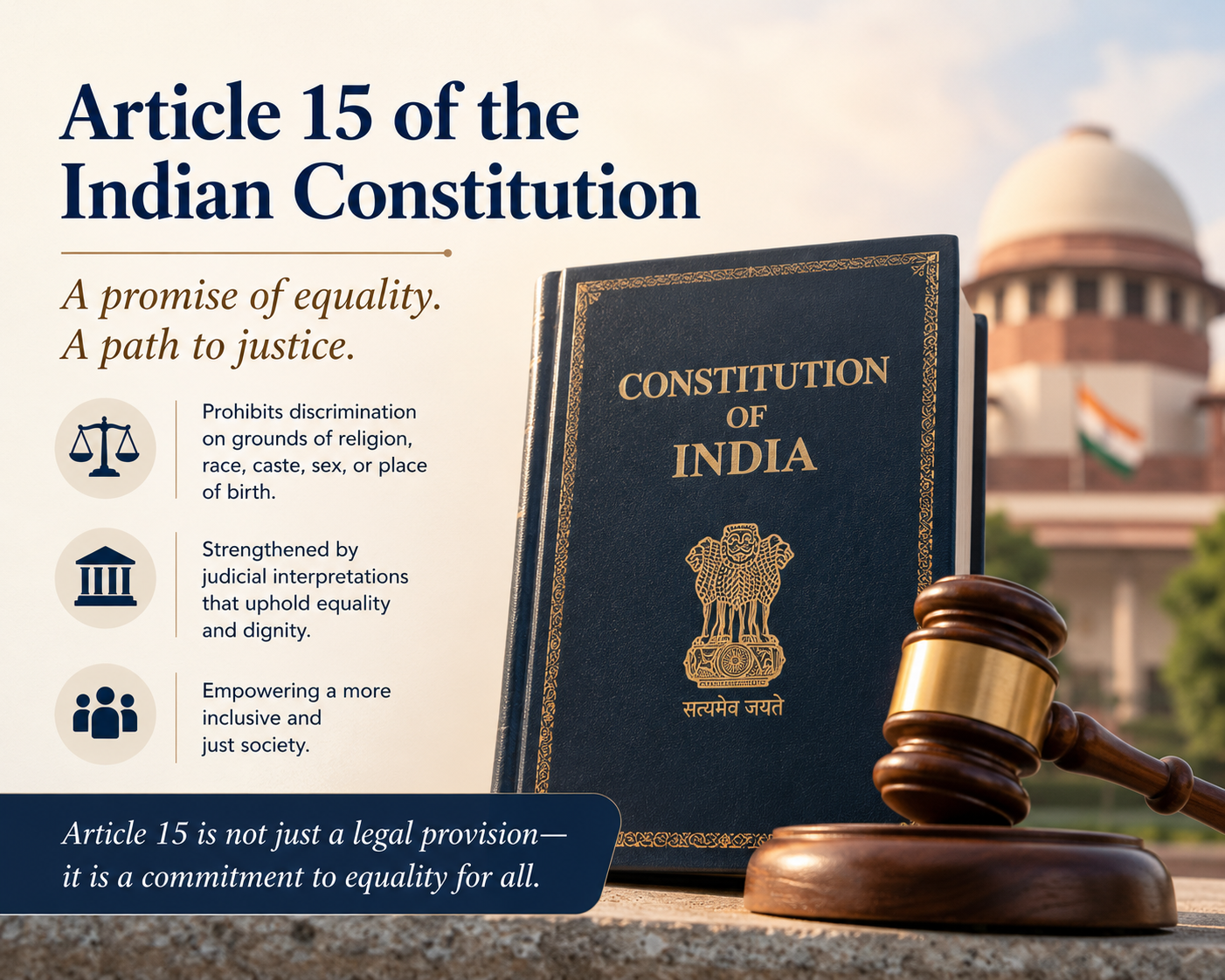
Article 15 of the Indian Constitution is a fundamental right under Part III, which prohibits discrimination on grounds of religion, race, caste, sex, or place of birth. This provision aims to eliminate socio-economic inequalities and promote social justice, forming the bedrock of India's commitment to equality.
Freedom of speech, expression, movement, and profession are fundamental pillars of Indian democracy protected under the Constitution. To understand the scope, reasonable restrictions, and landmark judicial interpretations of these rights, explore our detailed guide on Article 19 of the Constitution of India, covering key constitutional provisions and important Supreme Court judgments.
Text and Scope of Article 15
Article 15(1) specifically prohibits the state from discriminating against any citizen on the grounds mentioned above. Article 15(2) extends this prohibition to access public places, including hotels and places of entertainment. However, Article 15(3) allows the state to make special provisions for women and children, while Article 15(4) and 15(5) permit special provisions for the advancement of any socially and educationally backward classes or for the Scheduled Castes and Scheduled Tribes.
Judicial Interpretation and Landmark Judgements
The Indian judiciary has played a crucial role in interpreting Article 15. The landmark case of State of Madras v. Champakam Dorairajan (1951) was pivotal, leading to the First Amendment in 1951 that introduced Article 15(4), enabling reservations for backward classes.
Indra Sawhney and the Mandal Commission
The Supreme Court's decision in Indra Sawhney v. Union of India (1992), also known as the Mandal Commission case, upheld the validity of reservations for OBCs, further solidifying the understanding and application of Article 15.
Comparative Perspectives: Global Insights
While India has specific constitutional provisions like Article 15, its approach to equality is somewhat similar to the Equal Protection Clause of the 14th Amendment in the United States Constitution. However, the implementation and socio-political contexts differ significantly.
Sociological and Economic Impacts
Article 15 has far-reaching impacts on Indian society. It has been instrumental in promoting the rights and social status of historically marginalized communities, contributing to social mobility and economic empowerment.
Ethical Considerations and Challenges
While Article 15 aims to promote equality, it also raises ethical questions about the extent and manner of reservations. Balancing meritocracy with affirmative action continues to be a contentious issue in Indian society.
Case Studies: Humanizing the Legal Provisions
Consider the case of a Dalit student who, thanks to the provisions under Article 15, was able to access higher education and break the cycle of poverty. Such narratives highlight the transformative power of constitutional provisions when effectively implemented.
Extended FAQ Section
- What is Article 15 of the Indian Constitution? Article 15 prohibits discrimination on the grounds of religion, race, caste, sex, or place of birth.
- Does Article 15 apply to private individuals? No, it primarily binds the state, but Article 15(2) extends to private entities in terms of access to public facilities.
- What is the significance of Article 15(3)? It allows the state to make special provisions for women and children.
- How does Article 15(4) help backward classes? It allows for special provisions for their advancement, including educational and social measures.
- What was the impact of the Champakam Dorairajan case? It led to the First Amendment, adding Article 15(4) to address the needs of backward classes.
- How does Article 15 relate to reservation policies? It forms the constitutional basis for affirmative action and reservations in education and employment for disadvantaged groups.
- Is Article 15 unique to India? While similar in intent to global equality provisions, its socio-cultural context and implementation are unique to India.
- Can Article 15 be amended? Yes, it can be amended by the Parliament under the constitutional amendment process.
- How does Article 15 impact women's rights? Through Article 15(3), it empowers the state to make special provisions for women, promoting gender equality.
- What role does the judiciary play in Article 15? The judiciary interprets and enforces Article 15, ensuring its provisions are upheld and expanded through various judgments.
- What are the criticisms of Article 15? Critics argue it sometimes overemphasizes reservations, potentially undermining meritocracy.
- How does Article 15 affect education? It facilitates affirmative action in educational institutions, helping marginalized communities access higher education.
- Are there any exceptions to Article 15? Yes, the state can make special provisions for certain groups as outlined in the subsequent clauses.
- Does Article 15 affect employment? Indirectly, through reservation policies that promote the employment of underrepresented groups.
- How does Article 15 promote social justice? By prohibiting discrimination and enabling affirmative action, it seeks to reduce social inequalities.
- What is the relationship between Article 15 and the Right to Equality? Article 15 is a specific embodiment of the broader Right to Equality enshrined in Articles 14-18.
- Can Article 15 be challenged in court? Yes, any law or policy purportedly based on Article 15 can be challenged for its constitutionality.
- How does Article 15 influence policy-making? It guides the formulation of policies aimed at promoting equality and social justice.
- What is the ethical debate surrounding Article 15? The main debate is between promoting equality and ensuring fairness without compromising merit.
- How does Article 15 affect religious minorities? It prohibits discrimination based on religion, protecting the rights of religious minorities.
- What is the role of Article 15 in affirmative action? It provides the constitutional framework for implementing affirmative action policies.
- How does Article 15 address caste discrimination? By explicitly prohibiting discrimination based on caste, it seeks to dismantle caste-based inequalities.
- Are there any landmark cases related to Article 15? Yes, cases like State of Madras v. Champakam Dorairajan and Indra Sawhney v. Union of India have been significant.
- Is Article 15 relevant to private education institutions? Post the 93rd Amendment, Article 15(5) extends to private educational institutions regarding reservations.
- How does Article 15 intersect with international human rights? It aligns with international norms against discrimination, such as those outlined in the Universal Declaration of Human Rights.
- What is the impact of Article 15 on the legal system? It strengthens the legal framework for challenging discriminatory practices and policies.
- How has Article 15 evolved over the years? Through constitutional amendments and judicial interpretations, its scope and application have expanded.
- What is the importance of Article 15 in modern India? It remains crucial in promoting an inclusive society by addressing historical injustices and inequalities.
- How do social movements use Article 15? Activists and social reformers often invoke Article 15 to challenge discriminatory practices and demand equality.
Op-Ed: The Continuing Journey Towards Equality
Article 15 of the Indian Constitution represents more than a legal provision; it is a beacon of hope and a testament to India's commitment to creating a just society. As we navigate the complexities of modern-day India, the principles enshrined in Article 15 continue to resonate, challenging us to reflect on our societal structures and the persistent inequalities that exist.
The journey towards equality is neither straightforward nor devoid of challenges. The debates surrounding affirmative action, meritocracy, and the extent of state intervention highlight the delicate balance that must be maintained. While some argue that reservations and special provisions undermine merit, it is essential to recognize that these measures are not just compensatory but necessary to level the playing field for those who have been historically marginalized.
Globally, the challenges faced by India are not unique. The struggle to achieve equality transcends borders, with nations grappling with their histories of discrimination and inequality. However, the Indian context, with its deep-rooted caste system and socio-economic disparities, presents unique challenges that require tailored solutions.
As we reflect on the impact of Article 15, it is crucial to acknowledge the positive changes it has fostered. Educational opportunities for marginalized communities have increased, allowing individuals to break free from the shackles of poverty and contribute meaningfully to society. These narratives of empowerment and transformation underscore the transformative potential of Article 15.
However, challenges remain. The effective implementation of policies and the need for continuous monitoring to ensure that benefits reach the intended beneficiaries are critical. Moreover, the discourse around Article 15 must evolve, embracing a more nuanced understanding of equality that goes beyond mere anti-discrimination to addressing structural inequalities.
As we move forward, the role of civil society, the judiciary, and policymakers becomes paramount. A collaborative approach, rooted in dialogue and understanding, is essential to address the ethical and practical challenges that arise. The spirit of Article 15 demands that we not only recognize the injustices of the past but actively work towards a future where equality is not just an aspiration but a lived reality for all Indians.
In conclusion, Article 15 is a testament to India's vision of a society where every individual is valued and treated with dignity. As we continue to strive towards this ideal, let us remain steadfast in our commitment to equality, ensuring that the principles enshrined in our Constitution are not merely words on paper but a guiding force for a more just and equitable society.
International Comparisons and Global Lessons
In exploring Article 15 of the Indian Constitution, it is instructive to consider how other jurisdictions approach the principle of equality and non-discrimination. Many countries have enshrined similar provisions within their constitutional frameworks, albeit with different emphases and socio-political contexts.
The United States: Equal Protection Clause
The United States Constitution's 14th Amendment, particularly its Equal Protection Clause, serves a similar purpose to Article 15. This clause prohibits states from denying any person within their jurisdiction the equal protection of the laws. Notably, landmark cases like Brown v. Board of Education (1954) underscore its role in dismantling racial segregation, reflecting a commitment to combat discrimination through judicial oversight.
South Africa: Post-Apartheid Reforms
South Africa presents a unique case with its post-apartheid constitution, which includes explicit provisions to address historical injustices. The South African Constitution allows for affirmative action to redress past discrimination, reflecting a broader commitment to substantive equality, similar to the objectives of Article 15 in India.
European Union: Anti-Discrimination Directives
The European Union's legal framework incorporates several directives aimed at preventing discrimination on various grounds, including race, gender, and religion. These directives provide a supranational legal structure that member states must adhere to, promoting equality across diverse jurisdictions.
Sociological and Economic Dimensions of Article 15
The enactment and application of Article 15 have profound sociological and economic implications, particularly in a diverse and stratified society like India. The provision not only addresses immediate discriminatory practices but also seeks to alter deeply entrenched social hierarchies.
Impact on Social Stratification
By prohibiting discrimination and enabling affirmative actions, Article 15 directly challenges the rigid social stratifications that have historically marginalized certain communities. This legal mandate supports efforts to create a more egalitarian society, fostering social cohesion and national unity.
Economic Empowerment and Mobility
Article 15 is instrumental in facilitating economic mobility for disadvantaged groups. By ensuring access to education and employment opportunities, the provision enables individuals to improve their socio-economic status, contributing to the overall economic development of the nation.
Case Studies: Transformative Stories
Real-life narratives illustrate the transformative impact of Article 15. Consider the story of a tribal woman from a remote village in Odisha, who, due to affirmative action policies in education, was able to pursue a degree in medicine. This opportunity not only altered her personal trajectory but also empowered her to return and serve her community, thus initiating a cycle of positive change.
Another example is a young Dalit entrepreneur in Tamil Nadu, who utilized state-sponsored training programs to build a successful business. These stories humanize the legal provisions, showcasing the tangible benefits of Article 15's implementation.
Challenges and Criticisms
Despite its noble intentions, Article 15 is not without its challenges and criticisms. These issues often revolve around the implementation of affirmative action policies and the perceived tensions between equality and meritocracy.
Implementation Hurdles
The effective implementation of Article 15's provisions remains a significant challenge. Bureaucratic inefficiencies, lack of awareness among beneficiaries, and socio-political resistance often hinder the realization of the article's full potential.
Debate over Meritocracy
Critics argue that reservations and affirmative actions compromise meritocracy by prioritizing group identity over individual qualifications. This debate is particularly pronounced in competitive sectors like higher education and employment, where concerns about fairness and efficiency frequently arise.
Extended FAQ Section Expansion
- How do affirmative action policies under Article 15 operate? These policies include reservations in education and employment, aiming to uplift underrepresented groups by providing them with greater opportunities.
- What are the legal mechanisms to challenge discrimination under Article 15? Individuals can file constitutional petitions in high courts or the Supreme Court to challenge discriminatory practices or policies.
- How does Article 15 interact with other equality provisions in the Indian Constitution? It complements Articles 14 (Right to Equality) and 16 (Equality of Opportunity in Public Employment), creating a comprehensive framework for non-discrimination.
- What role does public opinion play in shaping policies under Article 15? Public opinion can influence legislative changes and policy implementations, highlighting the importance of societal awareness and advocacy.
- Are there any international treaties that support the objectives of Article 15? Yes, conventions like the International Covenant on Civil and Political Rights (ICCPR) and the Convention on the Elimination of All Forms of Discrimination Against Women (CEDAW) support these objectives.
- What are the implications of Article 15 on private sector employment? While primarily binding on the state, Article 15's principles encourage private sector initiatives for diversity and inclusion.
- How does Article 15 influence state policies on education? It mandates state interventions to ensure equitable access to education for disadvantaged groups, often through reservations and scholarships.
- What are the ethical considerations in implementing Article 15? The balance between compensatory justice for marginalized groups and maintaining standards of merit is a key ethical consideration.
- How have recent judicial pronouncements shaped Article 15's application? Recent judgments have expanded the scope of Article 15, reinforcing its application in contemporary contexts.
- What is the role of educational institutions in advancing the goals of Article 15? They play a pivotal role by implementing reservation policies and fostering inclusive environments.
- How does Article 15 address gender discrimination? Article 15(3) specifically empowers the state to make provisions for women, tackling gender-based inequalities.
- Can state laws override the provisions of Article 15? No, state laws must conform to the constitutional mandate of Article 15.
- What is the role of civil society in upholding Article 15? Civil society organizations advocate for the rights enshrined in Article 15, often acting as watchdogs and facilitators of change.
- How does Article 15 relate to the rights of LGBTQ+ individuals? While not explicitly mentioned, Article 15's anti-discrimination ethos supports broader interpretations that include gender identity and sexual orientation.
- What is the significance of Article 15 in the context of social justice? It is a cornerstone in India's pursuit of social justice, aiming to rectify historical injustices and promote equality.
- How do reservation policies under Article 15 impact economic development? By fostering inclusivity, these policies can contribute to a more equitable distribution of resources and opportunities, promoting sustainable economic growth.
- What challenges do policymakers face in implementing Article 15? Policymakers must navigate complex socio-political landscapes and address competing interests to implement Article 15 effectively.
- How does Article 15 align with India's international human rights obligations? It aligns well with India's commitments under international human rights treaties, reinforcing global standards of equality.
- What is the impact of Article 15 on India's democratic fabric? By promoting inclusivity and equality, Article 15 strengthens the foundations of India's democracy, ensuring diverse representation and participation.
- How does Article 15 influence legal education and awareness? Legal education often incorporates Article 15 as a fundamental topic, promoting awareness and understanding of equality rights.
- What is the scope of Article 15 in addressing modern forms of discrimination? Evolving interpretations of Article 15 continue to address new and emerging forms of discrimination, ensuring its relevance in contemporary society.
- How do state governments implement Article 15 provisions? State governments implement these provisions through specific policies and programs, often tailored to address local socio-economic conditions.
- What role does the media play in highlighting issues related to Article 15? The media is crucial in raising awareness, shaping public opinion, and holding authorities accountable for implementing Article 15 effectively.
- How has Article 15 evolved in response to societal changes? Through amendments and judicial interpretations, Article 15 has adapted to address contemporary issues of discrimination and inequality.
- What are the potential future directions for Article 15? Future directions may include further judicial clarification and legislative initiatives to address emerging equality challenges.
Op-Ed: A Reflective Editorial on Article 15's Vision for the Future
Article 15 of the Indian Constitution embodies a vision of egalitarianism that is both aspirational and pragmatic, seeking to dismantle the barriers of discrimination and forge a path towards a more inclusive society. As we stand at the crossroads of progress and tradition, the ongoing journey towards equality necessitates not only legal compliance but a transformative societal shift in attitudes and perceptions.
In reflecting on Article 15's journey, it becomes evident that while laws can mandate behavior, true equality requires a deeper societal commitment to embracing diversity and fostering inclusivity. This commitment calls for a multi-faceted approach, engaging not only legal frameworks but also educational systems, economic policies, and cultural narratives.
The role of education cannot be overstated in this quest for equality. By instilling values of empathy, respect, and understanding from a young age, educational institutions can cultivate a generation that values diversity as a strength rather than a challenge. Moreover, by ensuring equal access to quality education for all, Article 15's vision can be realized in tangible outcomes—where every individual, regardless of their background, has the opportunity to contribute meaningfully to society.
Economically, the principle of non-discrimination must permeate policies that govern access to resources, employment, and entrepreneurial opportunities. The economic empowerment of marginalized groups is not merely a constitutional obligation but a strategic imperative for national growth. By harnessing the potential of all citizens, India can build a robust and resilient economy that thrives on innovation and inclusivity.
Furthermore, the role of civil society and grassroots movements in upholding the ideals of Article 15 is indispensable. These entities act as catalysts for change, bridging the gap between policy and practice. They provide a platform for marginalized voices, advocating for systemic reforms and holding authorities accountable. Their engagement ensures that the spirit of Article 15 remains vibrant and responsive to the needs of the populace.
As we envision the future trajectory of Article 15, it is essential to recognize the dynamic nature of equality. The challenges of today may differ from those of tomorrow, necessitating a flexible and adaptive legal framework. Continued judicial interpretation and legislative innovation will be crucial in addressing emerging forms of discrimination, ensuring that Article 15 remains a living document that evolves with society.
The ethical dimension of Article 15's implementation also warrants consideration. The balance between achieving equality and maintaining meritocracy is an ongoing dialogue that requires nuanced understanding and sensitivity. Policymakers must strive to ensure that affirmative actions are both fair and effective, addressing historical injustices without compromising individual excellence.
Ultimately, the vision of Article 15 is one of hope and resilience. It challenges us to confront our biases, question entrenched norms, and reimagine a society where equality is not a privilege but a right. As we continue this journey, let us draw inspiration from our constitutional promise, working collectively to build a nation that celebrates its diversity and champions the cause of justice for all.